
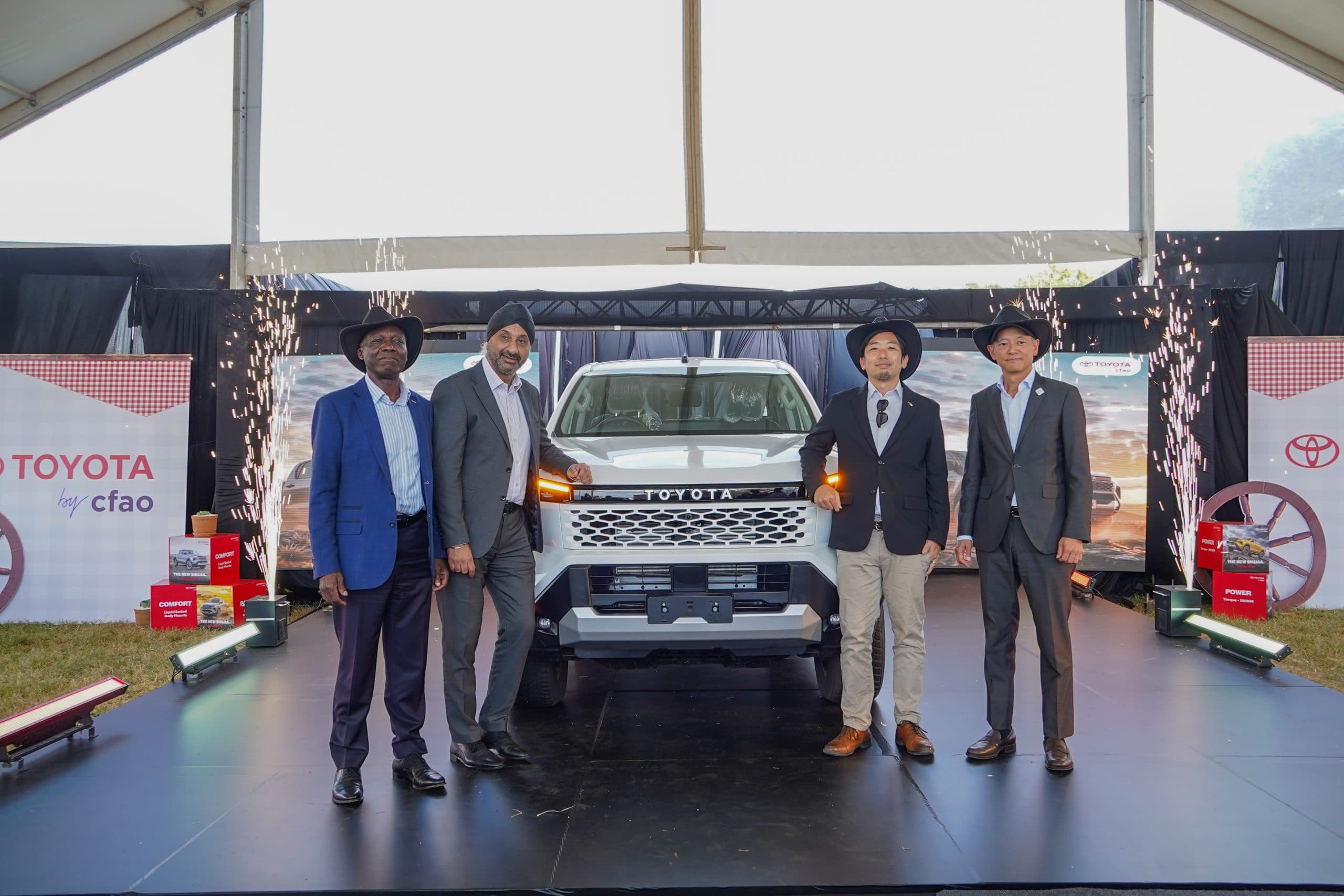
CFAO Mobility Kenya has introduced the ninth-generation Toyota Hilux into the Kenyan market, bringing a new range of features to one of the country’s most established pickup models as demand for commercial vehicles continues to rise among businesses and individual buyers.
The new model, which starts at Ksh 7.87 million, comes with improvements in engine performance, fuel efficiency, cabin technology and driving comfort, while retaining the heavy-duty capabilities that have made the Hilux popular among farmers, contractors, transport operators and companies that depend on pickups for daily operations.
The launch comes at a time when Kenya’s automotive market is experiencing increased demand for pickups, with industry figures showing that the category is growing considerably faster than the overall new vehicle market. For Toyota, the introduction of the new generation presents an opportunity to strengthen its position in a segment where reliability, operating costs, carrying capacity and after-sales support often influence purchasing decisions.
The ninth-generation Hilux is initially available in the 2.8-litre Double Cab automatic configuration, with the Mid specification retailing at Ksh 7,870,000 and the High specification going for Ksh 10,840,000. The price difference reflects the additional technology, interior features and driver assistance systems included in the more expensive version, although both models retain the same engine and core mechanical capabilities.
Rising demand for pickups drives competition
The launch follows a strong performance in Kenya’s new vehicle market, where sales increased by 24.8% to 10,944 units between January and August 2026, according to Kenya Motor Industry data. Pickups recorded a much faster expansion during the same period, with sales increasing by 52.6% to 2,949 units, reflecting the growing demand for vehicles that can support commercial activities across different sectors of the economy.
CFAO Mobility Kenya reported that its Hilux sales rose by more than 20% to 850 units during the eight months, with the company estimating that the Double Cab accounts for approximately one in every three Double Cab pickups sold locally. The performance highlights the model’s established position in the market, although the introduction of the new generation also comes with the challenge of maintaining customer loyalty as buyers become increasingly conscious of vehicle acquisition costs and long-term operating expenses.
Kenya’s estimated 7.4 million micro, small and medium enterprises provide an important market for commercial vehicles, given their contribution to employment and economic activity. According to the Kenya National Bureau of Statistics, these businesses employ close to 15 million people and contribute approximately 30% of national output, making transport an important part of their operations, particularly for enterprises involved in construction, agriculture, distribution, manufacturing and retail.
For many business owners, purchasing a pickup is a financial decision linked directly to productivity, since the vehicle must generate value through the transportation of goods, equipment and personnel while remaining affordable to maintain. This explains why manufacturers are increasingly expected to offer vehicles that combine durability and carrying capacity with better fuel consumption, safety features and cabin comfort, rather than focusing exclusively on engine size and off-road performance.
Engine specifications, fuel consumption and new features
The new Hilux is powered by Toyota’s 2.8-litre 1GD turbo diesel engine, which produces 150kW and 500Nm of torque through a six-speed automatic transmission with Eco, Normal and Sport driving modes. Its four-wheel-drive system, Multi-Terrain Select, motorised rear differential lock and Downhill Assist Control are designed to support driving on challenging surfaces, while the 312mm ground clearance provides additional room when navigating uneven roads and rough terrain.
The vehicle has a payload capacity of approximately 1,000kg and a braked towing capacity of 3,500kg, specifications that make it suitable for businesses transporting heavy equipment, construction materials and commercial goods. It also comes with an 80-litre fuel tank, while the stated fuel efficiency of approximately 12km per litre provides prospective buyers with a basis for estimating fuel expenses, although actual consumption will depend on driving conditions, vehicle loading and maintenance.
Inside the cabin, Toyota has introduced several upgrades intended to make the pickup more comfortable for drivers who spend long hours on the road, with the Mid specification featuring an eight-inch touchscreen, an eight-speaker audio system, wireless phone charging, cruise control, front and rear parking sensors, fabric seats and 17-inch alloy wheels. The High specification adds a larger 12.3-inch touchscreen, nine-speaker premium audio, leather upholstery, a power-adjustable driver’s seat, a 360-degree peripheral camera, power-folding mirrors, tyre-pressure sensors and 18-inch alloy wheels.
While the Mid version is positioned towards businesses and fleet operators who prioritise functionality, the High specification targets customers who want additional convenience and technology alongside the vehicle’s commercial capabilities. The distinction also reflects the changing expectations in the pickup market, where some buyers want a vehicle capable of handling demanding work during the week while offering the comfort and features associated with a premium passenger vehicle.
Local assembly and after-sales support
CFAO Mobility Kenya has also highlighted local assembly as part of the new Hilux’s introduction, noting that it reintroduced the model’s assembly in Kenya at CKD Level 2 in 2019. The latest generation has been adapted to local operating conditions, including heat, dust, rainfall and demanding road surfaces, while the continuation of local assembly supports the country’s efforts to develop its automotive manufacturing capacity.
Managing Director Arvinder Reel said the new model builds on the relationship Toyota has established with Kenyan customers over several generations, particularly those who rely on the pickup for business and commercial activities.
“The Hilux has earned the trust of generations of Kenyan customers because it has consistently delivered what they need to get the job done. Eight generations on, the New Shujaa is our investment in the next chapter of Kenyan enterprise: tropicalised, assembled here by Kenyans, and engineered to give our customers greater efficiency and unrivalled Quality, Durability and Reliability,” Reel said.
The company is also relying on its after-sales network to attract buyers who consider maintenance and vehicle downtime when investing in commercial transport. Hilux owners will have access to more than 50 branches, dealerships and authorised service centres, alongside genuine Toyota spare parts, trained technicians and a five-year or 150,000-kilometre warranty, whichever comes first.
Customers can also explore financing arrangements through CFAO Mobility Kenya’s banking partners, with options offering up to 100% financing, subject to the lenders’ approval and applicable terms. The arrangement could make the vehicle accessible to buyers who prefer financing their purchases rather than paying the full amount upfront, although monthly repayments and the overall cost of credit will remain important considerations.
The company plans to expand the new Hilux range in 2027 through the introduction of 2.4-litre and Single Cab models, which are expected to serve businesses with different operational requirements and purchasing budgets. The current launch is being promoted under the New Shujaa campaign, a reference to the previous generation’s Shujaa wa Kazi identity and the role played by workers and entrepreneurs in keeping businesses and communities running.
With the ninth-generation Hilux entering a market where pickup sales are expanding, Toyota will be looking to convert its established reputation into continued sales growth, while buyers will have to consider whether the new features, local assembly, warranty and operating capabilities justify an investment that starts at nearly Ksh8 million and exceeds Ksh10 million for the top specification.


Comments
No comments yet. Be the first to share your thoughts.