
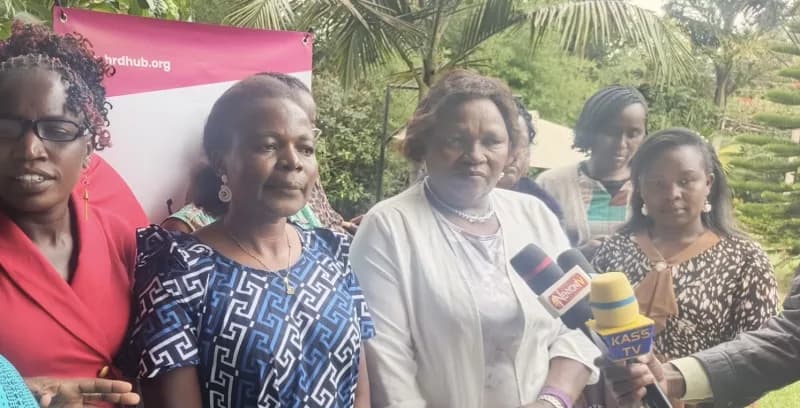
The women called on authorities to ensure a safe environment where they could express themselves without fear of violence or intimidation.
Women human rights defenders led by Alice Kirui (centre) speaking in Bomet.

Women human rights defenders in Bomet county have called for stronger protection against gender-based violence and online harassment as electioneering period approaches.
The activists said women, particularly those seeking elective positions, continued to face threats, abuse and discrimination that undermined their freedom of expression and participation in leadership.
They spoke to journalists during a workshop for the Women Human Rights Defenders (WHRD) Hub at a hotel in Bomet on Wednesday.
Alice Kirui, a human rights defender from Konoin, said femicide and attacks against women remained major concerns. She called for urgent measures to protect women both offline and online.
"We are here to say that women must be protected and given a safe space," she said.
Kirui said women were increasingly exposed to online attacks, including content that humiliated them or violated their dignity. She called for greater awareness and action against technology-facilitated gender-based violence (TFGBV).
She said the workshop had equipped participants with skills in livelihood development, environmental safety and security, business management, budgeting and responding to technology-facilitated gender-based violence.
The final day of the training brought participants together with journalists to discuss how the media could work with women human rights defenders to highlight violations and amplify their concerns.
Joyce Sigei, a human rights defender from Chepalungu subcounty, said the approaching electioneering period required deliberate measures to protect women seeking various elective positions, from governor to member of the county assembly.
She called on security agencies and local administrators to protect women candidates from heckling, intimidation and disruptions to their campaign activities.
"We do not want a situation where women are heckled as they present their agendas, denied an opportunity to speak or chased away by goons," Sigei said.
She said women should be given equal opportunities to present their manifesto and demonstrate their leadership abilities. They should not be confined to administrative and professional roles while being discouraged from seeking political office, she added.
"We want to demonstrate that women have the capacity to lead and distribute resources equitably," she said.
Sigei appealed to police officers, chiefs and other relevant authorities to take their responsibility to protect women seriously and ensure those who threatened or intimidated them were held accountable.
She also challenged society to stop shouting down women seeking leadership positions, saying their participation was essential to inclusive governance.
The activists said women human rights defenders were often portrayed as troublemakers when they exposed social injustices and violations, leaving them vulnerable to hostility and intimidation.
They praised the media for supporting their work and called for continued collaboration in reporting gender-based violence and holding perpetrators accountable.
Sigei further urged that journalists covering gender-based violence be protected, saying media practitioners also faced risks while exposing abuses and defending the rights of vulnerable groups.
Charlotte Chelangat, another women's rights activist, said journalists played a critical role in holding perpetrators accountable and giving a voice to women and communities affected by abuse and discrimination.
"A free press is the backbone of accountability, especially when it reports on sensitive matters of human and women's rights. Journalists who expose abuse, discrimination and injustice often do so at personal risk, and they cannot carry out this work effectively without protection and adequate resources.
"Safeguarding the media through safety guarantees, fair pay, training and access to information is also safeguarding the voices of women and communities who would otherwise go unheard," she said.
Another activist, Neria Nyanchama, from Sotik subcounty, condemned gender-based violence against women and girls, saying it remained a major concern in Bomet county.
She attributed the high prevalence of GBV in the county partly to cases being settled outside the courts, warning that such arrangements could deny survivors access to justice.
As the Judiciary marks 10 years of the Alternative Justice System (AJS), Nyanchama urged residents to understand which cases could be resolved through alternative mechanisms and which should be referred to court to ensure survivors of gender-based violence obtained justice.
The workshop provided a platform for activists and journalists to discuss ways of strengthening cooperation in documenting violations, raising public awareness and promoting the protection of women's rights.



Comments
No comments yet. Be the first to share your thoughts.