
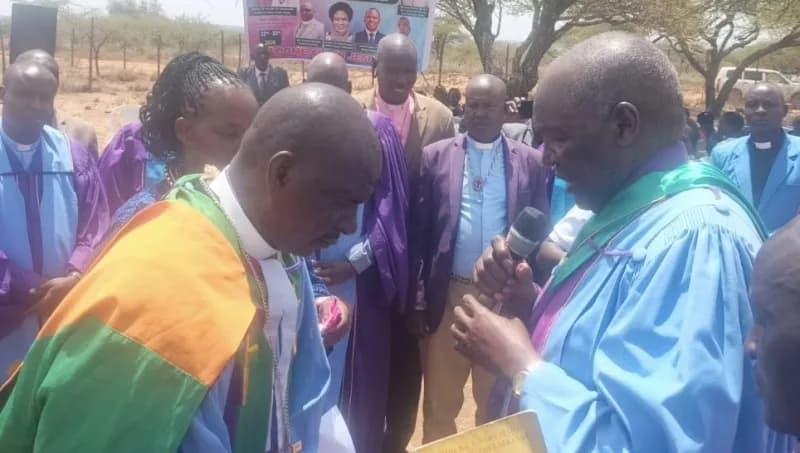
A section of clergy in Kajiado during a prayer meeting

Church and community leaders in Kajiado have called on the government to urgently address rising human-wildlife conflict in Kajiado and neighbouring Narok counties, saying more than 15 people have been killed.
The leaders accused the government of failing to protect residents from dangerous encounters with wild animals, warning that more lives could be lost without immediate intervention.
They spoke during the ordination of Presbyterian Outreach Mission Church Presiding Bishop Dr Joseph Sinkil Karia at the church’s headquarters in Najile, Keekonyie Ward, Kajiado West.
Bishop Karia said the crisis had affected his family, revealing that his son had recently been killed by elephants.
“My own son has been killed by elephants. It is painful that people are losing their lives to wild animals in their own communities. This matter must be declared a national disaster and addressed with the urgency it deserves,” he said.
He criticised the movement of wild animals into settlements, saying residents were increasingly exposed to danger despite the existence of national parks and game reserves.
The bishop urged religious and political leaders to speak openly about the crisis and called for lasting solutions that would allow residents to live and work without the constant threat of wildlife attacks.
Engineer Dickson Ntikoisa also called on the national government to prioritise human-wildlife conflict, saying the deaths required immediate intervention rather than continued promises.
He challenged both levels of government to address longstanding development challenges in Kajiado West, particularly inadequate water supply and poor road infrastructure.
Ntikoisa said parts of the subcounty had gone a decade without tarmacked roads. He urged authorities to invest in infrastructure to improve access to essential services and support livelihoods.
Community leader Moses Kusero linked the conflict to shortages of water and pasture, saying competition for these resources was leading to increasingly dangerous encounters between people and wild animals.
He urged the National Water Harvesting and Storage Authority to construct dams and other water-storage facilities to capture rainwater that would otherwise be lost through flash floods.
Kusero said the projects could improve water access for communities and wildlife, reducing the need for animals to venture into residential areas in search of water.
“Water scarcity and inadequate pasture are contributing to these conflicts. We need dams to harvest floodwater and ensure water is available for both people and wildlife,” he said.
The leaders called for coordinated action by the national and county governments to improve water access, strengthen wildlife management and protect residents in affected areas.
They said urgent intervention was needed to prevent further deaths and enable communities living alongside wildlife to coexist safely.
Rising human-wildlife conflict in Kajiado and Narok highlights the cost of conservation for communities living alongside wildlife. The death of a bishop’s son underscores the personal toll of a crisis that residents say has gone unresolved for too long. Beyond compensation for victims, the government must strengthen wildlife management, improve access to water and pasture, and establish effective measures to prevent deadly encounters before more families lose their loved ones.


Comments
No comments yet. Be the first to share your thoughts.