
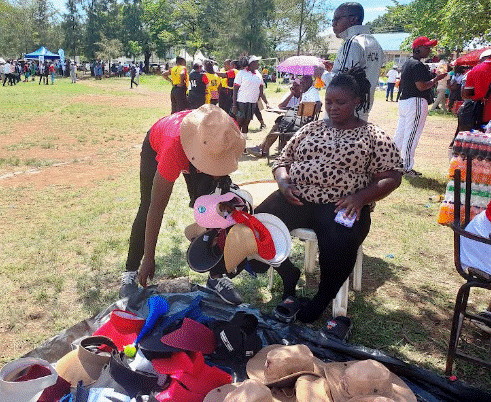
As Members of County Assemblies (MCAs) from across the country gather in Kisumu city this week for the ongoing Seventh County Assemblies Sports Association (CASA) Games, on the sides, business flourishes
Food, clothes, hats and caps and many other types merchandise was on display at various venues where games are taking place.
For the last two weeks, Kisumu has seen an influx of visitors, thanks to the just ended 2026 African Road Cycling Championships (CAC) which gave way to the ongoing Seventh County Assemblies Sports Association (CASA) Games, and the small scale and middle level businesses have had a windfall.
Businesspeople like Josephine Kamau and Michel Mickey, a Burundi national are pursuing a different kind of victory, one measured not in medals or trophies, but in the money, they earn to support their families.
With a sack filled with hats, Kamau has travelled all the way from Ongata Rongai to Kisumu, hoping to turn the sporting event into an opportunity to earn a living.
As athletes compete on the field and spectators cheer for their teams, she moves among potential customers, displaying her merchandise and hoping that each sale will bring her closer to meeting her daily needs.
For Kamau, the games are more than a sporting competition. They are an opportunity to earn money to pay rent and educate their children among other responsibilities in the family.
“I come from Ongata Rongai, and I have come to Kisumu to do business because selling hats is the work I do,” Kamau says.
Her journey reflects the determination of small-scale traders who travel from one event to another in search of customers, hoping that large gatherings will provide a market for their goods.
However, as Kamau has discovered during nearly five years in the business, finding customers is not always easy. The economic situation, bargaining and the uncertainty of daily sales continue to test her resilience.
For Kamau, selling hats is more than a business; it is a means of providing for her family. Rather than depend on a single location, she follows events that attract large crowds, identifying them as opportunities to reach potential buyers.
Her decision to travel from Ongata Rongai to Kisumu demonstrates the lengths to which traders can go in pursuit of customers. Although such journeys offer opportunities, they do not guarantee good returns.
Kamau says she began selling her merchandise a day in Kisumu before the games kicked off and that business was relatively better. Nevertheless, she notes that customers are increasingly cautious about spending, making it harder for traders to achieve the sales they previously enjoyed.
For Kamau, every customer represents a possibility, but turning that possibility into a sale requires patience and negotiation.
One of Kamau’s biggest challenges is bargaining. She says customers frequently complain that prices are high and push for lower prices before agreeing to buy.
“They are bargaining too much, saying the prices are high, but I also understand them,” she says.
Her response reveals the delicate balance between understanding customers and protecting her business.
She recognizes that the economic situation affects everyone and that some customers may be struggling to meet their own financial obligations.
Despite these challenges, Kamau remains optimistic about her efforts. She says she has never returned from her business trips completely empty-handed, demonstrating her belief that persistence can yield results even when the market is difficult.
Her determination keeps her moving from one event to another, searching for opportunities rather than waiting for circumstances to come. Kamau says the business has helped her educate her child and pay rent, achievements that have kept her committed to selling hats for nearly five years.
“I must work hard. That is why I came all the way here,” she says. Her words reflect the determination of a mother who understands that providing for a family sometimes requires sacrifice, persistence and a willingness to venture beyond familiar surroundings.
These sporting events have transformed the lakeside city into a bustling economic hub. Street food and snack vendors have also positioned themselves near event venues to cash id on the high food demand. Other sectors such as transport have also not been left behind, reaping big from the sporting events.
For street food operators, the influx of international and local delegations into the city, sports men and women, fans, and local spectators created an instant consumer boom. According to local vendors, average daily margins have spiked significantly compared to standard operational weeks.
Michael Mickey, a local food vendor from Burundi operating a “chapo-smokie” and egg stall in city, noted that his business experienced phenomenal growth during the event.
“Before the games started, my daily average earnings stood at just 500 shillings,” Mickey explains. “But since the championship competition kicked off, increased traffic pushed my daily sales revenues to 3,000 shillings, netting me up to 5,000 shillings in absolute profits.”
The massive culinary demand required street vendors to drastically increase their daily stock. Mickey revealed that he regularly exhausted large commercial orders, utilizing up to 16 packets of wheat flour daily alongside multiple crates of eggs and packets of smokies just to keep pace with the hungry crowds.
The windfall was equally felt by mobile refreshment sellers who have spent years anchoring their livelihood on street trade. Justin Mumbasi, an ice cream vendor who has been operating in the region since 2010, stated that the heavy congestion brought a unique lifeline to the local business community.
“This ice cream business is what allowed me to build my own house and build a three-room home for my mother back home,” Mumbasi shared. “On regular days, I can clear anywhere from two to four boxes of ice cream, retailing items at sh. 50 and sh.100. With the crowds coming together for this game, the high volume of visitors gives us hope to push even more volume before the events closes out.”
For Michael Otieno, a tuktuk operator, his daily income, he says has more than tripled and given him more hope for tomorrow.
This economic boost perfectly aligns with the county’s strategy to turn sports into a wealth-generating avenue.
Speaking during the event cycle, Kisumu Governor Professor Peter Anyang’ Nyong’o noted that hosting high-profile continental games like the CAC championships and CASA games is central to rebuilding the regional economy.
“Our mission remains clear: to attract opportunities, strengthen our local economy, and directly improve the livelihoods of our people by unlocking enterprise at every level,” stated Governor Nyong’o.
The success of the international cycling tournament and CASA games did set a high benchmark for the region, leaving small traders optimistic about sustaining their elevated sales in future.
The CASA Games have brought Members of County Assembly (MCAs) from across the country to Kisumu, creating opportunities for traders hoping to reach new customers.
For athletes, the event is an opportunity to compete and represent their counties. For Kamau, it is a chance to sell her hats and earn money to support her household.
Although their goals differ, both are working towards something meaningful. Kamau, Michael Mumbasi and other traders experience demonstrates that major sporting events have significance beyond the competition itself. They can also create temporary markets for small-scale traders, food vendors and other entrepreneurs seeking to benefit from the movement of people.
While athletes compete for victory on the field, the traders pursue success one sale at a time. Kamau`s journey from Ongata Rongai to Kisumu is a reminder that behind many small businesses are people working tirelessly to support their families, overcome challenges and build better futures. And for Josephine Kamau, no amount of ridicule can outweigh the value of earning an honest living.
by Mabel Keya- Shikuku / Chrispine Oduor Onyango / Rose Anyul


Comments
No comments yet. Be the first to share your thoughts.