
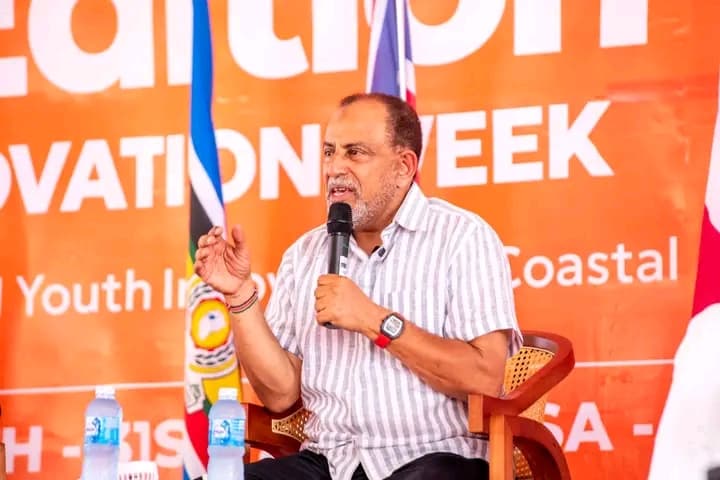
Businessman and Mombasa gubernatorial aspirant Suleiman Shahbal used a fireside chat at Coastal Youth Innovation Week to urge young people to never despair or give up in pursuit of success.
The session, part of Coastal Youth Innovation Week, drew a large turnout of young entrepreneurs who posed questions on business diversification, martial arts training ventures and how to adapt to the AI era.
Reflecting on a career that has spanned Gulf African Bank, Gulf Energy, Gulf Power, Gulf Homes and Gulf Investment Bank, Shahbal said he counts his failures as proudly as his successes.
“On this side, I wear the medals of success and on this side, I wear my service medals, my failures. I have failed in 29 different businesses. And I have never given up,” he said, describing an ill-fated venture importing Chinese-sized lingerie into the Kenyan market as a case study in the importance of sticking to what you know.
“The moral of the story: stick to things that you know. I’m never doing lingerie again,” he said, to laughter from the audience.
He urged young people not to fear failure, describing his own coping ritual of taking three days to process a setback before starting again. “Every failure is a stepping stone to success. Don’t fail and feel like this is the end of the world. It’s the beginning of your journey,” he said.
On what it would take to grow Mombasa’s economy, Shahbal argued that attracting large anchor companies rather than only nurturing small businesses in isolation is what creates the multiplier effect needed to generate jobs at scale.
He cited his decade-long pursuit of global ports operator DP World as an example, saying the eventual investment would generate thousands of direct and indirect jobs in transport, logistics, catering and engineering.
“If DP World was a woman, I would have given up on her a long time ago. But I chased them for 10 years. Eventually they have come,” he said.
He also made the case for value addition in Kenya’s agricultural exports, pointing to the country’s position as Africa’s fourth-largest coffee producer yet a marginal earner compared to countries like Germany, which process and re-export raw coffee at a steep markup.
He raised similar concerns over Kenyan tea being shipped to Dubai for blending and re-export, arguing Mombasa should be capturing that value locally rather than exporting raw commodities.
On manufacturing, Shahbal warned that Kenyan industries attempting to compete with Chinese-scale production face a losing battle without deliberate government strategy, citing an example from the tile manufacturing sector, where he said Chinese firms bought up local producers before raising prices once competition was eliminated.
Turning to technology, Shahbal said artificial intelligence has fundamentally changed the barrier to entry for young entrepreneurs, recounting how he used an AI tool to generate a cost estimate and business plan for setting up an intensive care unit within seconds.
“If anybody in this hall today is not using AI and is not sharpening your AI skills, in another three years, you will be a dinosaur,” he said.
Asked what matters more than money in building a successful business, Shahbal told attendees that ideas, not capital, people or education alone, are the true starting point.
“Money follows ideas,” he said, outlining a process of developing an idea into a sharpened, researched vision before approaching investors. He also stressed personal branding, organisation, reliability and integrity as non-negotiable traits for any young entrepreneur hoping to be trusted with other people’s money.
by Joan Kinuthia


Comments
No comments yet. Be the first to share your thoughts.