
As the country prepares for the high-stake 2027 General Election the political conversation is already taking shape across social media, where a comment, meme, video or reshare, can reach thousands of people within minutes.
Media experts and civil society organizations in the coastal city of Mombasa, have already intensified calls for the responsible use of social media spaces and balancing free speech with the need to curb fake news and misinformation.
For Dr. Fathima Azmiya Badurdeen, a researcher, social scientist and founder of the Centre for Religion, Conflict and Peacebuilding (CRCP) at the Technical University of Mombasa (TUM), this presents both an opportunity and a responsibility, particularly for young people, who increasingly use digital platforms to organise, express themselves and participate in public discourse.
Dr. Fathima has long worked with young people in development and peacebuilding, and her work emphasises the importance of moving research beyond academic spaces and into practical interventions that respond to the daily challenges facing communities.
“As Gen Z movements expand transnationally, Kenyan youth have demonstrated the significant potential of youth-led protests and initiatives, to address corruption and entrenched, stagnated economic and political systems,” she quipped.
But with that influence, she notes, comes a need to consider the responsibilities and ethical questions that accompany youth-led movements and digital activism.
It is this intersection between youth participation, digital communication and peacebuilding that informs DARE Crafting: #SlashTheHate, a digital advocacy campaign being implemented by CRCP.
The Researcher says the campaign seeks to promote responsible social media use, counter online hate and violence, and encourage citizens to engage in political and social disagreements, without turning them into personalised attacks or hostility.
The campaign will be formally launched on November 3, 2026 at the Technical University of Mombasa (TUM), marking a key public milestone in an initiative that is already engaging young people and partners around digital peacebuilding and responsible online participation.
CRCP is implementing the campaign in collaboration with various partners, including the Hassan Joho Foundation. The official launch will be graced by Cabinet Secretary for Mining, Blue Economy and Maritime Affairs, Hassan Joho.
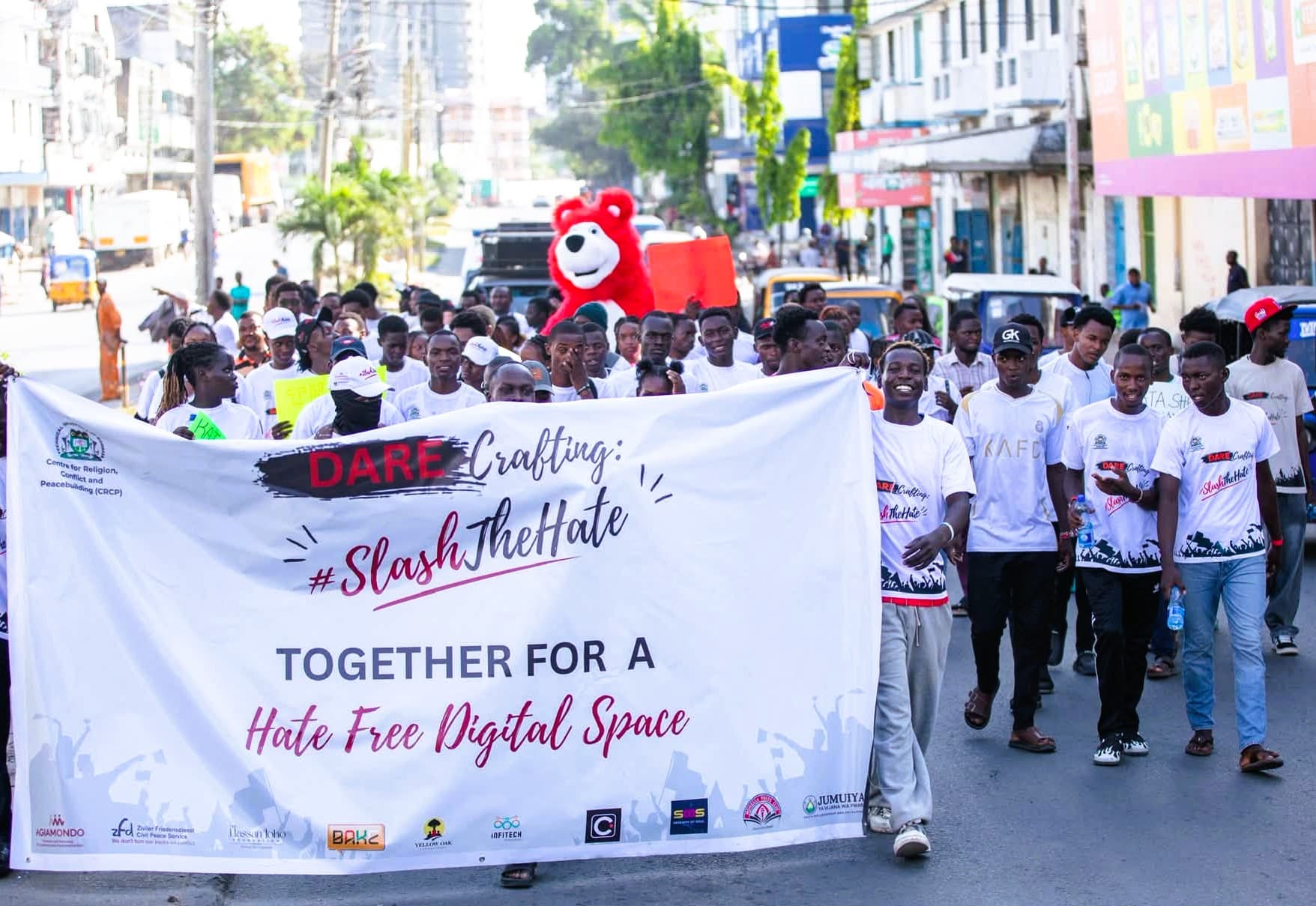
The Digital Advocacy Campaign against Online Hate and Violence by the Centre for Religion, Conflict and Peace-building (CRCP) of the Technical University of Mombasa (TUM) in partnership with the Hassan Joho Foundation kicked-off with a spirited awareness walk.
CS Joho said the walk marks the start of a campaign aimed at raising awareness and mobilising collective action against online hate, violence and harmful digital content, while promoting responsible digital engagement, tolerance and peaceful co-existence.
The CS called for the responsible use of social media spaces and balancing free speech with the need to curb misinformation, cyberbullying, and threats to national security.
The need for such conversations is particularly relevant in Kenya, where political differences have historically contributed to social tensions and, at times, violence.
While social media is not the cause of these historical experiences, digital platforms can influence how information, narratives and emotions circulate during periods of heightened political activities.
For many Kenyans, the words that come to mind when they hear “elections” may include fear, tension, violence or division borne out of the experiences of the 2007/8 post-election violence.
Observers contend that political disagreements itself is a normal part of democratic life, but the challenge lies in how that disagreement is expressed and handled.
Dr Fathima sees youth participation as particularly significant because of the growing influence of youth-led movements both in Kenya and beyond.
“The #SlashTheHate campaign exemplifies an approach to engaging young people online in pursuit of collective, peaceful change,” she says.
CRCP is collaborating with national universities and local youth networks, to create opportunities for young people to participate in peacebuilding and digital advocacy.
Recent collaboration between TUM and Garissa University, for instance, included discussions on digital peacebuilding, misinformation and youth participation, with participants developing practical approaches to promoting peaceful online conversations.
The campaign’s message, however, is not intended for young people alone. Social media cuts across generations, making responsible digital engagement a shared responsibility among citizens, institutions, political actors and other users of digital platforms.
As Kenya approaches another election period, the way citizens communicate online will form part of the broader public environment in which political participation takes place.
For Dr Fathima, the long-term question is what kind of society today’s youth will help shape.
“I believe that the responsible actions of young people, today, will shape the leadership of tomorrow,” she says.
“Political disagreement is neither unusual nor undesirable,” says Lubnah Abdulhalim, a communication specialist supporting CRCP’s campaign communication and digital advocacy work.
“The question is not whether we should disagree. We should. The question is how we disagree.”
Across TikTok, X, Instagram, Facebook and other platforms, political conversations can quickly move from criticism of ideas or policies to attacks on individuals.
A person may be insulted because of their political affiliation, subjected to sustained attacks over an opinion or harassed for sharing content associated with a particular political figure.
Lubnah says these interactions matter because digital behaviour can have consequences beyond the screen.
“When false information is deliberately spread about an individual, when someone’s physical appearance, ethnic identity or religious affiliation becomes a target of abuse, when artificial intelligence is used to demean an individual or group, or when sustained online bullying causes serious harm, the consequences can extend beyond the digital space,” she says.
She says the concern extends to the content people choose to amplify. A single comment or meme may appear insignificant, but repeated exposure to particular narratives, can influence perceptions of individuals, communities and political groups.
For Lubnah, responsible digital communication is, therefore, not about discouraging political participation or asking people to avoid difficult conversations.
It is about creating room for people to challenge leaders, question policies and express strong political views without dehumanising those who disagree with them.
Someone may believe that a politician has betrayed their supporters because of something the politician has said or done. Another person may strongly disagree with a particular policy. Both positions can be expressed in a democratic society. The distinction is in what happens next.
“Insulting, dehumanising or attacking another person because of their political views does not resolve the underlying disagreement,” Lubnah says.
She says #SlashTheHate is not limited to online messaging. The campaign is currently being implemented through a range of activities, including training, talks, peace walks, debates, hackathons and social media challenges, among other engagements.
Recent CRCP engagements have included practical sessions on misinformation, disinformation, malinformation and fake news, alongside discussions on how young people can use social media strategically to promote peaceful coexistence and counter divisive narratives.
The approach also encourages young people to move from being passive consumers of digital content, to active participants in shaping the online environment.
For Lubnah, this is where communication becomes central to peacebuilding and the responsibility can begin with something much smaller and more immediate: the next comment, post or retweet.
“A comment, meme, video or reshare, may appear insignificant in isolation, yet repeated exposure to such content can contribute to negative perceptions of particular individuals, communities or places,” she says.
The campaign, therefore, encourages people to pause before sharing, question the information they encounter, recognise harmful narratives and consider the potential impact of their digital interactions.
Building peaceful digital spaces does not require people to agree with one another. It requires them to recognize that disagreement does not have to become hatred. And sometimes, changing the conversation begins with deciding what we choose to say next.
Members of the public can follow the Centre for Religion, Conflict and Peacebuilding on its social media platforms for updates on #SlashTheHate activities, opportunities to participate and conversations on responsible digital engagement.
For more information about DARE Crafting: #SlashTheHate, contact CRCP via crcp@tum.ac.ke or +254 723 401509.
By Hussein Abdullahi
Comments
No comments yet. Be the first to share your thoughts.