

Kenya Cubing Federation is pushing for the integration of cubing into academic activities in schools to help students develop problem-solving skills and discipline in their studies.
The federation has encouraged students to embrace the game as a way of enhancing their skills while pursuing their academic goals in line with the Competency-Based Curriculum (CBC), which promotes hands-on learning.
Speaking during the official launch of the Kenya Cubing Federation’s Speedcubing School Championships at Zetech University, Ruiru, President of the Kenya Cubing Federation, who is also Zetech University Manager for Student Experience and Outreach Marketing Wycliffe Sirengo, urged students to practice consistently and use the game to develop their skills, connect with others and explore opportunities beyond school.
Mr. Sirengo encouraged the students to reduce the amount of time they spend on screens and instead dedicate more time to speedcubing, noting that the game could open opportunities for them to represent their schools, counties, Kenya and Africa in international competitions.
“This is just a start. We are not bosses; we are leaders, and we are here just to guide you. We are servants,” he said.
He urged participants not to give up, saying some Kenyan competitors who recently took part in competitions in South Africa had trained for only two months or less.
“You have all the time to practice. You have all the time to change your life,” Sirengo said, encouraging the students to remain committed to the sport.
He, however, stressed that participation in sports should not come at the expense of education, urging students to work hard in their studies, obey their teachers and respect their parents.
“You can be good in sports, but make sure you put in more effort when it comes to study,” he said.
The event brought together students and officials for the competition and promotion of speedcubing among learners.
Sirengo said he looked forward to interacting with the students at future competitions, including national events, and encouraged them to remain committed to both their studies and the sport.
Cubing is an interesting sport where participants solve Rubik’s cubes and other twisty puzzles accurately as quickly as possible. The participants, referred to as cubers, engage in different cube stages including the 2×2, 3×3, 4×4 and other larger cubes as well as other twisty puzzles. The sport is highly mind engaging and innovative, requiring concentration, memory, problem solving, hand -eye coordination and speed. Competitors are timed and the person who solves the puzzle within the shortest time and within set competition rules wins the game.
Speaking at the event, Kenya Cubing Federation Secretary General (SG) Grace Wangari commended the students for their progress, urging them to continue practicing and training regularly to improve their skills.
The secretary general said two months after beginning their cubing journey, students who had little or no knowledge of the game had made significant progress, with some advancing from solving the 3×3 cube to mastering the complex 2×2 cube.
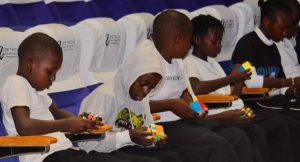
“Two months ago, they knew nothing. Some hadn’t even seen a cube, while others knew only one type of cube, that is, a 3×3. They were able to learn the other one, 2×2, and they are now some of the best we can cite. We keep improving; we keep training ourselves,” she said.
According to Samuel Kamau, who is in charge of cubing in schools and learning institutions (Early Childhood Development (ECD) to university level), the federation is engaging the Ministry of Education (MoE) to have cubing integrated into the Competency-Based Curriculum (CBC), noting that the activity combines elements of mathematics, science, sport and art.
“The federation is developing mechanisms to expand cubing to schools and learning institutions countrywide to nurture young talent,” said Kamau, adding that integrating cubing into learning would give students an opportunity to develop skills beyond the classroom while exposing them to competitive activities.
Kamau said the federation would later expand cubing to the wider East African region, including Uganda and the Democratic Republic of Congo.
He added that Kenyan cubers are being prepared to participate in regional, continental and global competitions, with a competition scheduled to take place in Arusha, Tanzania, in November.
“We are going to all counties. Number two, we are going to introduce cubing within East Africa; as I speak, in November, we have a cubing competition at Arusha,” Kamau said.
He added that the federation was exploring partnerships with schools in other countries to create opportunities for Kenyan students to participate in international events and interact with cubers from different parts of the world.
Kamau said the federation is also considering participation in competitions in countries including New Zealand, while noting that logistics and performance standards would guide the selection of participants for international events.
He challenged students to improve their solving times, saying the federation would set performance thresholds for those seeking opportunities to represent Kenya in international competitions.
“From today, get prepared. Two things we need to prepare. One, your timing,” he said, urging students to work hard to improve their performance.
Kamau further encouraged students who are conversant with cubing to teach their fellow students as well as their parents, grandparents and other family members.
By Ian Chepkuto



Comments
No comments yet. Be the first to share your thoughts.