
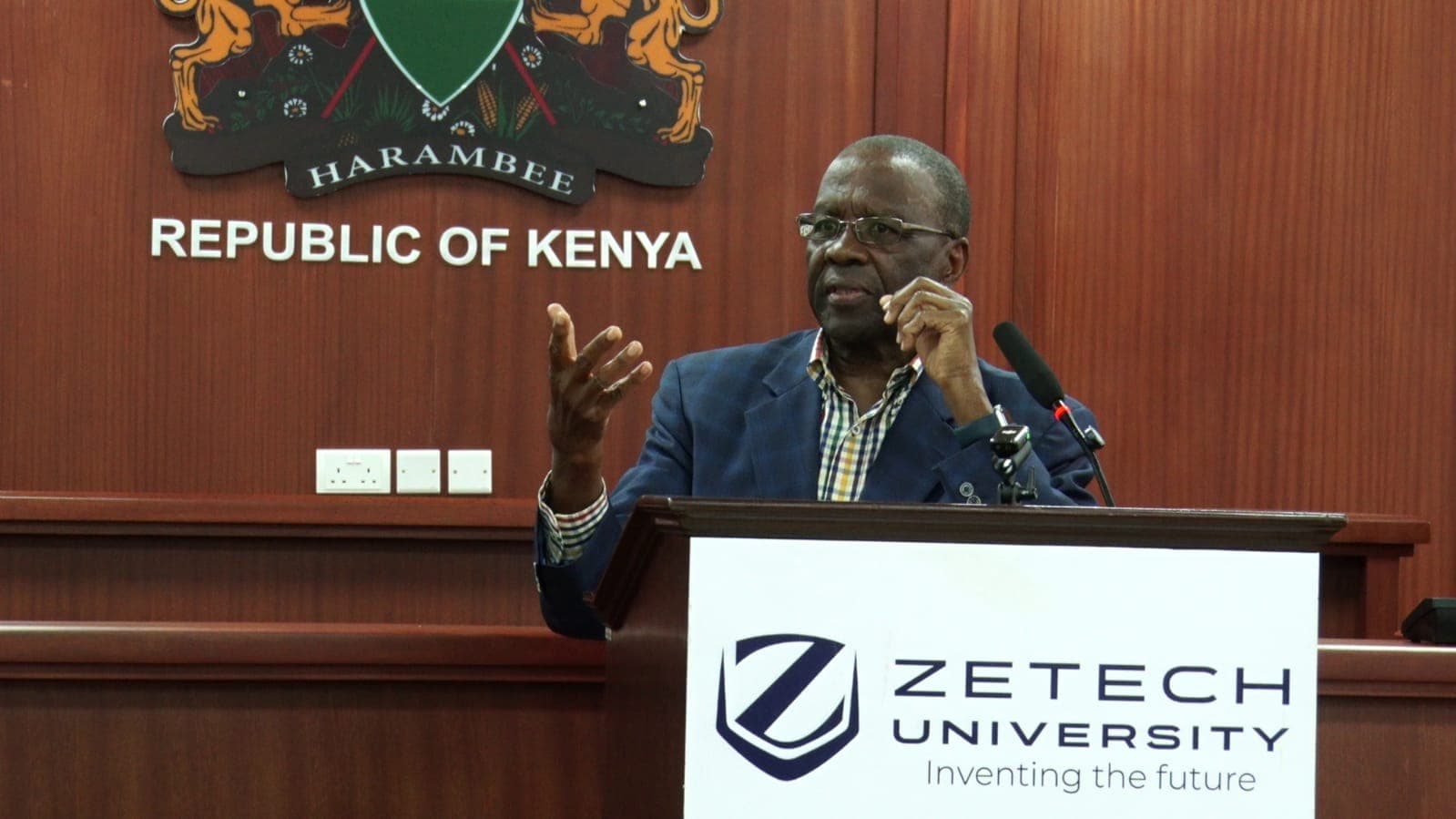
Former Chief Justice Dr Willy Mutunga has challenged universities to integrate technology and artificial intelligence into legal training to equip lawyers with skills to respond to emerging legal and societal challenges, including electoral problems.
Mutunga said technology is rapidly reshaping the legal profession and the way justice is delivered, making training in areas such as digital evidence, data protection, cybercrime, intellectual property and AI regulation has become necessary.
Speaking while delivering a public lecture at Zetech University’s Law School in Thika, the former CJ said there should be no running away from technology and AI in law training, urging universities to move beyond the traditional classroom training and encourage students to develop solutions into real-world problems.
He cited electoral processes as one area where law students could apply technology and innovation, saying they should be developing applications capable of addressing challenges associated with voting and election management.
“For example, students should now have developed an app which requires us to vote in the coming general election at our comfort using our mobile phones. At this time and age, we should not be queueing for hours to vote,” he said.
Mutunga said such innovations would make universities relevant while preparing graduates for a technology-driven legal profession.
His remarks came as three students were awarded the TechSheria Scholarship, an initiative offering 100 per cent tuition support for the Bachelor of Laws programme for the prescribed four-year duration, subject to academic and administrative requirements.
The scholarship seeks to promote legal education while preparing future lawyers to engage with emerging fields in the digital space.
Zetech Law School Dean Dr Eric Kibet said the beneficiaries were selected from needy and deserving families, giving them an opportunity to pursue legal education without the burden of tuition fees.
The beneficiaries are Ronney Okello Ochieng from Trans Nzoia, Nelson Muwo Mutuku from Mombasa and Jane Wambui Muthoni from Nyeri.
Okello said his desire to study law was shaped by his father’s experience after being shot in the leg while conducting business, a case that took about 10 years to reach justice. He hopes to use his legal career to pursue justice for people unable to access it.
Muthoni said she wants to use law to help close gaps in constitutional implementation and address social challenges, while Mutuku hopes to specialise in property law and tackle land-related disputes in Mombasa.
The Law School, launched last year with about 20 students, has since grown to more than 100 students in its first year, signalling rising interest in its technology, innovation and entrepreneurship-focused approach to legal education.
by Muoki Charles


Comments
No comments yet. Be the first to share your thoughts.