
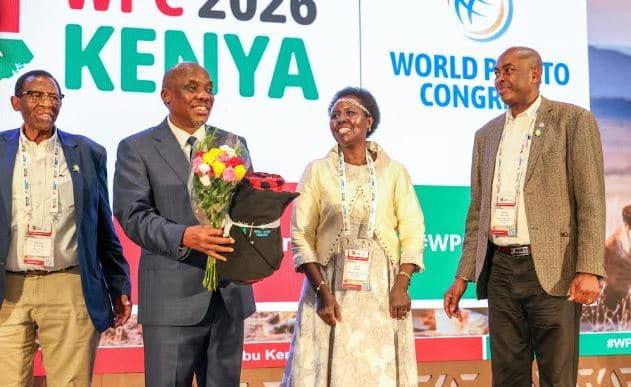
Kenya has called on African countries to increase investment in sustainable water management to strengthen food production, improve nutrition, and build resilient agrifood systems amid rising food insecurity across the continent.
Principal Secretary (PS) for Agriculture Dr. Kipronoh Ronoh noted access to sustainable water resources was critical to improving agricultural productivity, safeguarding livelihoods and ensuring the availability of safe, nutritious and affordable food for all Africans.
Speaking during the official opening of the 17th Africa Day for Food and Nutrition Security (ADFNS) at Safari Park Hotel in Nairobi, Dr. Ronoh observed that Africa continued to face significant challenges, including drought, water scarcity, declining water quality, and biodiversity loss.
Further, he stressed that these challenges were undermining the resilience and productivity of food systems, calling for integrated approaches that link water management with agriculture, nutrition, sanitation, and environmental conservation.
“Climate-resilient water management is therefore not a side agenda; it is the foundation of resilient agrifood systems,” the PS asserted.
Notably, the two-day continental gathering was held under the theme, ‘Harnessing Sustainable Water for Resilient Agrifood Systems, Nutrition Security, and Inclusive Prosperity in Africa’.
Dr. Ronoh pointed out that the meeting came at a critical time as African countries transition from the Comprehensive Africa Agriculture Development Programme (CAADP) Malabo Declaration to the Kampala Declaration and its Agrifood Systems Strategy and Action Plan for 2026–2035.
He explained that the new strategy provided an opportunity for countries to strengthen their commitment to transforming agricultural production systems and addressing food and nutrition challenges.
Equally, the commemoration also aligns with the African Union’s 2026 Theme of the Year, which focuses on ensuring sustainable water availability and safe sanitation systems.
Dr. Ronoh maintained that the link between water, agriculture, nutrition, and health required governments and development partners to coordinate their interventions instead of addressing the challenges independently.
He specifically highlighted that water was essential across the entire agrifood value chain, including crop production, livestock farming, fisheries, aquaculture, food processing, food safety, and the provision of healthy diets.
Conversely, the PS cited growing food insecurity as a major concern, noting that approximately 309 million Africans were undernourished in 2025, compared with about 171 million in 2010.
He added that nearly 57 percent of Africa’s population experienced moderate or severe food insecurity in 2025, underscoring the need for urgent and coordinated interventions.
Although global hunger had begun to decline, with about 645 million people experiencing hunger in 2025, Dr. Ronoh cautioned that the recovery remained fragile and uneven, with Africa bearing a disproportionate share of the burden.
The PS stated that the statistics reflected the daily struggles of families, mothers and children who lacked reliable access to adequate and nutritious food.
In this respect, Dr. Ronoh challenged delegates to ensure the Nairobi meeting produced practical commitments and measurable actions rather than resolutions that would not be implemented.
“We expect concrete commitments and actions for implementation, stronger integration of water and nutrition priorities, increased investment and partnerships, and a clear voice from Africa’s youth in shaping our food future,” affirmed the PS.
Importantly, the meeting sought to strengthen political commitment and accountability for sustainable water management, promote collaboration across agriculture and nutrition sectors, and mobilise investment from governments, financial institutions, development partners and the private sector.
Dr. Ronoh reiterated that involving young people in agrifood systems was essential to building a sustainable food future, adding that partnerships with youth-led organisations, academia, civil society, and private enterprises would help accelerate progress.
He further called for greater promotion of indigenous foods, aquatic products, and other sustainable food sources to diversify diets and improve nutrition outcomes.
Similarly, the PS emphasised that African countries needed to harness their water resources responsibly to strengthen food production and protect communities against the effects of climate change.
He urged policymakers, technical experts, financiers and other stakeholders to use the conference to identify practical measures that would make nutritious diets more accessible and prevent children from going hungry.
Meanwhile, Kenya is hosting the event in partnership with the African Union Commission and the African Union Development Agency-NEPAD, bringing together government representatives, development partners, civil society, private sector players, farmers, and young agripreneurs.
By Aron Kinyamasyo

Comments
No comments yet. Be the first to share your thoughts.