
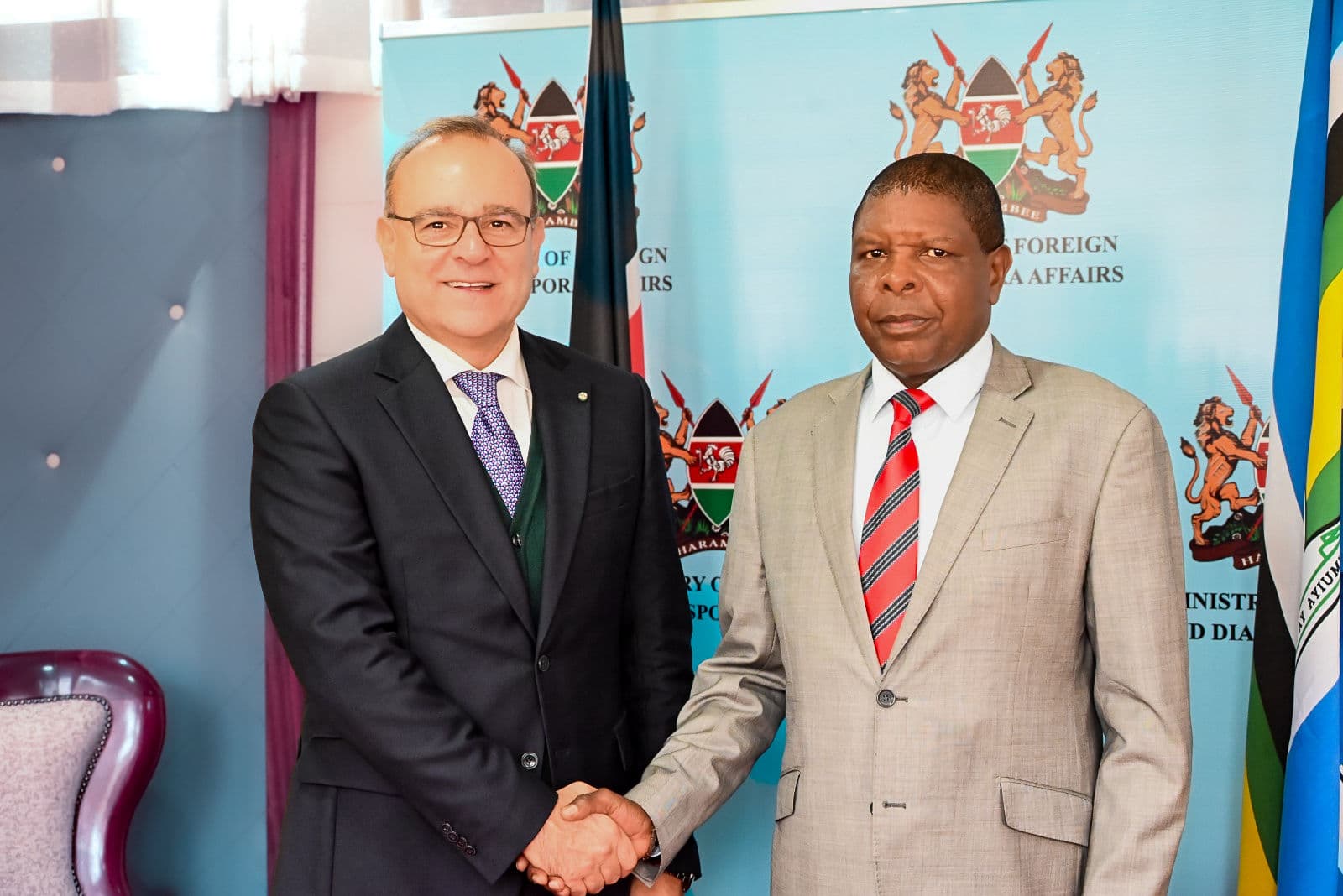
Kenya and Italy are strengthening bilateral cooperation across security, trade and investment, science and technology, development cooperation, culture and multilateral affairs, with the two countries advancing new areas of engagement under the Italy–Kenya Action Plan 2026–2029.
The state of the bilateral relationship was reviewed when Ambassador Josphat Maikara, Director-General, Political and Diplomatic Affairs, State Department for Foreign Affairs, received Italy’s Ambassador to Kenya, H.E. Vincenzo Del Monaco, at the Ministry Headquarters.
The discussions focused on advancing areas of mutual interest and following up on key bilateral commitments.
“Kenya and Italy enjoy warm and cordial relations, anchored in longstanding cooperation and strengthened by a shared commitment to expanding our partnership across security, trade and investment, science, technology, innovation, culture and development cooperation,” Maikara said.
Kenya and Italy established diplomatic relations in 1964 and have since developed broad cooperation spanning political, economic, security and development affairs.
The relationship gained fresh momentum following President William Ruto’s official visit to Italy from 19–21 April 2026, during which the two countries launched the Italy–Kenya Action Plan 2026–2029.
The Action Plan provides a framework for political dialogue and cooperation in trade and investment, sustainable development, science, technology, innovation and space, education, defence and security under the Mattei Plan for Africa.
The two countries also signed instruments covering defence cooperation, transfer of sentenced persons, research and innovation, ICT and leather-sector development, alongside grant agreements.
Ambassador Del Monaco said Italy attaches importance to the relationship and remains committed to broadening cooperation between the two countries.
“Italy attaches great importance to its partnership with Kenya and is committed to deepening cooperation in security, trade, investment, innovation and sustainable development. The Italy–Kenya Action Plan 2026–2029 provides a strong framework for translating our shared priorities into concrete outcomes,” he said.
Security cooperation remains a key pillar of the relationship. Cabinet Secretary for Interior and National Administration Kipchumba Murkomen is scheduled to visit Rome from 12–13 October 2026 for bilateral security talks with Italy’s Minister of the Interior, H.E. Matteo Piantedosi.
The visit is expected to facilitate conclusion of the Kenya–Italy Security Cooperation Agreement, which has been cleared by the Office of the Attorney-General and is awaiting transmission to the Italian Embassy through the State Department.
The planned visit follows Piantedosi’s visit to Kenya from 1–3 July 2026, during which a Letter of Intent on cooperation in preventing and combating crime was signed.
Kenya is also drawing on Italian experience in metropolitan policing. From 9–11 June 2026, the Ministry of Interior and National Administration undertook a benchmarking mission to Rome in support of the operationalization of the Nairobi Metropolitan Police Unit.
The Kenyan delegation engaged Italian security institutions, including the Polizia di Stato, Direzione Investigativa Antimafia and Servizio Centrale Operativo.
Economic cooperation is another major area of engagement, with Kenya seeking to expand exports and attract Italian investment in value addition, agro-processing, manufacturing, renewable energy, infrastructure, pharmaceuticals, leather, technology and food security.
In 2024, Kenya exported goods worth approximately US$75 million to Italy and imported about US$164 million. Kenyan exports included cut flowers, fish and aquatic products, leather, raw hides and skins, and vegetable and fruit preparations, while major imports included machinery, fertilizers, pharmaceutical products and electrical and electronic equipment.
A delegation from Italy’s Lombardy Region, led by Undersecretary Raffaele Cattaneo, is in Kenya from 23–25 September 2026 to engage partners involved in the AGRIPACT project, valued at more than €10 million and focused on dairy and horticultural value chains in Nakuru and Kilifi.
Science, technology and innovation are also important areas of cooperation. The Luigi Broglio Malindi Space Centre remains a longstanding platform for collaboration under the 2016 agreement on the peaceful uses of outer space for scientific, technological and socio-economic development.
Kenya is also among 14 African countries participating in Italy’s AI Hub for Sustainable Development, launched in Rome in June 2025 by Italy’s Ministry of Enterprises and Made in Italy and the United Nations Development Programme.
The Nairobi AI Forum 2026, co-hosted by Kenya, Italy and UNDP, was held in February 2026, further highlighting cooperation in emerging technologies.
Cultural diplomacy is gaining prominence, with Kenya selected as one of the countries to host the Italian Year of Culture 2028.
The initiative will provide a platform for cultural exchange and cooperation in culture, education, tourism, trade, investment, innovation and the creative economy.
The Cultural Diplomacy Directorate is leading preparations, while the Italian Embassy has requested a courtesy call with the Cabinet Secretary for Gender, Culture and Children Services to advance preparations.
Development cooperation remains an important component of the relationship. The Italian Agency for Development Cooperation (AICS), whose regional office is based in Nairobi, supports programmes in areas including gender equality, agriculture, food security, urban regeneration and ARABIKA.
The two sides are also addressing work-permit challenges affecting some AICS experts, with the Italian Embassy engaging the relevant Kenyan authorities on the issuance and renewal of permits.
At the multilateral level, Kenya and Italy are discussing reciprocal support for their respective candidatures to the International Telecommunication Union Council and Radio Regulations Board for the 2027–2030 term.
Kenya has proposed supporting Italy’s candidature to the ITU Council and Radio Regulations Board in exchange for Italy’s support for Kenya’s candidature to the ITU Council (Region D) and the re-election of Judge Phoebe Okowa to the International Court of Justice for the 2027–2036 term.
Kenya has also requested Italy’s support for the candidature of Hon. Justice Njoki Ndung’u for election as a Judge of the International Criminal Court for the 2027–2036 term.
The engagement reflects the breadth of Kenya–Italy relations and the two countries’ focus on translating the Italy–Kenya Action Plan 2026–2029 into concrete cooperation across security, economic development, innovation, culture and multilateral affairs.
by Hassan Adan Ali -PCO

Comments
No comments yet. Be the first to share your thoughts.