
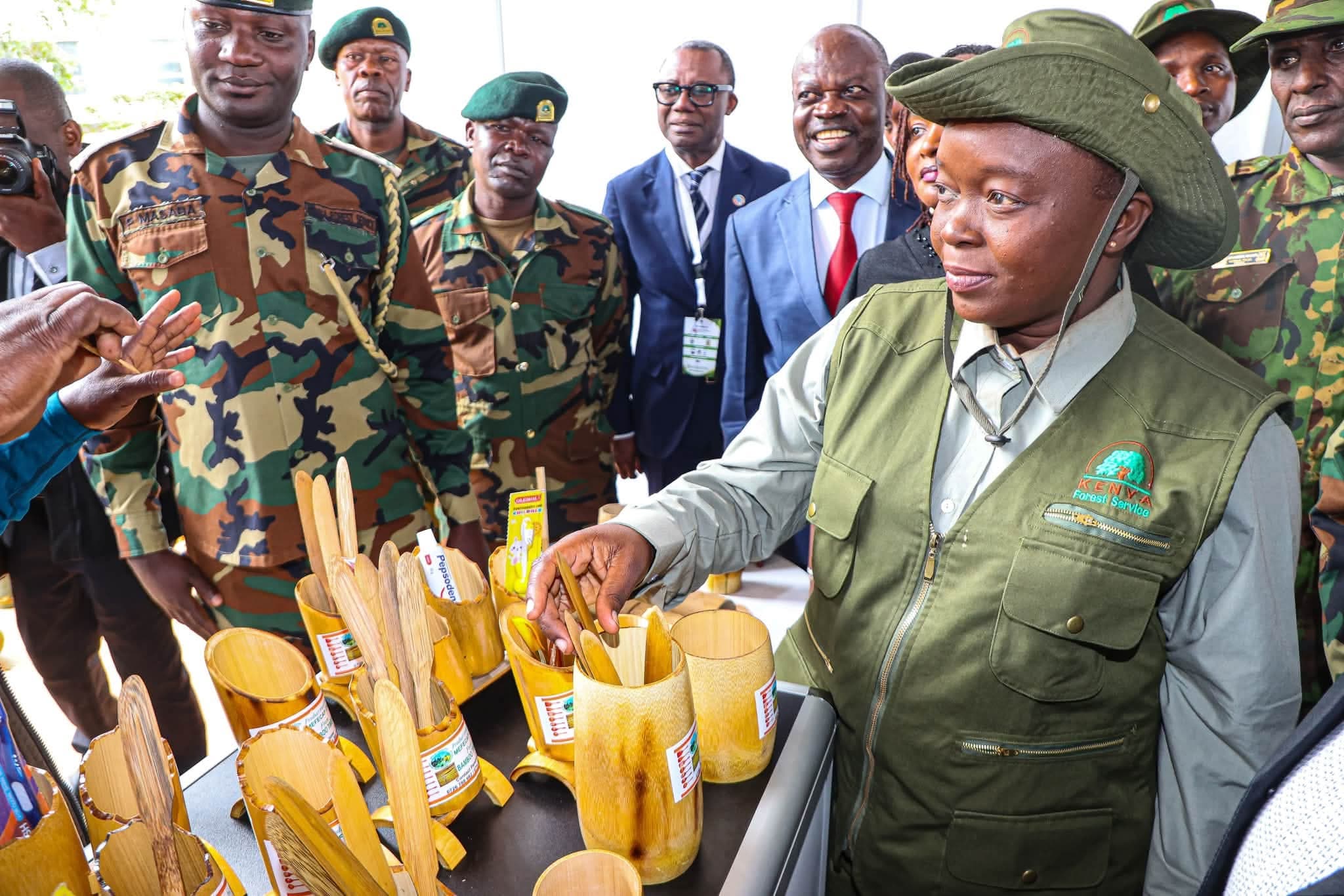
The government has called for concerted efforts to transform Kenya’s bamboo resources into a commercially viable industry capable of creating jobs, restoring degraded landscapes and improving community livelihoods.
Cabinet Secretary for Environment, Climate Change and Forestry Dr Deborah Barasa said Kenya has the potential to build a competitive bamboo industry but must now move beyond discussions about its potential to actual production, processing, value addition and marketing.
Speaking during the official opening of the National Bamboo Expo and Conference 2026 at Meru University of Science and Technology, the CS said Kenya has approximately 130,000 hectares of natural bamboo forests, predominantly indigenous highland bamboo, besides bamboo grown on private land.
She said the government had established an enabling policy framework through the National Bamboo Policy 2022 and the National Bamboo Development Strategy and Action Plan 2025–2035.
Under the strategy, she said, the Government targets establishing an additional 150,000 hectares of bamboo, noting that the target was not merely about increasing acreage but creating a functional value chain that benefits farmers, industries, entrepreneurs and young people.
“We now need to move from potential to production, from production to processing, and from processing to markets. Bamboo has potential to contribute to restoration of degraded landscapes, protection of water catchments and climate resilience while providing raw materials for construction, furniture, energy, textiles, crafts and other products,” said Dr Barasa.
She called on farmers and communities to embrace bamboo as an enterprise opportunity, saying the government would promote greater participation of youth, women and local communities in the value chain.
She also urged private investors to explore opportunities across the sector, including nurseries, plantation establishment, processing, manufacturing, construction, furniture and energy.
Dr Barasa said universities, research institutions and TVETs should develop technologies, skills and innovations tailored to the needs of the emerging industry, while financial institutions and development partners should provide appropriate financing and support to enterprises.
“I challenge national and county governments to strengthen collaboration in creating an enabling environment for bamboo development,” said Dr Barasa.
She said the National Bamboo Expo and Conference should mark the beginning of a sustained national effort to develop the sector, rather than being a one-off event.
The CS added that the Government would continue providing policy and institutional support while working with counties and other stakeholders to ensure bamboo contributes to Kenya’s climate action, landscape restoration and green economic transformation agenda.
“Kenya’s ambition should be to have bamboo sustainably grown across its landscapes, processed locally, support industries, create jobs and generate income for communities,” said Dr Barasa.
Meru University of Science and Technology Vice Chancellor Professor Romanus Odhiambo said the conference themed, “Sustainable Bamboo for Climate Action, Economic Growth and Community Empowerment,” was timely, given the potential of bamboo to address unemployment, environmental degradation and economic challenges.
He said countries such as Ethiopia and Ghana had demonstrated that bamboo could generate employment and economic opportunities, and challenged Kenya to exploit its own potential.
“Bamboo builds, restores and employs. I urge stakeholders to transform the resource into industries and enterprises,” said Professor Odhiambo.
The Vice Chancellor called on researchers to take greater interest in bamboo and urged universities, governments, communities and industry players to establish stronger partnerships.
He said Kenya had already developed the necessary policy and strategy frameworks, adding that the priority should now be implementation.
Professor Odhiambo also urged farmers to receive adequate training and market linkages to encourage them to take up bamboo farming, while researchers should strengthen collaboration with industries to ensure innovations respond to market needs.
Bamboo industry representative Victor Mwanga called on academic institutions to rethink engineering and mechanics courses to prepare for increased use of bamboo as an alternative source of materials traditionally obtained from timber.
Mwanga, who paid tribute to bamboo researcher Dr Bernard Kigomo, said bamboo had demonstrated its viability as a resource and required appropriate technologies to unlock its full potential.
He challenged engineers and researchers to develop machinery that would improve the efficiency of bamboo processing and value addition.
“Bamboo takes about five years to mature to a usable state, and this makes it important for stakeholders to invest in its cultivation and develop markets for farmers,” said Mr Mwanga.
by Dickson Mwiti


Comments
No comments yet. Be the first to share your thoughts.