
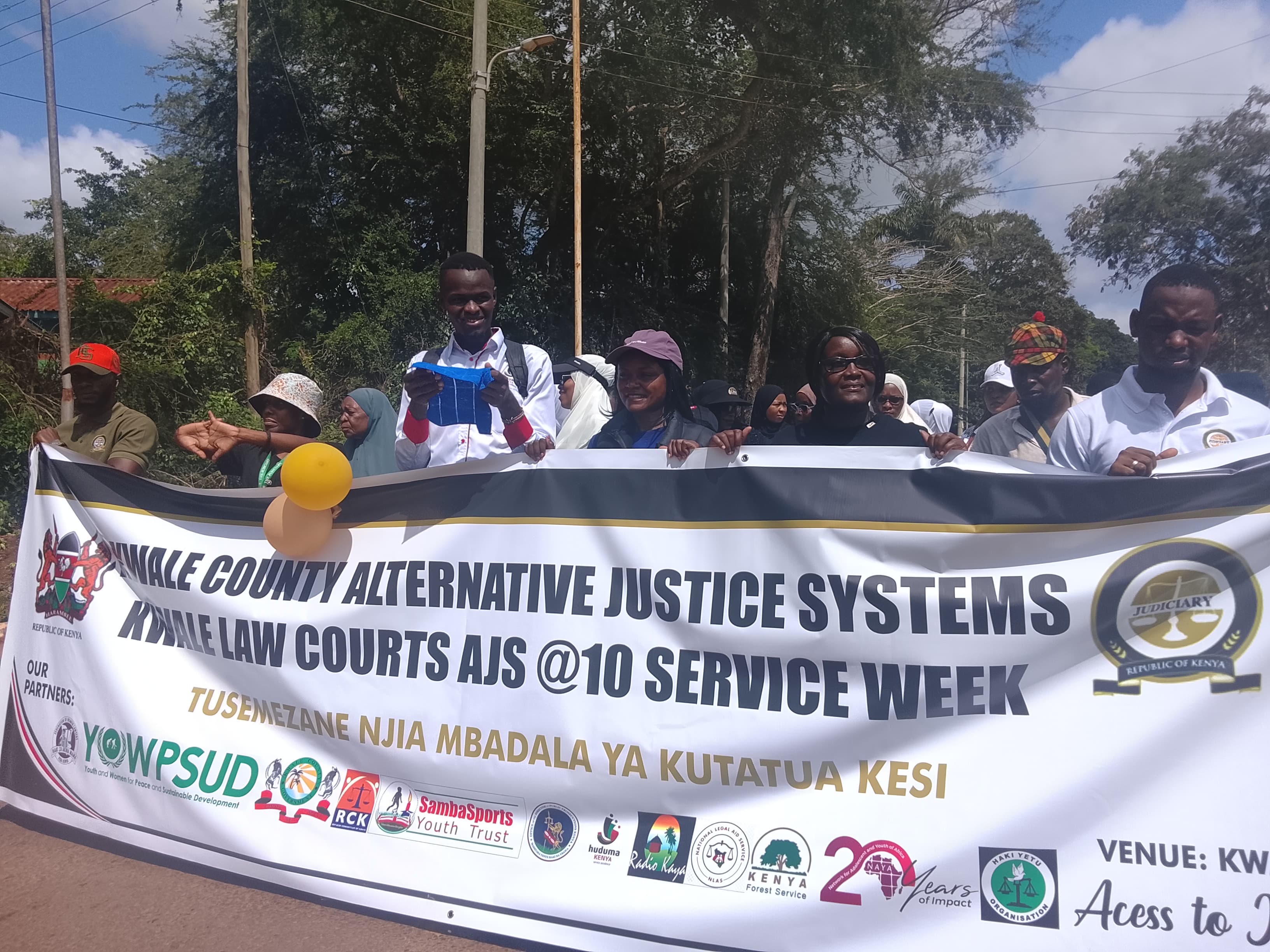
The Alternative Justice System (AJS) has successfully resolved 62 per cent of cases referred to it, Kwale Law Courts Administrator Lucas Nyakundi has said.
Speaking during celebrations to mark 10 years of the system in Kwale, Nyakundi said AJS had helped ease pressure on formal courts by providing communities with alternative mechanisms for resolving disputes.
He said the system, which draws on traditional community-based dispute resolution mechanisms, complements the formal judicial process by allowing disputes to be settled before they escalate into court cases.
“There is no competition between the court and AJS,” he said, urging Kaya elders to take an active role in resolving community disputes.
Nyakundi noted that AJS had existed long before the promulgation of the Constitution, adding that its strength lies in promoting amicable settlements that allow parties to maintain good relations after resolving their disputes.
Environment and Land Court Judge Elena Dericho said AJS enables communities to administer justice through mediation and the involvement of elders, thereby promoting peace while reducing the time and costs associated with formal court proceedings.
She cited the high number of pending cases in the magistrates’ court, which has more than 1,700 cases, saying the backlog often results in delays and frequent adjournments.
However, Dericho cautioned that disputes involving violations of constitutional rights could not be resolved through AJS.
Representing the Office of the Director of Public Prosecutions (ODPP), Rosemary Nandi urged residents to embrace alternative dispute resolution mechanisms, particularly for minor disputes that could be settled at the community level.
She said taking petty disputes to court unnecessarily contributed to case backlogs and congestion in police cells.
Rashid Mbwiza, representing lawyers serving in the AJS committee, said the initiative seeks to ensure that all residents have access to fair justice, noting that some communities lacked adequate knowledge of the available dispute resolution mechanisms.
Refugee Consortium of Kenya official Cindy Adundo called on residents to embrace refugees and promote peaceful coexistence, saying the organisation works to strengthen relations between refugees and their host communities.
The chief guest, Governor Fatuma Achani, commended the Judiciary for its contribution to the administration of justice, noting that AJS played an important role in promoting peaceful coexistence despite challenges in handling disputes involving parties with heightened tempers.
Achani, who recalled her previous involvement in alternative justice initiatives through the Federation of Women Lawyers (FIDA), said community-based dispute resolution remained important in addressing conflicts at the grassroots.
The Alternative Justice System is a community-based approach to resolving disputes outside formal court proceedings through mechanisms such as mediation, negotiation and the involvement of community elders, while respecting constitutional safeguards.
Nyakundi announced that another AJS celebration would be held on February 2, 2027.
By Eurelia Achieng and Mtumwa Makange



Comments
No comments yet. Be the first to share your thoughts.