
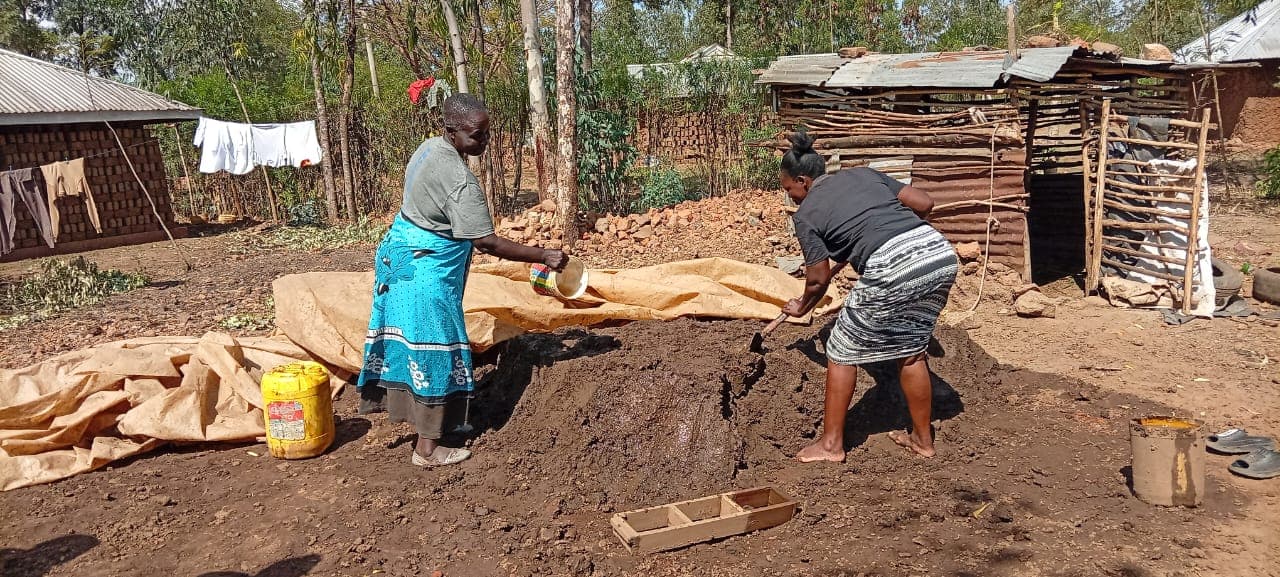
At first glance, the piles of bricks scattered across Lwala Nyakongo village appear to be nothing more than stacks of earth waiting to be sold.
But for a group of women in the village within the Central Karachuonyo ward, Karachuonyo constituency, the bricks represent something far more valuable, food on the table, children in school and a measure of financial independence.
Every day the women mould bricks from soil and water, leave them to dry under the sun and later burn them using firewood.
It is physically demanding work, but one that has gradually transformed the lives of the women and their families.
For Moreen Achieng Ouma, the decision to venture into brick making came after years of watching men dominate the business while the women saw little of the income.
“We formed the group as women to venture into brick making and selling after a lot of deliberations,” says Ouma,
Previously, she says, men in their households would make and sell bricks but would bring home only a small portion of the money.
“They would give us very little for food but kept the largest share for themselves,” she says.
The women decided they could do better by taking control of the business themselves.
“We sat down and said it was better to venture into the business because a woman will always naturally prioritize her family when she gets money. She will bring the money home without taking some for herself,” Ouma says.
Their decision has since yielded results.
The women say the income from brick making has enabled them to feed their families and pay school fees. Some have taken their children to universities and colleges, an achievement they say would have been difficult without the business.
“We have made a lot of progress with the business. We are now able to educate our children. We have also taken some to university and colleges. We are happy that we can now feed our families,” Ouma says.
Brick making begins long before the first brick takes shape.
The women first identify suitable soil for molding. They then pay people to dig it up and hire donkey carts to transport the soil to their worksite.
A suitable quantity of soil costs between Sh1,000 and Sh2,000, depending on the amount purchased. According to the women, soil bought for about Sh1,000 can produce approximately 1,500 bricks.
Each brick is sold for about nine shillings.
But the work requires more than soil.
Water has to be mixed with the soil to produce the right consistency. Because the mixing is physically demanding, the group hires people to do the task.
The women then take over the molding, shaping one brick after another by hand.
The freshly molded bricks are left to dry for several days before they are ready for burning.
That stage presents another expense.
The women need large quantities of firewood to burn the bricks. They search for firewood themselves or buy it, while also paying for transportation.
“It is a challenge because at times we lack the money for that,” Ouma says.
The business is closely tied to the weather.
During the rainy season, brick making comes to a halt. Rain can destroy bricks before they have dried, while wet firewood makes burning difficult.
To protect the freshly molded bricks from the rain, the women need heavy polythene sheets to cover them. But many cannot afford enough of the material.
“The rain destroys the uncooked bricks if left uncovered,” says Onyango.
The bricks must also first dry properly before they can be burned, making the hot, dry months the busiest period for the business.
Production therefore peaks during the dry season, when the sun provides the heat needed to dry the bricks.
When the rains arrive, the women turn to farming instead.
For about three to four months, they suspend brick making and concentrate on agriculture before returning to their brick sites when the rains subside.
For Winny Akoth who moved to Lwala from central Karachuonyo about 10 years ago, the decision to join the women was driven by the limited returns from farming.
“When I came to Lwala, the people here were farmers though they did not make a lot of profit from it, so we joined hands with other women to start a bricks business,” she says.
Farming remains an important fallback during the rainy season, but Akoth says brick making brings better returns.
Despite the physical demands and costs involved, she says the business has helped the women feed their families.
“The process of brick making requires money,” she says. “For mixing soil and water we need someone with strength to do that, we also have to buy firewood and also have to pay for transportation.”
The women now have a bigger ambition.
Carolyne Adhiambo says the group wants to buy a vehicle that can transport bricks to customers.
Currently, customers who purchase large quantities often have to arrange their own transportation. When they do not have a vehicle, the women call for one from Kendu Bay.
The group believes owning a vehicle would solve that problem while creating another source of income.
“Our target is to buy a vehicle to transport bricks to clients,” Adhiambo says.
The vehicle would allow the group to deliver bricks directly to customers and charge for transportation.
For a business that began as an attempt by women to take greater control of their income, the ambition represents another step forward.
The story of the Lwala brick makers is not simply about the production of building materials. It is about women finding a way to turn a readily available resource, soil into an income that supports their households.
The role of the women in Lwala’s brick business goes beyond molding bricks.
Some have also become the link between brick makers and customers.
They have taken on an unusual but important task, standing by the roadside and looking out for potential customers.
When they spot customers looking for bricks, they direct them to the brick-making sites and persuade them to buy.
For them, finding customers has therefore become as important as making the bricks.
Enock Onyango, a brick maker, says the business can struggle when the women are absent.
He says the men may make and burn the bricks, but women also play a crucial role in ensuring that the finished products find buyers.
Onyango says the role is crucial because the brick makers often depend on these women to find customers.
“Their role is critical in bringing in customers. They position themselves along the road and look out for vehicles carrying potential buyers,” he says.
Sometimes, he adds, brick makers can spend weeks with unsold stock if the women are not available to attract customers.
“When the women are absent, we can go for up to one month without selling bricks,” Onyango says.
The arrangement has created an interdependence between the men and women involved in the trade.
Men often undertake some of the heavier tasks, including burning bricks, while women are heavily involved in molding, finding customers and ensuring the bricks reach the market.
Some women, however, also have the skills to make and burn bricks themselves, Onyango emphasizes.
The arrangement illustrates how the business has become a shared livelihood, with men and women performing different roles in the production and sale of the bricks.
For Onyango, the business has also provided a way to cope with a lack of formal employment.
“There are no jobs in Kenya and we brickmakers depend on our businesses to take care of our families,” he says.
The economic significance of the business is evident in the homes of those who depend on it.
Onyango credits brick making with enabling him to build a house and educate his children.
For the women, the same business has helped pay school fees, put food on their tables and keep their families going through difficult economic times.
Their work remains vulnerable to the weather, the cost of firewood, transportation expenses and fluctuations in demand. But each brick molded and sold is another contribution towards keeping their households afloat.
Under the hot sun in Lwala, the women continue to mould the earth into bricks.
One after another, the bricks take shape.
And with them, so does a livelihood.
by Sitna Omar
Comments
No comments yet. Be the first to share your thoughts.