
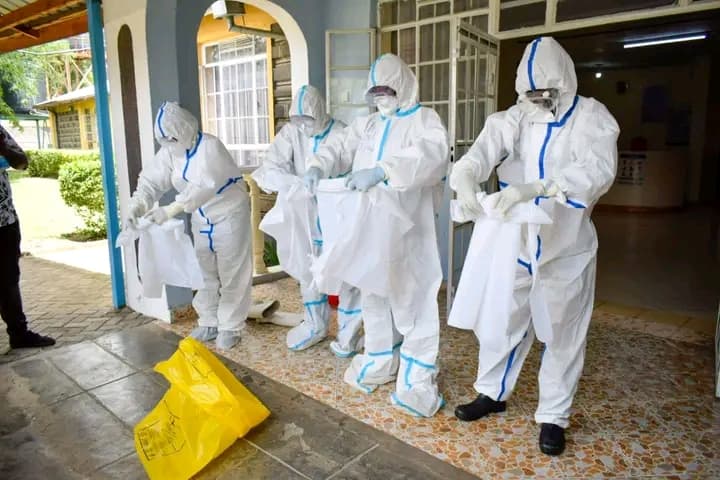
Nakuru County in partnership with the Ministry of Health and Amref Health Africa has strengthened readiness to manage suspected Ebola Virus Disease (EVD) cases after frontline healthcare workers completed a weeklong training programme and practical response simulation at Langalanga Sub-County Hospital, the proposed isolation centre.
The Ag. Chief Officer for Public Health Dr. Elizabeth Kiptoo said the programme targeted volunteer healthcare workers drawn from all sub-counties including personnel with experience from the COVID-19 response.
According to Kiptoo, the training was intended to strengthen surveillance and support timely response in event of an outbreak.
She emphasized that preparedness also requires refresher training, adequate PPE supplies, reliable ambulance arrangements, laboratory coordination and clear referral protocols.
“Health facilities need trained personnel, designated isolation areas, safe patient-transfer procedures and the capacity to collect and transport specimens without exposing other patients or staff,” said Kiptoo.
The Ag. Chief Officer further highlighted that the simulation was designed to test the chain of actions that would be required if a suspected case were referred to Langalanga Sub-County Hospital.
However, she did not specify the centre’s operational status, bed capacity, staffing complement or available isolation equipment.
Those details will be important in determining whether the facility can safely receive and manage suspected cases.
Kiptoo urged the healthcare workers to protect themselves, while providing quality care, stressing that staff safety is essential to an effective outbreak response.
Kiptoo’s emphasis on protecting frontline workers reflects a central lesson from Ebola responses: staff safety and patient care cannot be separated.
Correct PPE use, particularly safe removal after contact with a suspected case, is critical to preventing accidental exposure.
She thanked the partners for supporting county preparedness and reaffirmed the department’s commitment to coordinated action against potential outbreaks.
The exercise tested how health teams would identify and receive a suspected patient, protect staff and the public and coordinate care from community engagement and screening through ambulance transfer, laboratory testing and eventual discharge.
The programme began with classroom sessions at Nakuru County Referral and Teaching Hospital (NCRTH), covering EVD case management and infection prevention and control.
Ministry of Health trainers then guided participants through a simulation that included the use of personal protective equipment (PPE), safe donning and doffing, ambulance transportation, laboratory testing, patient reassurance and security procedures.
The exercise also included a simulated recovery and discharge, followed by a feedback and debriefing session.
The training comes as Kenya continues to manage the consequences of an imported Bundibugyo Ebola case reported in October.
In a statement on November 1, Health Cabinet Secretary Aden Duale said the outbreak remained confined to a single cluster linked to the imported case, with no new case reported since October 19.
The Ministry said the eight confirmed cases were linked to the index case and included four healthcare workers and four close family members.
The Ministry of Health Director-General Dr. Patrick Amoth said on October 26 that the first 20 contacts had completed the mandatory 21-day monitoring period and were cleared to return home.
The remaining 98 contacts were expected to be released in phases, subject to individual health assessments. The developments underline why preparedness extends beyond identifying an outbreak.
The World Health Organization (WHO) says healthcare workers face increased infection risk, when they lack appropriate PPE or fail to follow infection prevention and control procedures.
Its May 2026 guidance for Ebola and Marburg disease recommends coordinated measures covering screening and triage, isolation, PPE, hand hygiene, occupational exposure management, environmental cleaning and safe handling of deceased patients.
WHO also emphasizes that community engagement is central to outbreak control.
Residents must understand how to report symptoms and possible exposure, while health workers need to communicate clearly with patients and families to support timely assessment and safe referral.
Kenya’s national preparedness framework has placed similar emphasis on coordinated surveillance, laboratory capacity, infection prevention, risk communication, case management and cross-border cooperation.
At the National Ebola Virus Disease Preparedness and Response Taskforce’s inaugural meeting in July, Principal Secretary for Public Health and Professional Standards Mary Muthoni said Kenya’s regional connectivity and cross-border movement required sustained vigilance and a coordinated response across national and county governments.
For Nakuru, the designation of Langalanga Sub-County Hospital as a proposed isolation centre adds a local facility to the response plan.
As Kenya continues monitoring the Ebola cluster, Nakuru’s exercise demonstrates the importance of preparing health teams before an emergency reaches their facilities.
The next measure of readiness will be whether the county can sustain trained personnel, operational isolation arrangements and coordinated referral systems beyond the simulation.
By Jefther Afuyo and Jane Ngugi


Comments
No comments yet. Be the first to share your thoughts.