
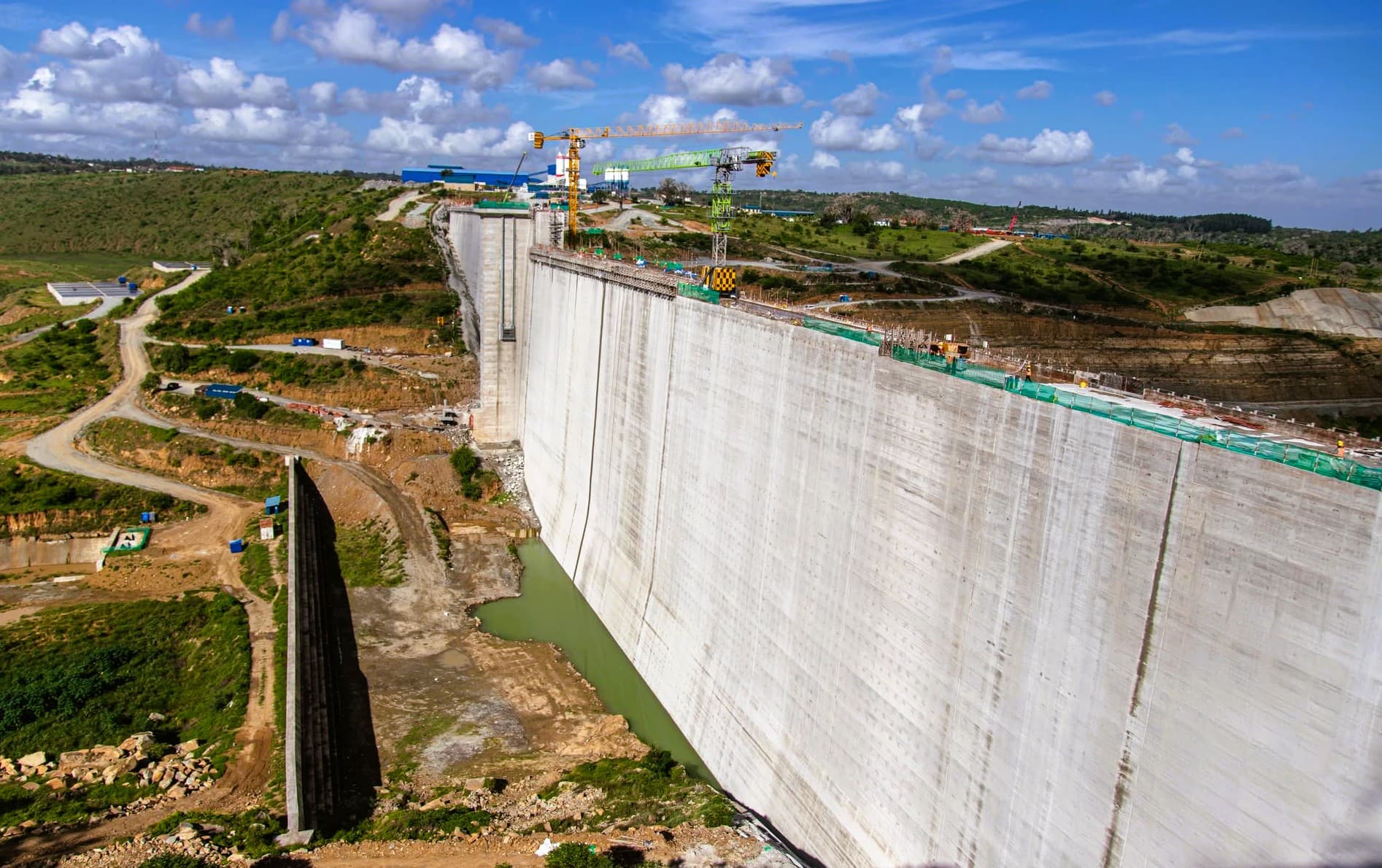
The national government is actively advancing several multi-purpose mega-dam water infrastructure projects across the country to strengthen its water and food security agenda.
The Cabinet Secretary (CS) for Water, Sanitation and Irrigation Eng. Eric Mugaa says the state is leading a massive expansion of national water and irrigation infrastructure projects to boost food security and advance agricultural productivity.
The Mwache project remains a strategic investment in enhancing water security, supporting irrigation, strengthening climate resilience, and improving the socio-economic wellbeing of communities in the Coast region.
Eng. Mugaa says these initiatives are aimed at expanding irrigation for food security and securing a reliable potable water supply under the government’s developmental agenda.
He said the government is focused on completing strategic water projects that deliver tangible benefits to communities and support sustainable development.
CS Mugaa said the Mwache Multipurpose Dam is designed to harness flood flows from the Mwache River Basin for domestic water supply and irrigation in Mombasa and Kwale counties, while strengthening resilience to increasing variations in weather and climatic patterns.
The Mwache Multipurpose Dam Project is a flagship national infrastructure project in Kwale designed to solve chronic water shortages and boost food security in the coastal region.
The CS said the Mwache project reflects the government’s commitment to accelerating water infrastructure development, expanding access to clean and safe water, and improving the quality of life for communities.
He was speaking during an inspection tour of the Sh45 billion Mwache Multipurpose Dam project in Kwale county which has reached a 94 percent completion rate.
The dam is being constructed as an 84-metre-high Roller-Compacted Concrete (RCC) gravity dam, with a crest length of 530 metres. It is set to be the first RCC dam to be constructed in the East African region, deploying modern dam construction technology.
The development has raised hopes of relief for thousands of residents in Kwale and the wider coastal region who continue to grapple with persistent water shortages.
Implemented under the Coast Region Water Security and Climate Resilience Project, the dam is poised to become a transformative asset for the coast region unlocking growth and strengthening resilience against climate-related shocks.
“Access to a sustainable water supply is fundamental to improving the quality of life and livelihoods of citizens, and our mission remains clear, which is to provide clean and safe water, together with dignified sanitation,” he said.
Eng. Mugaa has called for the fast-tracking of financing for the remaining water transmission infrastructure, warning that delays could prolong the region’s water crisis even after the dam is completed.
He said the development objective of the Mwache Dam project is to sustainably increase bulk water supply to Kwale and Mombasa counties and increase access to water and sanitation.
The minister said the Mwache Dam will store up to 136 billion litres of water and supply approximately 186 million litres of treated clean water daily to households, industries, and institutions across Kwale and Mombasa counties.
He said the 84-metre-high roller-compacted concrete gravity dam continues to take shape at unparalleled speed bringing closer to ‘delivering a reliable water supply to the coast region’.
Eng. Mugaa said the government had signed contracts for the water treatment plant and the South Mainland Pipeline, which will supply water to areas including Likoni sub county of Mombasa, but was still pursuing funding for two additional pipelines needed to expand distribution.
“We have a financing agreement that is being prepared to fast-track the project. Any delay means the people of Mombasa and the surrounding areas will continue to feel the pressure of water shortages,” he said.
The CS was accompanied by the French Ambassador Wadid Benaabou, Director General of the European Investment Bank, Andrew McDowell, and the African Development Bank Kenya Director, Anne-Gaël Chapuis, the Water Secretary, Eng. Samuel Alima, the Chief Executive Officer of the Coast Water Works Development Agency (CWWDA) Hamoud Mguza.
The team jointly inspected the progress of the Mwache Dam and associated Works in Kwale County and held consultations on resources mobilization strategies for the Downstream Works including the 186 million litres a day Water Treatment Plant and Transmission Mains to Likoni in Mombasa South Mainland, Changamwe in Mombasa West Mainland and Nguu Tatu in Mombasa North Mainland.
“This landmark project will be a transformative asset, unlocking growth, improving livelihoods, and strengthening resilience against climate shocks for over 1.6 million residents,” said Mugaa.
The CS reaffirmed the shared determination to further deepen the strong and productive partnership between Kenya, the European Investment Bank, and the African Development Bank in the water and sanitation sector.
Mugaa expressed satisfaction with the progress and thanked France’s commitment to supporting Kenya’s water sector through development financing.
Ambassador Benaabou said the dam had the potential to transform the lives of more than one million people in the coastal region, noting that the project had received support from the French Development Agency (AFD) and the World Bank.
He said AFD remained one of Kenya’s key bilateral partners in the water sector, with investments in Mombasa, Nairobi and Kisumu, and pledged continued cooperation in improving access to reliable water supplies.
Coast Water Works Development Agency (CWWDA) Chief Executive Officer Hamoud Mguza said the project was 94 percent complete, with the agency also working to secure financing for the transmission infrastructure required to deliver water to consumers.
Mguza described the dam as a potential game changer for the coastal region, saying its benefits would depend on completing the remaining works and ensuring that the water could be treated and distributed efficiently.
CWWDA chairman Jimmy Kahindi said priority was being given to completing the main dam, two check dams, the water treatment plant and the distribution network.
Kahindi said the South Mainland Pipeline would particularly benefit residents of southern Mombasa and parts of Kwale County, including Likoni and Tongwe, once construction begins and the system becomes operational.
The project is expected to strengthen water security in the region, where demand continues to exceed available supply. Once fully operational, the dam is designed to provide approximately 186 million litres of treated water daily to Mombasa and Kwale counties, serving a growing population as well as businesses and public institutions.
Besides improving access to clean water, the project is expected to support agricultural activities, strengthen resilience to drought and help manage floodwaters by storing water for use during dry periods.
However, officials say completion of the dam alone will not resolve the region’s water shortages. The treatment plant, transmission pipelines and distribution systems must also be completed to ensure that water reaches households and businesses.
by Hussein Abdullahi

Comments
No comments yet. Be the first to share your thoughts.