
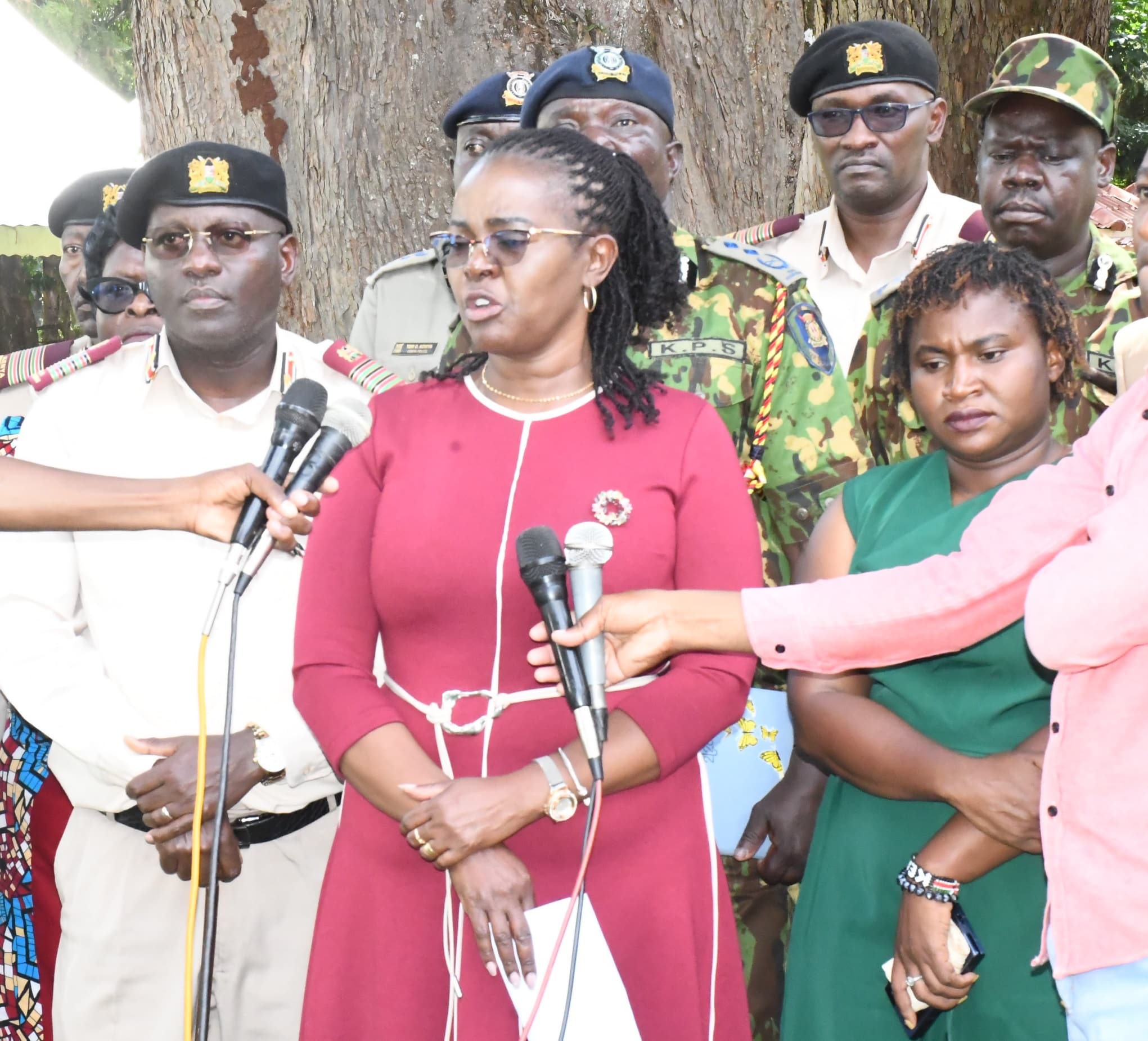
The government has rolled out a three-month rapid result initiative (RRI) to curb the increasing number of gender-based violence (GBV) and femicide cases in Western region.
State Department for Gender and Affirmative Action is spearheading the initiative, aimed at fast-tracking arrests, investigations, and court processes in an effort to strengthen protection systems and improve access to justice for victims.
Addressing the Press in Kakamega during the launch, Principal Secretary, State Department for Gender and Affirmative Action, Anne Wang’ombe called for concerted efforts by all stakeholders to help eradicate the vice.
She said the presidential technical working group appointed to look into issues of GBV including femicide, came up with recommendations that proposed intensified campaigns against GBV across the country.
“It is for this reason that the Ministry is launching the RRI here in Western region after launching one in the Central region.”
Wang’ombe said the government and specifically the President is resolute that the issue of GBV and femicide must come to an end.
“We have looked at the common cases and agreed that we need to retreat back to our respective counties and engage the key stakeholders including religious leaders, police, national government administrators, community elders, teachers, health workers, the office of the Director of Public Prosecutions and the Judiciary,” the PS said.
“Although they have been playing their roles, we want them now to do it in a coordinated manner as we have set up targets and timeliness with a view of getting rid of GBV cases in western region.
“As a government we want to ensure safety for all. We want to have a region that is free of any form of violence as GBV is not only physical, but it can be psychological, economic or technologically facilitated,” she said.
The Principal Secretary said the country cannot move forward if GBV perpetrators continue harming vulnerable groups including women, girls, boys, persons with disability and some men.
She disclosed that Western region is one of the hotspots in the country having reported 3,191 GBV cases including rape, defilement, femicide and others between January and September this year.
Wang’ombe said stakeholders in the region have agreed on specific measures to be undertaken by each of them with some of the measures originating from respective counties as each of them has its own unique challenges.
“For instance, we expect that the Judiciary will come up with certain measures like fast-tracking cases and avoiding unnecessary adjournments; we expect that the police will arrest the perpetrators and that there will be a proper and harmonized way of ensuring that investigations are carried out and prosecution is done successfully,” she said.
The PS said religious leaders will be expected to preach peace, address issues of GBV, initiate programs that will bring couples together.
Schools on the other hand are expected to initiate programs where teachers will teach learners issues to do with GBV and how to report on them.
“In the health sector we expect hospitals to fast-track GBV cases while Community Health Promoters should be capacity-built to enable them screen and report GBV cases in their respective areas.”
Western Regional Commissioner, Allan Machari echoed Wang’ombe’s sentiments saying the RRI will help accelerate actions against GBV and femicide in the region which, he added, is turning out to be a hotspot.
“We acknowledge and agree that the fight should be a concerted effort by all stakeholders as it cannot be won by one particular organization or set up. We are hence insisting on the issue of a common approach to a common enemy,” Machari said.
“We are currently having continuous collaboration between the national police service, the national government administrative officers, the county government and other stakeholders in the fight against GBV and femicide.”
Machari disclosed that all police stations in Western region currently have well established gender desks with all the counties having GBV centers and protection units.
He also reported that the region has adopted campaigns against GBV, child protection and welfare policies and continues to undertake community sensitization, awareness campaigns and multi-sectoral coordination.
The administrator noted that the approach has helped strengthen the police gender desk and child protection units through proper GBV referrals and case management, adding that whenever a case comes up there is a coordination structure in place to ensure it is dealt with in a systematic manner.
Kakamega County Executive for Social Services, Sports, Youth, Gender and Culture Jackline Masicha, who represented Governor Barasa, lauded the national government for the initiative that targets to curb the rising GBV cases in the country.
“This engagement has come at a critical time after the country has had numerous conversations, policies, programs and recommendations regarding GBV. However, the question now should be how quickly and effectively can we translate them into measurable results,” Masicha said.
“That is why the RRI has come at the right time. It is critical because it is providing us with an opportunity to move from recommendations to implementation, from implementation to measurable results, from short term interventions to sustainable measures of prevention and protection.”
Western Region Police Commander George Seda said the police have intensified the fight against illicit brews and hard drugs which he said have been the main cause of many gender-based violence cases.
“We are currently undertaking consistent raids. We are making arrests daily and taking perpetrators to courts. We have surveillance where we are teaming up with members of the public and other multi-agency stakeholders. We want to ensure our society is safe against any destructive vices,” he said.
by Melechezedeck Ejakait/Shilla Nicolle Akinyi
Comments
No comments yet. Be the first to share your thoughts.