
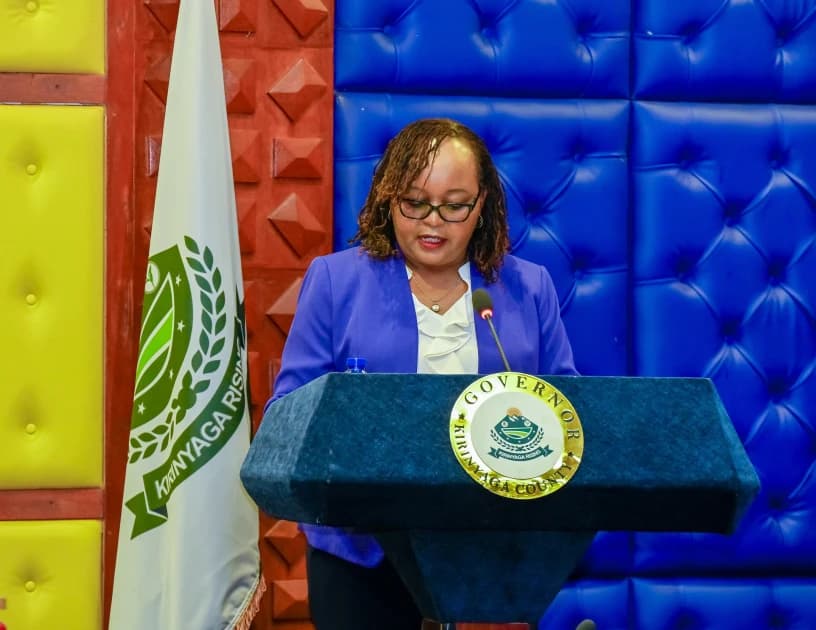
Kirinyaga Governor Anne Waiguru delivering her final State of the County Address before the County Assembly.
Waiguru said Kirinyaga recorded an economic growth rate of 8.7 per cent in 2025, outperforming the national growth rate of approximately 6 per cent.
Speaking during her final State of the County Address before the County Assembly on Tuesday, the outgoing governor attributed the growth to sustained investments in agriculture, healthcare, infrastructure, water, education and industrial development.
She also highlighted improvements in the county’s own-source revenue, which increased more than threefold from KSh344.4 million in the 2017/18 financial year to KSh1.11 billion in 2025/26.
She attributed the increase to the digitisation of revenue collection and management, as well as the operationalisation of the Facility Improvement Fund, which she said had strengthened the county’s capacity to mobilise resources for development.
“Today, we can proudly say that Kirinyaga has undergone remarkable transformation. Our economic foundation has strengthened, infrastructure has expanded, public services have improved, institutional capacity has grown, and our development outlook has become even more promising,” she said.
A key pillar of the county’s economic transformation, Waiguru said, was the development of Sagana Industrial City, which is expected to diversify the economy by expanding manufacturing, processing and value addition.
She said two investors targeting tomato and avocado processing had already delivered machinery in preparation for setting up operations at the industrial city.
The project's Special Economic Zone has also been gazetted as a customs-controlled area, paving the way for the leasing of industrial plots and the implementation of investment incentives.
Construction of 487 affordable housing units is also underway as part of the wider development.
According to Waiguru, the industrial city has generated more than 2,650 jobs during construction and is projected to create over 100,000 direct and indirect jobs when fully operational.
She said the project would provide farmers with reliable markets, facilitate local processing of agricultural produce and connect businesses to wider domestic and international markets.
Agriculture, which contributes approximately 42 per cent of Kirinyaga’s economy and supports 87 per cent of its population, has also benefited from the county's Wezesha Kirinyaga programme, which has reached more than 100,000 farming households.
Waiguru said the initiative had promoted organised farming, commercial agriculture, cooperative financing, improved productivity and better market access.
Rice production has increased from 65,000 metric tonnes in 2017 to 210,000 metric tonnes annually, generating an estimated KSh16 billion for farmers. Tomato production has also risen from 46,000 to 116,000 metric tonnes, with an annual value estimated at KSh6.9 billion.
Coffee production increased from 28,000 to 49,100 metric tonnes, with sales reaching a record KSh7.48 billion in the 2025/26 financial year.
In the dairy sector, average milk production per cow has risen from 2.5 litres to approximately eight litres daily, translating into an estimated annual production of 86 million litres valued at KSh3.1 billion.
In healthcare, Waiguru cited the construction of the Kerugoya County Referral Hospital Complex in 2023 as a major milestone in expanding access to specialised medical services.
She said hospital complexes in Kianyaga, Kimbimbi and Sagana were nearing completion and would upgrade the respective Level 3 facilities to Level 4 hospitals.
The county has also constructed and operationalised dispensaries in different parts of Kirinyaga, alongside investments in health infrastructure and human resources.
On infrastructure, the governor highlighted the Nyorosha Barabara Mashinani programme, which she said had improved connectivity between rural and urban areas, eased transportation challenges and opened up communities to economic opportunities.
She also cited the construction of approximately 30 markets and aggregation centres, alongside town improvement programmes and investments in education and human capital development.
In the water sector, Waiguru said more than 50,000 additional households had been connected to clean water, expanding access to the essential service across the county.
The governor also pointed to social and economic empowerment programmes targeting residents, particularly women and young people, as part of efforts to improve livelihoods.
Acknowledging that some flagship projects were still under implementation, Waiguru said her administration would use the remaining eight months of its tenure to complete ongoing projects, strengthen service delivery and consolidate the gains achieved.
“I want to assure the people of Kirinyaga that although my constitutional term is drawing to a close, my administration remains fully committed to serving you until the very last day in office. We still have eight months ahead of us, and we shall continue working with the same energy, focus, and determination that have defined our service from the beginning,” she said.
She urged residents to elect leaders who would sustain the development agenda, arguing that a change in leadership should not disrupt ongoing projects and investments.
“The roads we have built, the health facilities we have established, the water projects we have implemented, the industrial investments we have attracted, and the opportunities we have created for our people require leadership that understands the vision, values continuity, and is committed to taking Kirinyaga to the next level,” she said.
Waiguru, who has declared her interest in the Deputy President position, described her two terms as governor as the greatest privilege of her public life, expressing commitment to continuing public service and championing the interests of Kirinyaga, the Mt Kenya region and the country at a higher level.


Comments
No comments yet. Be the first to share your thoughts.