
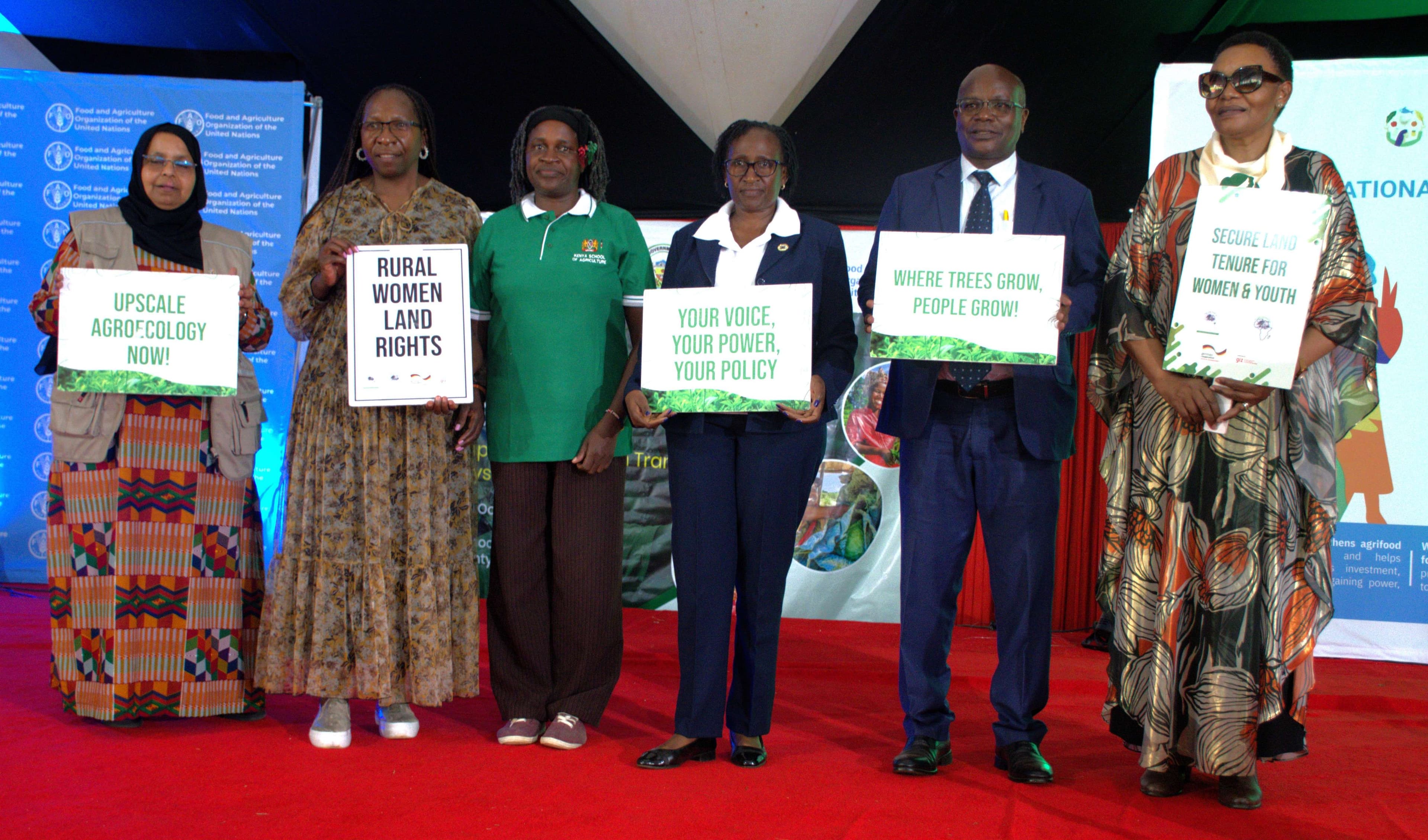
Women farmers have called for improved access to markets, land, finance and agricultural extension services to strengthen their contribution to Kenya’s food and nutrition security.
The farmers said inadequate market access and limited access to agricultural information continue to undermine their productivity and earnings, despite women accounting for 53 per cent of farmers registered in the country.
Speaking during the International Year of the Woman Farmer 2026 conference at the Kenya School of Agriculture in Nyeri County, Head of the Gender Unit at the State Department for Agriculture Elizabeth Yegon said the government was working with partners to address challenges facing women in agriculture.

Yegon said the two-day conference, held under the theme Women Farmers Leading the Transformation of Agrifood Systems: Innovation, Resilience, and Equality, provided an opportunity to equip farmers with skills and information to improve their enterprises.
She said the government was supporting targeted interventions, including capacity building, grants for women-led enterprises and the development of gender-responsive markets with facilities such as childcare centres.
“Women farmers face several challenges, including access to land, access to finance and participation in decision-making, both at the household level and within farmer organizations,” she said.
Yegon noted that farmer registration had enabled the government to identify women’s needs and plan services that respond to their challenges.
The conference also witnessed the launch of the Digi Shamba application by the Women Farmers Association of Kenya (WoFaAK) in collaboration with partners to improve farmers’ access to agricultural information.
Digi-Shamba is a WhatsApp-based agricultural advisory service and platform being introduced to help farmers access practical farming information in English or Kiswahili through text messages and voice notes.
Initially focusing on livestock feeding, manure management and soil health, the service uses curated research and extension materials to provide advice, particularly to women farmers facing barriers to extension services.
It is being implemented by KALRO and research partners, including ILRI, Agroscope, WoFaAK and Viamo, and is intended to complement, rather than replace, advice from agricultural extension officers.
WoFaAK founder and Executive Director Daphne Muchai said women farmers continue to face barriers to training, with some unable to attend sessions because of the distance to training venues, while access to smartphones in some households remained controlled by men.

Muchai cited a study on soil fertility management that found 85 per cent of farmers lacked adequate information, highlighting the challenge of ensuring agricultural knowledge reaches those who need it.
She urged women farmers to form groups and marketing cooperatives to consolidate their produce and negotiate better prices.
“Unity is power, especially when marketing agricultural produce, considering our farms are small and nobody can meet the market alone,” Muchai said.
Beatrice Wanja, a farmer from Mathira in Nyeri County who produces milk and grows wheat, said women were increasingly treating farming as a business but continued to struggle with access to land and markets.
She said some women faced difficulties making farming decisions where they lacked control over land, while others had limited opportunities to sell their produce.
“Women are farming for business. When you sow that seed, it gives you milk; you take it to the market, you get money and put it in your pocket,” Wanja said.
She emphasized that farmers growing crops and keeping livestock needed reliable markets to avoid losses and earn from their investments.
Wanja said farmer training and networking opportunities had helped women learn from one another, improve their farming practices and explore new markets.
The International Year of the Woman Farmer was declared by the United Nations to recognize women’s contribution to agriculture and promote efforts to address barriers that limit their participation and economic empowerment.
by Wangari Ndirangu


Comments
No comments yet. Be the first to share your thoughts.