
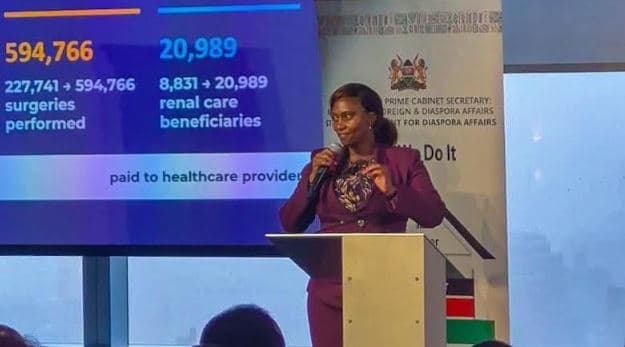
Kenya has called for long-term and predictable investment in climate-resilient primary healthcare as the country seeks to shield communities from the growing health impacts of climate change.
Principal Secretary for Public Health and Professional Standards Mary Muthoni said stronger investment in primary healthcare infrastructure, climate-informed surveillance, and early warning systems would be critical in preparing communities for climate-related health emergencies.
Speaking during the UN General Assembly 81 (UNGA 81) Amref Health Africa Roundtable, Ms. Muthoni identified resilient primary healthcare facilities, stronger community health systems, and increased access to climate finance as key priorities for Kenya.
The roundtable brought together Amref Health Africa, SEED, the World Bank, the Gates Foundation, Africa CDC, and government representatives from Kenya, Ethiopia, Sierra Leone, and other countries to explore ways of financing and scaling climate-resilient health solutions.
The discussions highlighted the need for stronger partnerships and innovative financing mechanisms to expand climate-resilient primary healthcare and strengthen the capacity of health systems to respond to climate-related threats.
Ms. Muthoni said Kenya was also making progress in strengthening its community health system through the professionalisation of Community Health Promoters (CHPs).
The Government is implementing shared financing arrangements between the national and county governments to support CHP stipends and medical insurance through the Social Health Authority (SHA).
The initiative is being complemented by investments in training, supervision, essential medical supplies and digital tools to improve the effectiveness of community health workers.
Ms Muthoni highlighted the measures on the sidelines of UNGA 81 during a high-level panel examining financing and implementation of professional Community Health Worker policies.
Through the Taifa Care programme and the Primary Healthcare Fund, the Government is seeking to establish sustainable financing for community health while strengthening the role of CHPs as a link between households and primary healthcare services.
The Government says the measures will help ensure community health workers remain a reliable first point of contact for millions of Kenyans while strengthening the country’s preparedness for the health consequences of a changing climate.
The push for climate-resilient healthcare comes as countries face increasing pressure to strengthen health systems against climate-related threats, including extreme weather events and other risks that can disrupt access to essential health services.
By Joseph Ng’ang’a

Comments
No comments yet. Be the first to share your thoughts.