
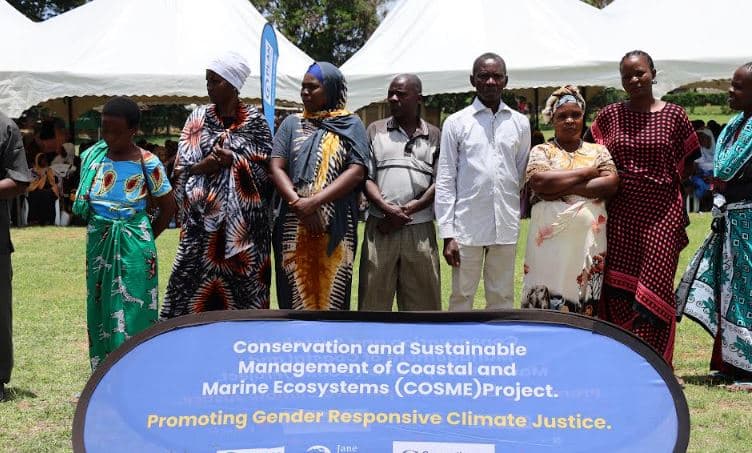
Women in Kilifi County have taken center stage in environmental conservation, leading community groups in restoring forests, while also breaking gender barriers to participate in leadership and decision-making at the grassroots.
With support from NGOs, women involved in conservation programmes across the region are increasingly engaged in preparing tree seedlings, planting and nurturing trees, and protecting natural resources as part of efforts to restore terrestrial and community forests.
Through environmental initiatives such as the Conservation and Sustainable Management of Coastal and Marine Ecosystems (COSME) project, implemented by Plan International, women have emerged as a major force in efforts to protect and restore Kilifi County’s natural ecosystems.
The COSME project, which incorporates gender-sensitive climate change interventions, works with Community Forest Association (CFA) groups, where women are increasingly taking up leadership roles and challenging cultural barriers that have traditionally limited their participation.
The programme addresses gender gaps in decision-making, access to and control of resources, family support, and attitudes towards gender roles, while recognizing women as important actors in protecting natural resources and building resilient communities.
In Takaungu, Chonyi, and Mwangea Hills, 42 forest conservation groups have a combined membership of more than 3,500 people, about 80 per cent of whom are women.
In Takaungu alone, 26 Community Forest Association groups with 606 members are involved in conserving and restoring mangrove forests, while in Chonyi, 15 groups with 463 members are involved in conserving and restoring community forests known as Kayas.
Plan International Project Lead Beryl Oduor said linking conservation with gender equality was important in ensuring that women had a voice in decisions affecting their environment and communities.
“Our main focus was conservation, especially the Kaya Chonyi forest, but also linking it with ensuring community participation, especially women. About 70 per cent of community participation in conservation is by women,” she said.
Oduor said the project engaged both men and women through weekly dialogue sessions to promote understanding of the importance of working together in conservation.
“We were also very keen on ensuring that men and women work together collaboratively through a methodology called Gender Justice Journey,” she said.
The approach has helped challenge traditional perceptions about the roles women can play in community development while strengthening their participation in community affairs and giving them a greater voice on issues affecting their livelihoods and environment.
For some women, however, taking an active role in forest conservation meant challenging deeply rooted cultural practices.
Caroline Kiti, Chairperson of the Tumaini Ondoni CFA group in Chonyi, said women had previously been restricted from accessing community forests because of cultural beliefs.
She became concerned as she watched the forest being destroyed despite its sacred status. This prompted her to mobilize other women to form groups, seek support, and take the lead in protecting their community forest.
“What angered me is that the men were dividing the forest and clearing it for farming. When we got gender equality training in conserving the environment, I realized we were equal and that we could also access the forest and stop what was happening inside,” she said.
Zuleha Abdalla, an official of the Mtakimau CFA group from Takaungu, said women previously had little say in community affairs, with most decisions being made by men.
“We were facing gender-based abuse of rights, the same with our children. Through the gender-based programmes, we have recognized ourselves, and we can make sound decisions on our own,” she said.
Meanwhile, conservation has become more than an environmental responsibility to women in Kilifi. It is also creating opportunities to challenge traditional gender roles, strengthen their voice in community affairs, and take greater responsibility for the natural resources and livelihoods of their communities.
By Jackson Msanzu

Comments
No comments yet. Be the first to share your thoughts.