

Knec requires examination officials to ensure candidates sit the examinations in strict compliance with the prescribed rules and regulations. /AI ILLUSTRATION

The 2026 Kenya Certificate of Secondary Education (KCSE) examinations enter a critical phase on Monday, November 2, as more than 1.04 million candidates begin sitting their theory papers.
This year's examinations are the second-last before the phase-out of the 8-4-4 education system, which is being replaced by the Competency-Based Education (CBE) curriculum.
A total of 1,048,355 candidates are sitting the examinations across more than 10,000 examination centres, marking the first time in Kenya's history that KCSE candidature has crossed the one-million mark.
The figure represents a 5.27 per cent increase from the 995,860 candidates who sat the examinations in 2025.
The examinations began on October 19 with oral and practical papers under strict regulations issued by the Kenya National Examinations Council (Knec) to curb examination malpractice.
Knec chief executive officer David Njegere has instructed field officers, including centre managers, supervisors, invigilators and security personnel, to ensure mobile phones are not allowed inside examination rooms.
"All mobile phones in the examination centre must be switched off then kept in a lockable locker outside the examination room when the examination session is on," he said ahead of the examinations.
Njegere also said candidates are prohibited from wearing wristwatches of any kind inside examination rooms, directing centre managers to provide wall clocks in every room.
Centre managers have further been instructed to maintain an approved weekly list of all authorised personnel at their examination centres, with each person required to present an original national identity card for identification.
The CEO wished candidates success as the council embarked on administering the large-candidature papers in the third week of the examinations.
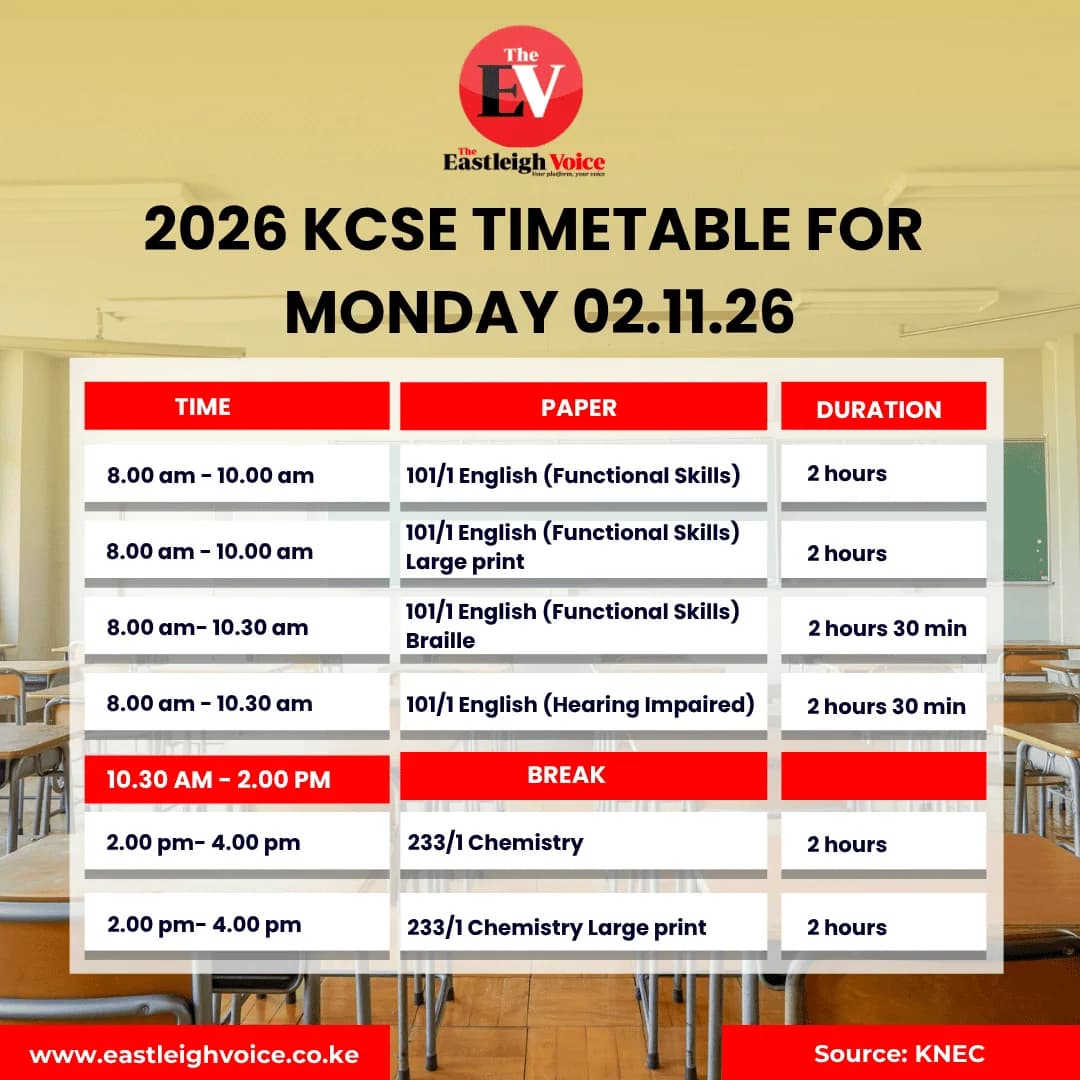
According to the Knec timetable, candidates will sit English (Functional Skills) in the morning and Chemistry in the afternoon, including the large-print version of the latter paper.
The morning examination session starts at 8am, with both papers scheduled to last two hours, except for English Braille and the paper for hearing-impaired candidates, which will take two hours and 30 minutes, ending at 10.30am.
The afternoon session starts at 2pm, with the papers scheduled to last two hours.
Ahead of the examinations, Interior Principal Secretary Raymond Omollo warned parents, teachers and other stakeholders against falling prey to fraudsters selling purported examination papers.
"Don't fall in the trap of those who want to make quick money by lying to you that they will steal for you examinations because when you do that, you are not just ruining the lives of our children, you're ruining your life as a parent and also as a professional teacher," he said on Sunday.
The PS warned that anyone found culpable would face the full force of the law.
"We have invested so much as a government, the President has hired enough teachers, he is putting a lot of money in the education sector, we cannot cheat or play games with the lives of our children," he said.
"Anyone who's deluded that they will want to take advantage, our law enforcement agencies are on your trail."
Knec has engaged 342,005 contracted professionals to facilitate and manage the 2026 national examinations and assessments across the country, including the Kenya Primary School Education Assessment (KPSEA) and Kenya Junior School Education Assessment (KJSEA).
For KCSE alone, the council has deployed 10,765 centre managers, 12,126 supervisors, 54,782 invigilators, 22,247 security officers and 2,692 drivers.
The KCSE theory tests follow the conclusion of KPSEA and KJSEA last week, bringing the combined candidature across the three national examinations and assessments to 3.63 million, the largest examination cohort in Kenya's history.
Comments
No comments yet. Be the first to share your thoughts.