
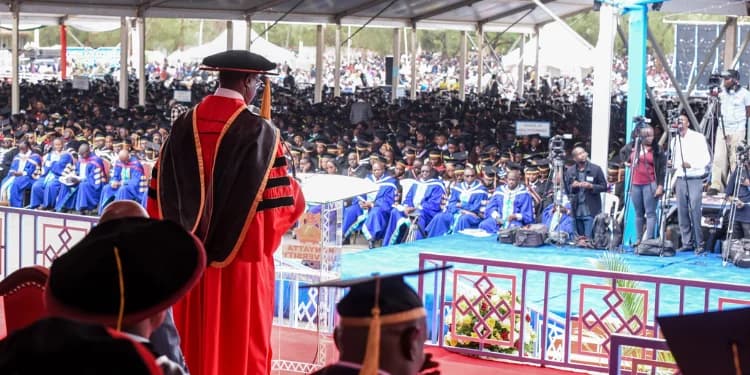
For many Kenyan parents, receiving a university admission letter is often followed by the calculation of the actual cost to educate a child through university in 2026.
Under Kenya’s current higher education funding framework, the amount a student pays depends on the university attended, the program chosen, and the level of funding awarded through the Higher Education Fund (HEF).
“The University Funds Scholarships are awarded based on a student’s level of financial need to help meet tuition costs. Eligible students are required to submit their applications through the HEF portal at www.hef.co.ke.” Universities Fund directly.
Unlike in previous years when government-sponsored students paid relatively uniform fees, the student-Centred Funding Model has changed how university education is financed.
Currently, public universities operate under a harmonized program fee structure while private universities determine their own approved fees.
The final amount payable by a student is influenced by scholarship support, HELB loans, and the household contribution determined through HEF assessment.
University Fees Budget Based on Different Courses
Parents enrolling their children in programs such as History, Sociology, Political Science, and International Relations generally attract lower tuition costs than science-based courses.
According to school fees from various institutions, parents should consider budgeting between KSh300,000 and KSh450,000 annually, including accommodation, food, transport, and learning materials.
Kenyatta University’s published fee structure places many arts-based programs within the KSh100,000 to KSh120,000 tuition range, excluding statutory charges and living expenses.
Students pursuing Education, Journalism, Public Relations and Communication-related programs typically require a budget of KSh300,000 to KSh460,000 per year.
On the other hand, courses such as Bachelor of Commerce, Economics and Accounting remain among the most popular programs in the country.
Jomo Kenyatta University of Agriculture and Technology (JKUAT), a Bachelor of Commerce and related business programs cost approximately KSh155,340 in annual tuition before additional charges.
A Bachelor of Science in Computer Science costs approximately KSh360,000 annually at the University of Nairobi.
At the same time, Open University of Kenya lists its Bachelor of Computer Science program at KSh79,000 per academic year under its published 2025/2026 fee structure.
Engineering and Law Courses
Engineering programs attract higher fees due to laboratory sessions, workshops, and specialized equipment requirements.
A student in the program requires an annual budget that falls between KSh400,000 and KSh650,000.
However, some programs may require additional expenditure for attachments and professional certification.
Legal education remains one of the more expensive programs. Kabarak University’s published fee structure lists Bachelor of Laws at approximately KSh161,850 per semester, and more than KSh320,000 annually before accommodation and other living expenses.
Nursing, Medicine and Health Sciences
Health-related programs involve practical training, clinical placements and specialized materials.
For Nursing, Clinical Medicine and related disciplines, parents should prepare for annual costs of approximately KSh420,000 to KSh650,000.
Among the most expensive programs in Kenya, Medicine and Pharmacy often require laboratory work, professional registration and clinical training over several years.
Families should expect to budget between KSh550,000 and KSh900,000 or more annually, depending on the institution and living arrangements.
Students may receive a combination of Government scholarships, HELB tuition loans, upkeep loans, and household contribution requirements.
How HELB and Scholarships Work
Under the current funding model, students may receive a combination of Government scholarships, HELB tuition loans, upkeep loans, and household contribution requirements.
Students who qualify for funding are expected to apply through the official HEF portal after receiving their admission letters.
Expenses Parents Should Consider
One of the biggest budgeting mistakes families make is focusing exclusively on tuition fees without considering accommodation and hostel fees.
In addition, parents should budget for food expenses, transport, books and stationery, printing, internet, emergency and medical expenses.
The final school fees payable will depend on the institution, the course chosen and the level of scholarship and HELB support awarded to the student.
Funding by the government delinks university placement from funding through the Means Testing Instrument (MTI) to assess the level of financial need.
Follow our and X Account for real-time news updates.


Comments
No comments yet. Be the first to share your thoughts.