
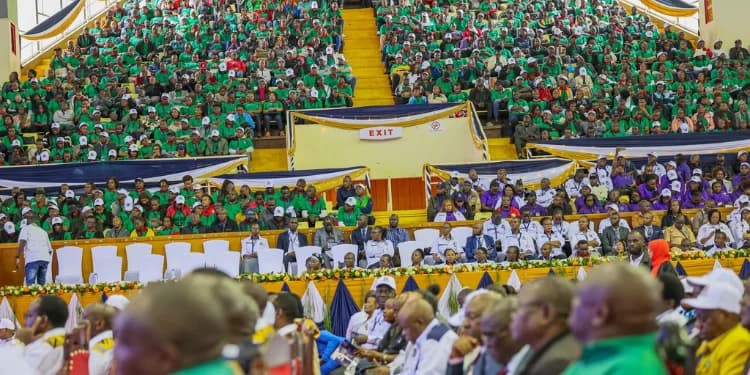
Teachers’ welfare is among the sectors that have gained support and enhancement reforms since President William Ruto assumed office in 2022.
Under Ruto’s initiative, teachers and the education sector have undergone key changes to increase the effectiveness and productivity of the sector.
The administration has introduced several initiatives the improve educators’ working conditions while strengthening the education sector.
In addition, the administration has focused on recruitment, professional development, and investment in school infrastructure.
Teacher Employment under Ruto’s Regime
One of the most visible changes has been the recruitment of teachers through the Teachers Service Commission (TSC).
The government has hired thousands of teachers to support the implementation of the Competency-Based Education (CBE) system, particularly at the Junior Secondary School level.
The recruitment exercise considered both permanent and pensionable teachers, as well as intern teachers, providing employment opportunities to graduates who had been jobless for years after completing their training.
According to the Teachers Service Commission, 76,928 teachers had been recruited, deployed, or confirmed for service in Junior Secondary Schools between 2022 and early 2025.
Of the 76,928 teachers, 39,550 were initially recruited as interns and later confirmed on permanent and pensionable terms.
An additional 20,000 intern teachers were recruited in 2025, and 9,000 teachers were hired directly on permanent and pensionable terms, while 8,378 P1 teachers were deployed to Junior Secondary Schools.
According to teacher Raphael Welimo from Matungu Sub-county in Kakamega County, internship programs have given many young teachers hope for future employment.
“When the government employs our young men and women on an internship basis to be teachers, it gives them hope. Hope that at least there is light at the end of the tunnel for their employment,” Raphael explained.
Teachers Access to Loans
For many years, teachers struggled to access loans from financial institutions despite being salaried employees.
Some banks were reluctant to lend to them, making it difficult for educators to invest in businesses, buy land, or improve their families’ economic situation, according to Raphael.
Today, however, reforms under Ruto’s regime have given teachers greater access to salary-backed loans through banks, SACCOs, and other financial institutions.
The growth of teachers’ SACCOs and improved salary structures have enabled many educators to qualify for credit facilities previously out of reach.
As a result, teachers can now more easily access loans for housing, education, farming, and business development than in the past.
Affordable Housing Opportunities
Housing remains one of the biggest challenges facing public servants, especially those working in urban areas.
To address this issue, the government announced that teachers would receive a dedicated allocation under the Affordable Housing Program, intended to enable them to own homes through affordable payment plans while recognizing their contribution to the national housing levy.
In September 2025, President William Ruto announced that 20 percent of all units under the Affordable Housing Program would be reserved for teachers during a meeting with teachers at State House.
Ruto later formalized the 20% reservation of the housing opportunity through a Memorandum of Understanding between the housing authorities and teachers’ representatives.
According to President Ruto, teachers contribute approximately 13 percent of the total monthly housing levy collections, amounting to about KSh900 million every month.
Under the arrangement, teachers are recognized as a priority group within the program and can apply for housing units through the established allocation framework.
Teachers’ Welfare and Training
The rollout of Competency-Based Education (CBE) created a need for large-scale teacher retooling to ensure educators could deliver the new curriculum effectively.
As part of this effort, the Teachers Service Commission reported that by early 2025, 229,292 teachers had been trained on Competency-Based Curriculum (CBC) and Competency-Based Assessment (CBA) since April 2019.
The training focuses on learner-centered approaches, assessment methods, technology integration, and classroom management.
The government retooled 60,642 Junior Secondary School teachers between May 2023 and November 2024 to support the implementation of the new learning system.
As part of teacher-training reforms, the government has also enhanced training at the Teacher Training Colleges (TTCs).
Kenya currently has 34 public Teacher Training Colleges spread across the country, alongside private institutions offering teacher education programs.
Recent reforms by the Ministry of Education have revised admission requirements to expand access to teacher training and increase enrolment in TTCs.
Investment in School Infrastructure
In previous years, parents often contributed through PTA arrangements to build classrooms and improve learning facilities, and most schools relied heavily on local fundraising to provide basic infrastructure.
According to Welimo, the government has increasingly taken responsibility for constructing and improving educational facilities.
In response to school infrastructure needs, the Ministry of Education has overseen the construction of new classrooms and the expansion of school facilities to accommodate learners under the new education system.
Government investments have also included the construction and equipping of laboratories, installation of smartboards to support digital learning, and solarisation of schools.
Beyond employment and infrastructure, teachers have also benefited from improved teachers’ welfare programs, including medical cover, career progression, and staff development.
President William Ruto also announced an increase in funding for teacher promotions from KSh1 billion to KSh2 billion annually.
Additionally, the government initiated a review of teachers’ medical cover following concerns over service delivery and cost-effectiveness.
Follow our WhatsApp Channel and X Account for real-time news updates.


Comments
No comments yet. Be the first to share your thoughts.