
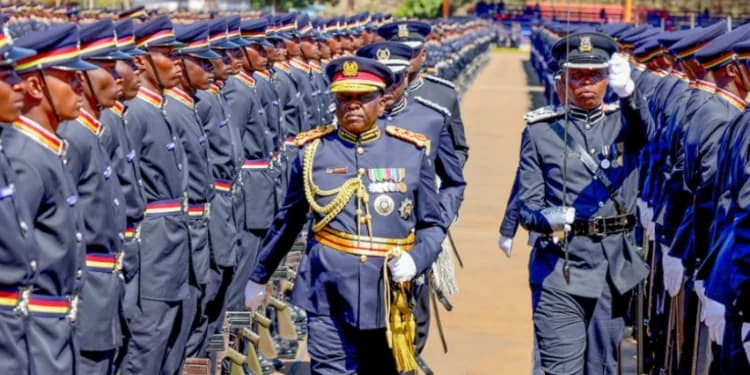
Former Chief Justice David Maraga has released the full report of the National Taskforce on Police Reforms, nearly three years after it was handed to President William Ruto on November 16, 2023.
Among its recommendations, the Maraga-led Taskforce proposed a new remuneration structure for uniformed officers in the National Police Service (NPS), with basic salaries and allowances assigned across 12 job grades.
“The Taskforce was required to review the remuneration and allowances of NPS members and to make recommendations that will enhance the Service’s professionalism, efficiency and effectiveness
The remuneration and allowances payable to NPS officers have been a key issue of public debate and focus in past reforms. There is a perception that low salaries and deplorable living and working conditions of NPS officers are directly linked to the endemic corruption and bribery that afflicts the Service,” read part of the report.
Maraga Report Recommended New Salary Grades for Police Officers
Under the proposed structure, police officers would earn a basic monthly salary ranging from KSh29,296 to KSh345,850, depending on their job grade.
The highest grade, PG12, would have a basic salary of between KSh204,637 and KSh345,850. Officers in the grade would also receive a monthly house allowance of KSh70,000, a commuter allowance of KSh24,500, and a police allowance of KSh18,000.
At the lowest level, PG1, the proposed basic salary would range from KSh29,296 to KSh57,700. Officers would receive KSh14,500 in house allowance, KSh3,250 in commuter allowance, and KSh9,000 in police allowance.
The proposed structure places officers in PG11 at a basic salary of between KSh163,535 and KSh262,020, with KSh60,000 house allowance, KSh20,500 commuter allowance and KSh15,000 police allowance.
For PG10, the proposed basic salary would range from KSh112,617 to KSh181,531, plus a KSh50,000 house allowance, KSh16,500 commuter allowance, and KSh15,000 police allowance.
Officers in PG9 would earn between KSh111,906 and KSh148,538, with a KSh45,000 house allowance, a KSh14,500 commuter allowance, and a KSh15,000 police allowance.
The proposed salary for PG8 ranges from KSh101,711 to KSh138,115, with a KSh45,000 house allowance, a KSh12,500 commuter allowance, and a KSh13,000 police allowance.
For PG7, the proposed basic salary ranges from KSh65,103 to KSh100,503. Officers would receive a KSh35,000 house allowance, a KSh8,500 commuter allowance, and a KSh11,000 police allowance.
The proposed PG6 salary ranges from KSh59,742 to KSh82,880, with KSh28,500 house allowance, KSh8,500 commuter allowance and KSh11,000 police allowance.
Officers in PG5 would earn between KSh53,246 and KSh74,887, plus a KSh24,100 house allowance, KSh5,250 commuter allowance, and KSh11,000 police allowance.
At PG4, the basic salary would range from KSh51,546 to KSh71,964, with a KSh22,100 house allowance, KSh4,250 commuter allowance, and KSh9,000 police allowance.
The proposed PG3 salary ranges from KSh48,114 to KSh67,018, with a KSh15,700 house allowance, a KSh4,250 commuter allowance, and a KSh9,000 police allowance.
For PG2, the proposed basic salary would range from KSh36,040 to KSh61,588, with a KSh15,050 house allowance, KSh4,250 commuter allowance, and KSh9,000 police allowance.
Why the Taskforce Proposed the New Structure
The Taskforce found that the existing remuneration system did not adequately reflect the nature of police work.
It established that the National Police Service had never developed and approved its own job descriptions or a job description manual, despite these documents being important in determining the relative value of jobs.
As a result, the Salaries and Remuneration Commission’s job evaluation did not fully capture critical aspects of police duties.
The Maraga Taskforce found that a police constable had effectively been placed at the same level as a clerical officer under the public service job structure.
It also noted that the evaluation failed to adequately consider the risks faced by police officers, the specialized skills required, responsibility for handling dangerous weapons and equipment, the intensity of duties, and the need for quick decision-making.
The proposed structure was therefore intended to better reflect the unique responsibilities and working conditions of uniformed police officers.
“NPS officers are exposed to the threat of real or perceived violence in a physically unsafe or uncomfortable environment, and the danger of death or injury in the course of their duties is greater than that which most people in public service are exposed,” read part of the report.
Other Police Reforms Proposed
The Maraga Taskforce also recommended reforms to police recruitment and human resource management.
It found that corruption, cronyism, nepotism, and political influence had affected recruitment, undermining merit-based selection through political interference and connections.
The Taskforce recommended stricter adherence to existing recruitment laws and procedures, including transparent vetting, interviews, document verification and publication of results.
It further recommended that the National Police Service Commission and the Inspector General develop policies to improve coordination between personnel and human resource management directorates.
Officers handling HR functions should also be certified human resource professionals, while HR services should be decentralized to county and sub-county levels.
On transfers and deployments, the Taskforce called for greater transparency after receiving complaints of favoritism, corruption and misuse of deployments.
It recommended stronger enforcement of transfer regulations and clearer procedures to prevent transfers from being used as punishment or rewards.
The Maraga Taskforce also called for officers with specialized skills to be deployed to areas where their expertise is needed and for transparent deployment procedures during elections and periods of unrest.
Follow our WhatsApp Channel and X Account for real-time news updates.



Comments
No comments yet. Be the first to share your thoughts.