

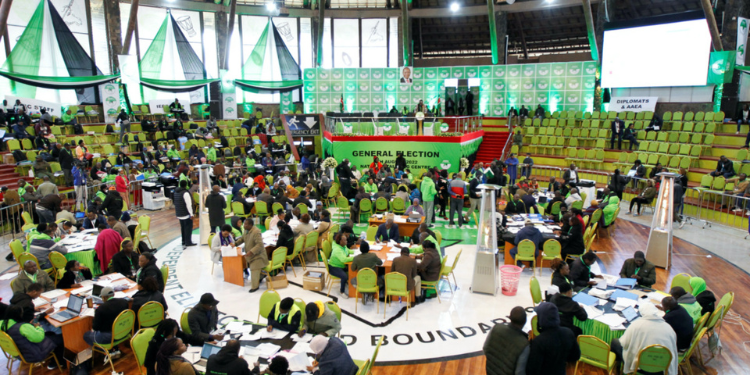
Independent Electoral and Boundaries Commission (IEBC) Commissioner Ann Nderitu has clarified the academic requirements for candidates during the 2027 general election.
Speaking on Citizen TV’s Sunday Live on August 23, Nderitu explained that aspirants vying for office in the 2027 election would have changes in educational qualification requirements.
In explaining the changes, Nderitu emphasized that the issue dates back to legal challenges filed before the 2022 General Election against degree requirements for the presidency, Parliament and governorship.
According to Ann, the courts found the provisions of the Elections Act unconstitutional, ruling that candidates vying for the presidency, MCA, MP, and Governor will not need degree qualifications.
Nderitu said the court considered 2019 Census data showing only 3.5% of Kenyans held university degrees.
Following the census, Ann argued that requiring degrees could therefore exclude 96.5% of citizens from contesting elective positions, raising discrimination concerns under Article 27.
The court also found that Section 22 had not undergone adequate public participation under Article 10.
“The Election Act, Section 22, was being passed. That means it never met the Article 10 threshold for public participation. Therefore, as of today, there is no degree requirement for anyone. That is the situation we are in,” Ann noted.
What the law previously required
The university-degree requirement was contained in Section 22 of the Elections Act, requiring candidates for Parliament and the County Assembly to hold degrees from universities recognized in Kenya.
Section 22(2) separately required candidates for President, Deputy President, Governor, and Deputy Governor to hold university degrees.
The provision became the legal basis for requiring academic qualifications during the nomination and clearance of candidates.
However, courts ruled that the degree requirements could not continue to operate in their existing form.
Despite the change in the degree requirements, IEBC directs that Candidates must still comply with applicable constitutional and statutory requirements, including those relating to citizenship, voter registration, nomination, and eligibility conditions.
The 2022 court ruling
A major change came in Wambui & 10 Others v Speaker of the National Assembly & 6 Others case, decided by the High Court on April 13, 2022, which made a university degree a prerequisite for nomination as a Member of Parliament.
The High Court declared the provision violated Article 10 on public participation, Article 24, Article 27, Article 38(3) on political rights, and Article 56 on minorities and marginalized groups.
During the case, the petitioners argued that making a degree mandatory could exclude a large section of Kenyans from seeking elective office.
Additionally, the court also examined whether Parliament had adequately involved the public before introducing the requirement.
Presidency Qualification Requirements for Election
The court’s decision on MPs affected the presidency requirement as the Constitution links presidential eligibility to parliamentary eligibility.
Article 137(1)(b) provides that a person qualifies to run for President if the person is qualified to stand for election as a Member of Parliament.
Following the 2022 ruling, the High Court noted that the removal of the university-degree requirement for MP restricted the imposition of a different academic threshold on presidential candidates.
The court further held that the declaration would take effect at the next General Election, making the decision relevant to the 2027 electoral cycle.
Additionally, under Article 180(2) of the Constitution, a person is eligible for election as governor if that person is eligible for election as a Member of County Assembly, connecting the position of governors to MCAs’ elective office.
What the Constitution Says
The Constitution does not prescribe a university degree as a requirement but allows Parliament to prescribe educational requirements through legislation.
For Parliament, Article 99(1)(b) requires a candidate to satisfy educational, moral, and ethical requirements prescribed by the Constitution or an Act of Parliament.
At the same time, Article 193(1)(b) guides the requirements for MCAs.
According to Ann Nderitu, the law can enforce the degree requirement if a petition is submitted to the court or public participation is initiated to allow the requirement to the recognized.
“Unless now, maybe somebody will go to court, or we then start the process of public participation and allow the degree process now to come through the proper public participation,” Ann Nderitu explained.
Follow our WhatsApp Channel and X Account for real-time news updates.


Comments
No comments yet. Be the first to share your thoughts.