
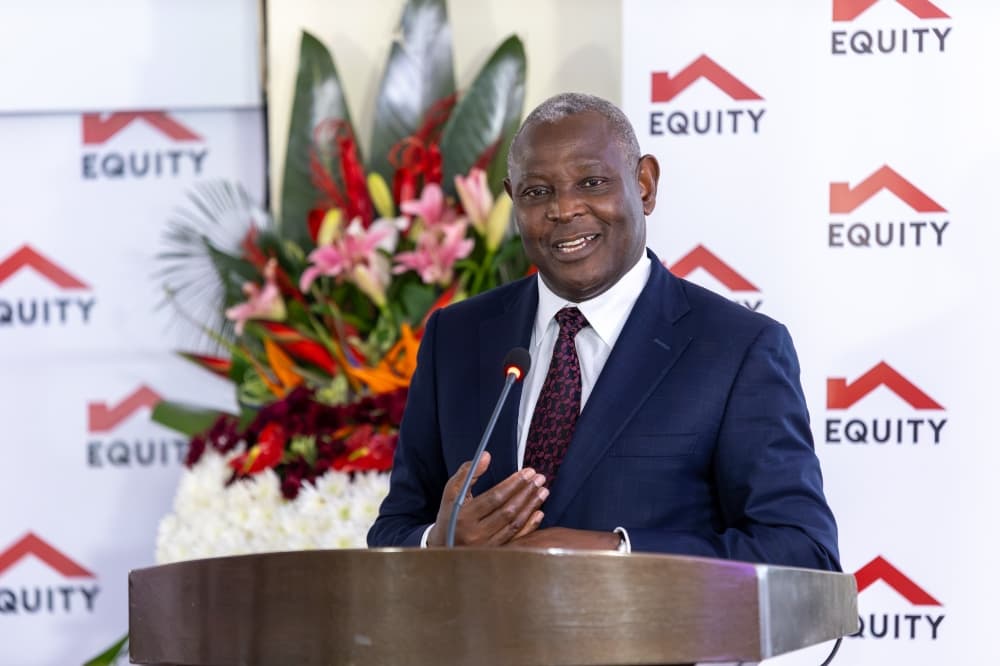
Dr. James Mwangi, Group Managing Director and CEO of Equity Group Holdings, has been appointed to the South-North Commission on Development, an independent body established by the German government to rethink international cooperation between the Global South and North.
The Commission’s 20 members were presented in Berlin on October 5 by its Co-Chairs, former German Chancellor Olaf Scholz and former Costa Rican President Laura Chinchilla.
Dr Mwangi is one of only two business leaders appointed to the Commission and the only representative from Africa.
Dr James Mwangi joins prominent global leaders
The South-North Commission brings together senior figures from international institutions, government, business, academia, development and civil society.
Its members include World Bank President Ajay Banga, World Trade Organization Director-General Dr Ngozi Okonjo-Iweala, UN Development Programme Administrator Alexander De Croo and Nobel Peace Prize laureate Dr Denis Mukwege.
The Commission also includes former senior government officials from South Africa, Senegal, Indonesia, Spain, Brazil, Uruguay and Germany, with a majority of its members coming from the Global South.
Equity’s Dr James Mwangi Receives the UNHCR Visionary Award
Commenting on his appointment, Dr Mwangi said the Commission has an opportunity to move beyond traditional approaches to development cooperation and establish more effective partnerships.
“Willy Brandt’s Commission gave the world the language of interdependence. Fifty years on, our task is to turn that language into partnerships that work.”
He added that Africa should increasingly be viewed as a source of growth, talent, innovation and investment rather than primarily through the lens of aid.
Dr Mwangi said he would bring to the Commission Equity’s experience in mobilising domestic and international capital, supporting entrepreneurs and small businesses, and using financial and economic inclusion to create jobs and shared prosperity.
Commission builds on Willy Brandt’s legacy
The South-North Commission builds on the legacy of the North-South Commission, chaired by former German Chancellor Willy Brandt from 1977.
The original Brandt Commission played an influential role in shaping discussions around economic interdependence and cooperation between developed and developing countries.
The new Commission is scheduled to hold its first meeting in Bangkok on October 16 and 17, 2026, alongside the IMF and World Bank Annual Meetings.
It is expected to present interim findings in 2027, marking 50 years since the establishment of the Brandt Commission, before publishing its final report at the end of 2028.
Its recommendations are expected to contribute to discussions on the global development agenda following the UN’s 2030 Sustainable Development Goals.
Dr Mwangi brings financial inclusion experience
Dr Mwangi joins the Commission with more than three decades of experience in banking, financial inclusion and private-sector development.
Equity Group serves 23.3 million customers across Kenya, Uganda, Tanzania, Rwanda, the Democratic Republic of Congo and South Sudan. The Group says 98% of its transactions now take place outside its physical branches.
His appointment also brings an African private-sector perspective to discussions about how domestic capital, private investment and financial institutions can contribute to development.
Dr Mwangi will serve on the Commission in his personal capacity.
Dr James Mwangi awarded Lifetime Achievement at the All-Africa Business Leaders Award
Equity advances Africa-focused development initiatives
Alongside Dr. Mwangi’s participation in the Commission, Equity Group is continuing several initiatives focused on economic development across Africa.
Africa Recovery and Resilience Plan
Equity’s Africa Recovery and Resilience Plan (ARRP) is a USD 6 billion initiative targeting 100 million customers and five million borrowing businesses by 2030.
The programme is designed to strengthen East African value chains and connect businesses to regional and international markets. Partners supporting the plan include the International Finance Corporation (IFC), British International Investment (BII) and FMO.
Private-sector financing for development
Equity also presented a proposal at the 2025 UN Financing for Development Conference in Seville, calling for a new approach to development financing with a greater role for private capital.
The proposed model seeks to use public funds to reduce investment risks and attract domestic savings and private capital through local financial institutions.
The approach comes amid increasing pressure on traditional development assistance and growing demand for alternative sources of development financing.
Accra Reset
Dr Mwangi also participated in the one-year review of the Accra Reset initiative during the United Nations General Assembly in September 2026.
Equity says it will continue supporting the Ghana-led initiative, which focuses on strengthening sovereign capacity and developing more balanced partnerships across the Global South.
From humiliation to empowerment: How Dr. James Mwangi redefined banking in Africa
Equity focuses on agriculture, climate and youth
Agriculture, climate finance, education and youth employment are also part of Equity’s development agenda.
About 30% of Equity’s lending is directed to agriculture, while the Group has set a target of allocating more than 30% of its loan book to climate-aligned sectors by 2030.
Through its Wings to Fly and Elimu programmes, Equity has supported more than 60,000 scholars.
In May 2026, Dr Mwangi and Equity launched a USD 1 billion fund aimed at supporting creative industries development across East and Central Africa.
The initiative is also linked to the objectives of Dr Mwangi’s work on the World Bank Jobs Council.
Who sits on the South-North Commission?
The Commission brings together leaders from international institutions, government, business, academia, development organisations and civil society.
International institutions: Ajay Banga, President of the World Bank; Dr Ngozi Okonjo-Iweala, Director-General of the World Trade Organisation; and Alexander De Croo, Administrator of the UN Development Programme, participating in an official and consultative capacity.
Former government leaders: Phumzile Mlambo-Ngcuka, Chancellor of the University of Johannesburg and former Deputy President of South Africa; Aminata Touré, former Prime Minister of Senegal; Sri Mulyani Indrawati, Independent Co-chair of the IDA22 replenishment and former Finance Minister of Indonesia; Arancha González Laya, Dean of the Paris School of International Affairs and former Foreign Minister of Spain; Izabella Teixeira, Co-chair of the UN International Resource Panel and former Environment Minister of Brazil; Omar Paganini Herrera, former Foreign Minister and former Minister of Industry, Energy and Mining of Uruguay; and Hermann Gröhe, President of the German Red Cross and former Health Minister of Germany.
Development, peace and civil society: Mark Green, President and CEO of ONE and former USAID Administrator; Dr Denis Mukwege, Nobel Peace Prize laureate and Co-president of the Global Survivors Fund; Dr Comfort Ero, President and CEO of the International Crisis Group; Daniel Bertossa, Secretary General of Public Services International; and Nudhara Yusuf, Co-chair of the Coalition for the UN We Need.
Academia and research: Prof. Kaushik Basu of Cornell University and Co-chair of the UN High-Level Expert Group on “Beyond GDP”; Prof. Xue Lan, Dean of Schwarzman College at Tsinghua University; and Elsy Milan, researcher at the Center for Environmental Policy at Imperial College London and COP30 negotiator for Lebanon.
Business: Altagracia Gómez Sierra, Chair of Promotora Empresarial de Occidente in Mexico, and Dr James Mwangi, Group Managing Director and CEO of Equity Group Holdings.
Africa’s private sector gains a seat in global development discussions
Dr. James Mwangi’s appointment gives Africa’s private sector representation in a commission examining the future of international development cooperation.
For Equity Group, the appointment also provides an international platform for the Group’s experience in financial inclusion, private-sector financing, entrepreneurship, agriculture, climate finance and job creation.
The Commission’s work over the next two years will provide recommendations on how countries and institutions in the Global South and North can build new forms of economic and development cooperation beyond the traditional aid model.

Comments
No comments yet. Be the first to share your thoughts.