
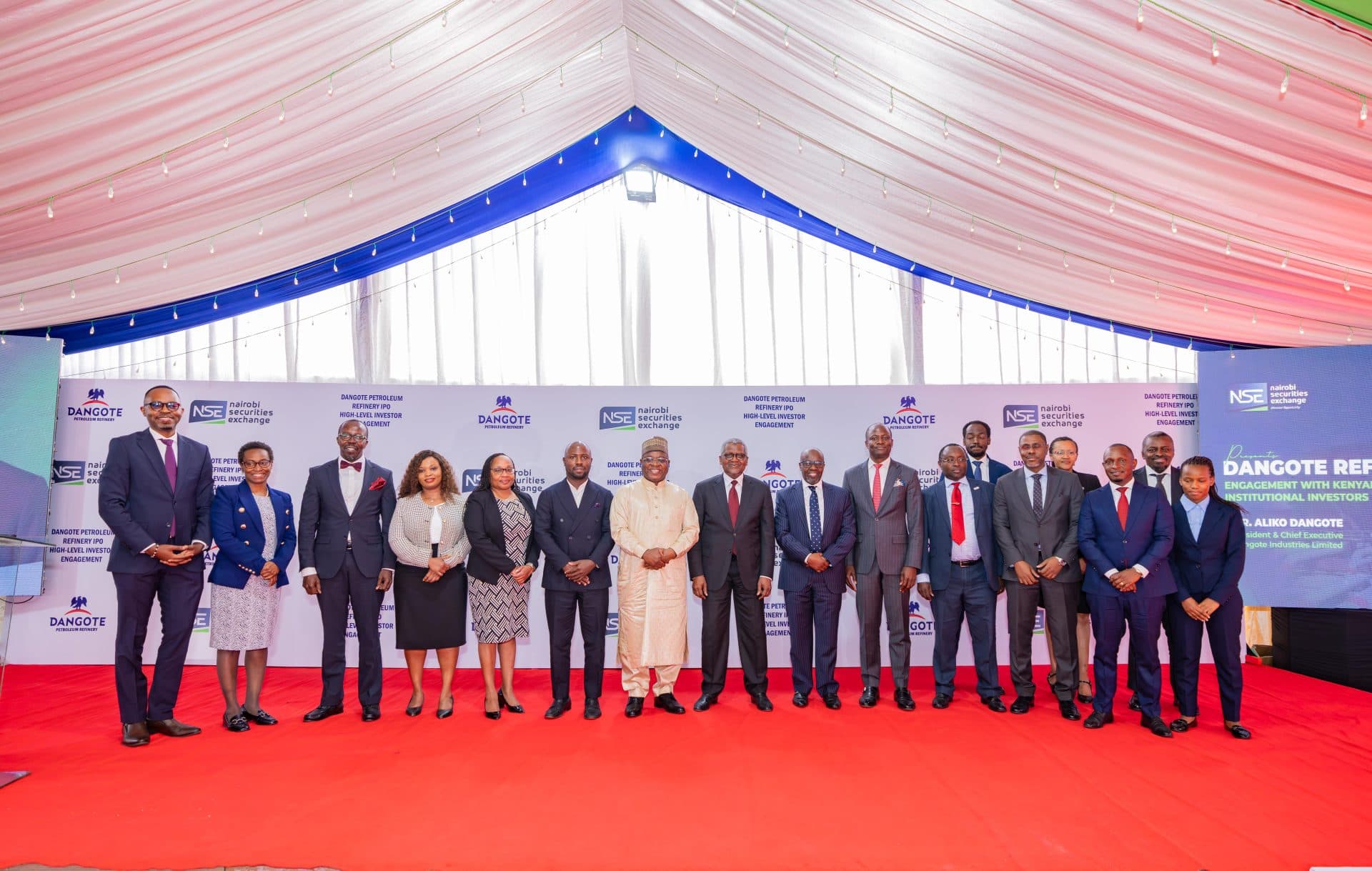
Kenyan institutional investors and capital market participants are exploring a proposed structure that would allow them to participate in the ongoing Dangote Petroleum Refinery & Petrochemicals FZE Initial Public Offering (IPO) through the Nairobi Securities Exchange (NSE).
The proposal was discussed during a high-level institutional investor engagement convened by the NSE on September 29, 2026. The forum brought together investors and capital market stakeholders to examine a proposed inward, unsponsored Global Depositary Receipt (GDR) programme for the Dangote Refinery IPO.
The session was attended by Dangote Group President and CEO Aliko Dangote and members of his executive team.
The proposed transaction is being advised by a consortium comprising Renaissance Capital Africa, G&A Advocates LLP, Stanbic Bank Kenya Limited, Image Registrars, KSTB, Phanice Global and Newmark Group Limited.
How Lamu refinery investor Aliko Dangote became Africa’s richest man
Proposed GDR structure
A Global Depositary Receipt allows investors in one market to obtain economic exposure to shares of a company listed in another market without directly trading on the foreign exchange.
Under the proposed Dangote arrangement, the underlying ordinary shares would remain in custody in Nigeria, while corresponding GDRs would be made available for trading and settlement on the NSE in Kenyan shillings.
The Nigerian Exchange (NGX) would remain the primary market for the underlying Dangote shares.
The proposed structure would therefore not amount to a direct listing of Dangote Refinery ordinary shares on the NSE. Instead, Kenyan investors would access the investment through GDRs representing the underlying Nigerian shares.
Programme could target up to US$300 million
Renaissance Capital Chairman David Kinyua said the proposed programme could target up to US$300 million in participation from Kenyan investors.
The programme remains subject to regulatory approvals, documentation, investor demand and final terms.
If approved and implemented as proposed, the transaction would be the first unsponsored inward GDR programme of its kind in Africa, according to Renaissance Capital.
NSE Chief Executive Officer Frank Mwiti said the initiative is intended to expand access to international investment opportunities through Kenya’s own capital-market infrastructure.
“Kenyan investors are already looking beyond our borders for investment opportunities,” Mwiti said, adding that the proposed structure would enable investors to access pan-African assets through the NSE, with trading and settlement in Kenyan shillings.
Dangote IPO: How Kenyans can buy shares using their mobile phones
How Kenyan investors would participate
Under the proposed arrangement, Renaissance Capital would act as lead transaction adviser, sponsoring broker and GDR issuer, subject to regulatory approval and final transaction terms.
Stanbic Bank Kenya would hold the underlying Nigerian shares in custody and support the GDR issuance.
Licensed Kenyan stockbrokers would serve as authorised selling agents. Their responsibilities would include collecting investor orders, conducting Know Your Customer (KYC) procedures and completing required investor checks.
The GDR issuer would determine final allocations according to a published methodology.
This structure would allow Kenyan investors to use local market infrastructure rather than directly opening brokerage arrangements in Nigeria.
Dangote IPO already underway in Nigeria
The proposed NSE mechanism comes as Dangote Petroleum Refinery and Petrochemicals FZE conducts its IPO on the Nigerian Exchange.
The offer comprises 4.1 billion ordinary shares at NGN525 per share, with the IPO running from September 14 to October 13, 2026. The offer is expected to raise about NGN2.15 trillion if fully subscribed.
The proceeds are intended to support the refinery’s expansion programme, while the IPO is being positioned as an opportunity for wider ownership of the business.
The official IPO information confirms that the offer is open and that the minimum subscription is 10 shares at NGN525 per share.
Nigeria’s Central Bank gives Dangote Sh. 21 billion funding for oil refinery
GDR could reduce cross-border investment barriers
For Kenyan investors, the proposed GDR structure could simplify some of the operational requirements associated with investing directly in a foreign market.
Investors would potentially be able to trade the GDRs through the NSE and settle transactions in Kenyan shillings, while the underlying Dangote shares remain held in Nigerian custody.
Renaissance Capital Managing Director Stanley Kariuki said the structure would address some of the practical challenges investors face when accessing a foreign-listed security, including differences in markets, currencies and trading arrangements.
The proposed model brings together custody, registry, brokerage, legal and market infrastructure participants to support the cross-border investment mechanism.
Legal and regulatory framework
G&A Advocates LLP is advising on the legal and regulatory aspects of the proposed transaction.
The law firm said Kenya’s capital-market framework is capable of supporting the proposed GDR structure and described the initiative as an example of increasing sophistication in African capital markets.
However, the proposed programme is not yet available for investment. Regulatory approvals, documentation and final terms must be completed before the structure can be implemented.
Dangote’s graphic designer under fire over birthday poster that looks like obituary
What investors should consider
The proposed GDR programme would create a new route for Kenyan investors to obtain exposure to a major Nigerian industrial company, but investors would still be exposed to the risks associated with the underlying Dangote shares.
These include share-price movements, company performance, market liquidity, regulatory changes and risks associated with the Nigerian market. GDRs may also involve specific costs and structural considerations that investors should understand before participating.
The Dangote IPO itself states that share prices can rise or fall and that dividends are not guaranteed. Investors are advised to review the official prospectus and risk factors before subscribing.
Kenya’s proposed GDR programme will similarly require investors to rely on the final approved documentation before making investment decisions.
A new cross-border capital-market channel
The proposed Dangote GDR programme comes at a time when African capital markets are increasingly exploring ways to facilitate cross-border investment and broaden participation in major African businesses.
For the NSE, the proposed transaction could provide a mechanism through which Kenyan investors gain exposure to a Nigerian-listed company without leaving the domestic trading environment.
For Dangote Refinery, the proposed structure could potentially broaden access to its IPO among investors elsewhere in Africa.
The immediate next steps will depend on regulatory approvals, final transaction documentation and investor demand.
Until those requirements are completed, the proposed NSE GDR programme remains an initiative under development rather than a completed investment product.

Comments
No comments yet. Be the first to share your thoughts.