
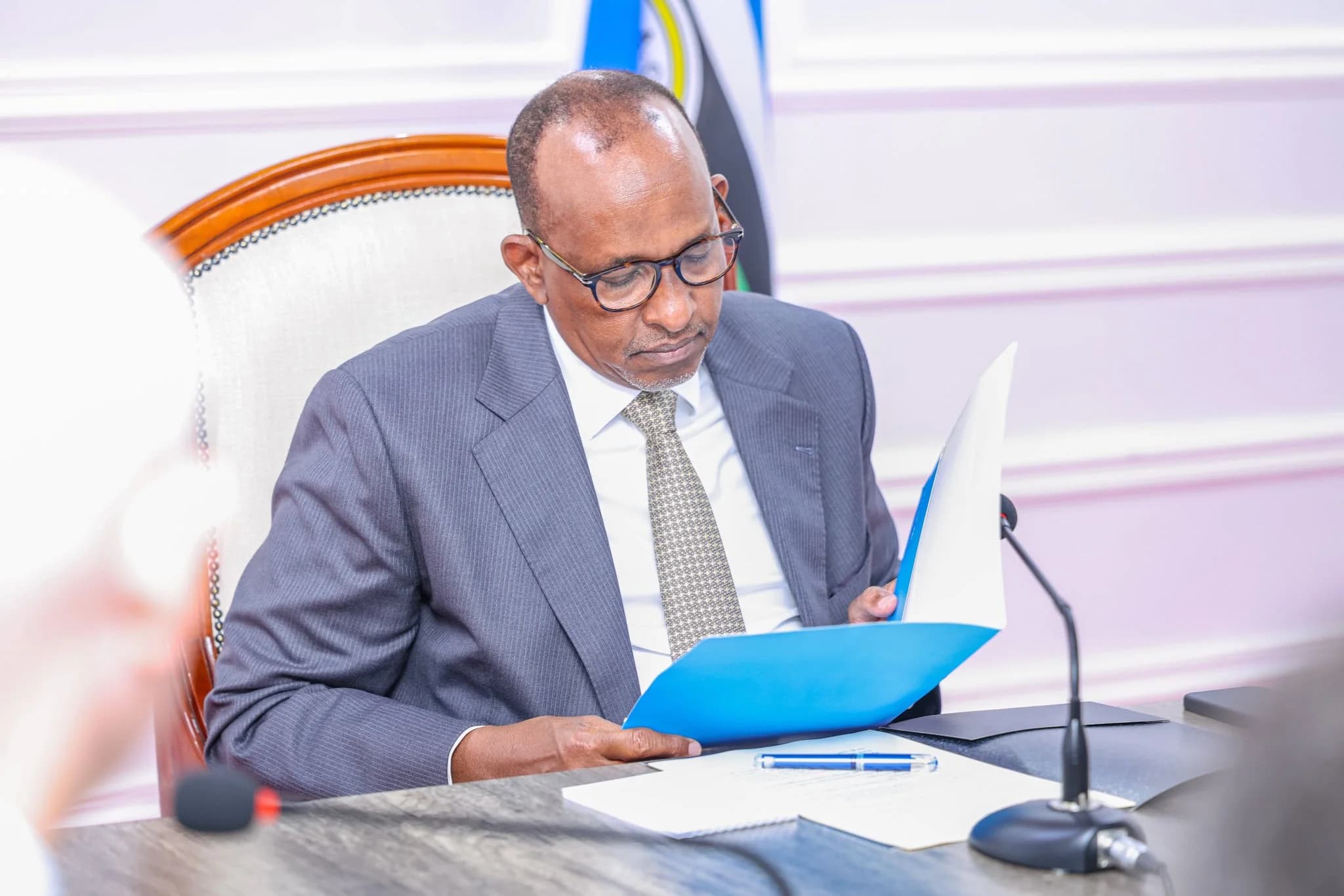
52 Ebola contacts remain under observation as 46 complete monitoring period, Duale says

Health CS Aden Duale stressed the need to sustain the gains made while ensuring that Kenyans continue to access essential health services without interruption.
A total of 52 people who had contact with confirmed Ebola patients in Kenya remain under observation, even as 46 others have completed the mandatory 21-day monitoring period and are scheduled for release, Health Cabinet Secretary (CS) Aden Duale has revealed.
Speaking on Tuesday during a high-level strategic engagement with a United Nations Children's Fund (UNICEF) delegation, Duale said no new Ebola cases had been reported since October 19, 2026, with all nine confirmed infections linked to a single chain of transmission and no evidence of community transmission.
"All nine confirmed cases are linked to a single chain of transmission, while 46 contacts have completed the mandatory 21-day monitoring period and are scheduled for release, with 52 remaining under observation," Duale said.
He emphasised that the government had strengthened surveillance and response measures across the country to prevent further spread of the Ebola (Bundibugyo) outbreak.
The CS highlighted the measures put in place, including increased surveillance across 26 designated points of entry, training of more than 4,900 healthcare workers, setting up 349 rapid response teams and designating five laboratories to conduct Ebola tests.
Duale also explained the legal provisions guiding the government's response, including the role of health officials in communicating with the public and enforcing isolation and quarantine measures.
Latest Stories
He cited Rule 24 of the Public Health (Ebola Disease) Rules, 2026, which allows medical officers of health to seek assistance from the National Police Service (NPS) when enforcing lawful orders relating to isolation and quarantine.
"Rule 24 allows our medical officers of health to seek national police service assistance in enforcing lawful orders. So, a CEO or a medical officer of health can seek the law enforcement orders through the police operation. Return of a person who lives in isolation or quarantine contrary to the order must be undertaken under lawful authority within medical supervision and appropriate measures," he said.
Duale said authorities had experienced difficulties with some people attempting to leave quarantine facilities against instructions, prompting the deployment of police officers to enforce the measures.
"So, sometimes the people in quarantine are in places that are not good, so they want to get out. We have had several incidents, so we have placed police officers there to make sure that they do not intermingle, sit together, share facilities or come out to hold group discussions. It has been very difficult. That is why we are seeking the assistance of the National Police Service in enforcing the law," he said.
He acknowledged UNICEF's support, which includes the delivery of more than 43,000 items of Personal Protective Equipment (PPE), with additional protective equipment and Water, Sanitation and Hygiene (WASH) supplies expected. The total contribution from the agency stands at $716,625.26 (Sh93,072,083.77) alongside the deployment of 25 public health personnel.
The UNICEF delegation commended Kenya's coordinated response, particularly its contact tracing, data transparency and accountability.
The discussions also focused on continued investment in community health systems, infection prevention and control, and the supply of essential materials needed to manage the outbreak.
Duale called on partners to maintain their support, provide clear timelines for implementing planned activities and conduct regular joint reviews to assess progress. He also stressed the need to sustain the gains made while ensuring that Kenyans continue to access essential health services without interruption.

Comments
No comments yet. Be the first to share your thoughts.