
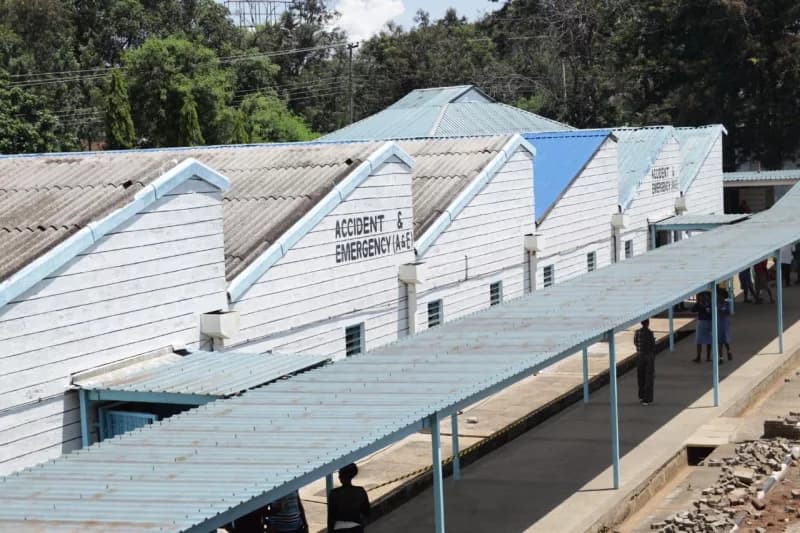
The upgrade comes as the government steps up efforts to address the health and environmental risks associated with asbestos
Asbestos roofs at Jaramogi Oginga Odinga Teaching and Referral Hospital (JOOTRH)/HANDOUT

Jaramogi Oginga Odinga Teaching and Referral Hospital (JOOTRH) has begun replacing its old asbestos roofs with modern roofing materials.
The move is in compliance with a directive by the Ministry of Environment to eliminate the hazardous construction material from buildings across the country.
Acting Chief Executive Officer Dr Joshua Okise said the ongoing works were in line with health and safety requirements aimed at protecting healthcare workers, patients and other people accessing services at the facility.
Okise said the exercise was also part of the hospital’s broader transformation following its elevation to a Level C5 parastatal, a status that marks a significant milestone in its development and its role in healthcare delivery across Nyanza and Western Kenya.
“We want our healthcare workers and staff to work in a safe environment and our clients to feel satisfied by the services that we are improving in all facets, including replacement of asbestos with more health-friendly roofing,” said Okise.
Workers removing asbestos roofs at Jaramogi Oginga Odinga Teaching and Referral Hospital (JOOTRH)/HANDOUT

In 2024, the then Environment Cabinet Secretary Aden Duale ordered the removal of asbestos roofs from buildings across the country within three months, citing the dangers posed by exposure to asbestos fibres.
Duale also directed the National Environment Management Authority (NEMA) to write to institutions requiring them to safely dispose of the hazardous material, warning of possible prosecution for non-compliance.
Asbestos exposure has been linked to serious illnesses, including asbestosis, lung cancer and mesothelioma. People working in construction face particular risks during the renovation, repair, maintenance and removal of asbestos-containing materials.
The mineral was widely used in buildings during the 1960s and 1970s, including in residential homes and industrial facilities, because its fibres are strong and resistant to heat.
NEMA first developed national guidelines on the safe management and disposal of asbestos in 2011 before revising them in 2013. The guidelines were developed in consultation with agencies including the Ministry of Health and the Directorate of Occupational Safety and Health Services.
They require those removing asbestos to secure work sites, restrict unauthorised access and wet asbestos sheets before removal to minimise the release of airborne fibres. The guidelines warn that breaking or crumbling asbestos materials can release dangerous fibres into the air.
JOOTRH’s roofing replacement is taking place alongside wider institutional changes following its elevation to Level C5 status.
Removed asbestos roofs at Jaramogi Oginga Odinga Teaching and Referral Hospital (JOOTRH)/HANDOUT

During a visit to the hospital, Principal Secretary for Medical Services Dr Ouma Oluga described the elevation as a critical step in aligning the institution with national healthcare reforms and positioning it as a centre of excellence in clinical care, research and community engagement.
“JOOTRH is no longer a county government hospital,” Oluga told the hospital’s leadership, urging them to adopt the discipline and strategic outlook expected of a national institution.
The changes are expected to support the hospital’s transition into a higher-level referral institution serving patients from across the region.


Comments
No comments yet. Be the first to share your thoughts.