
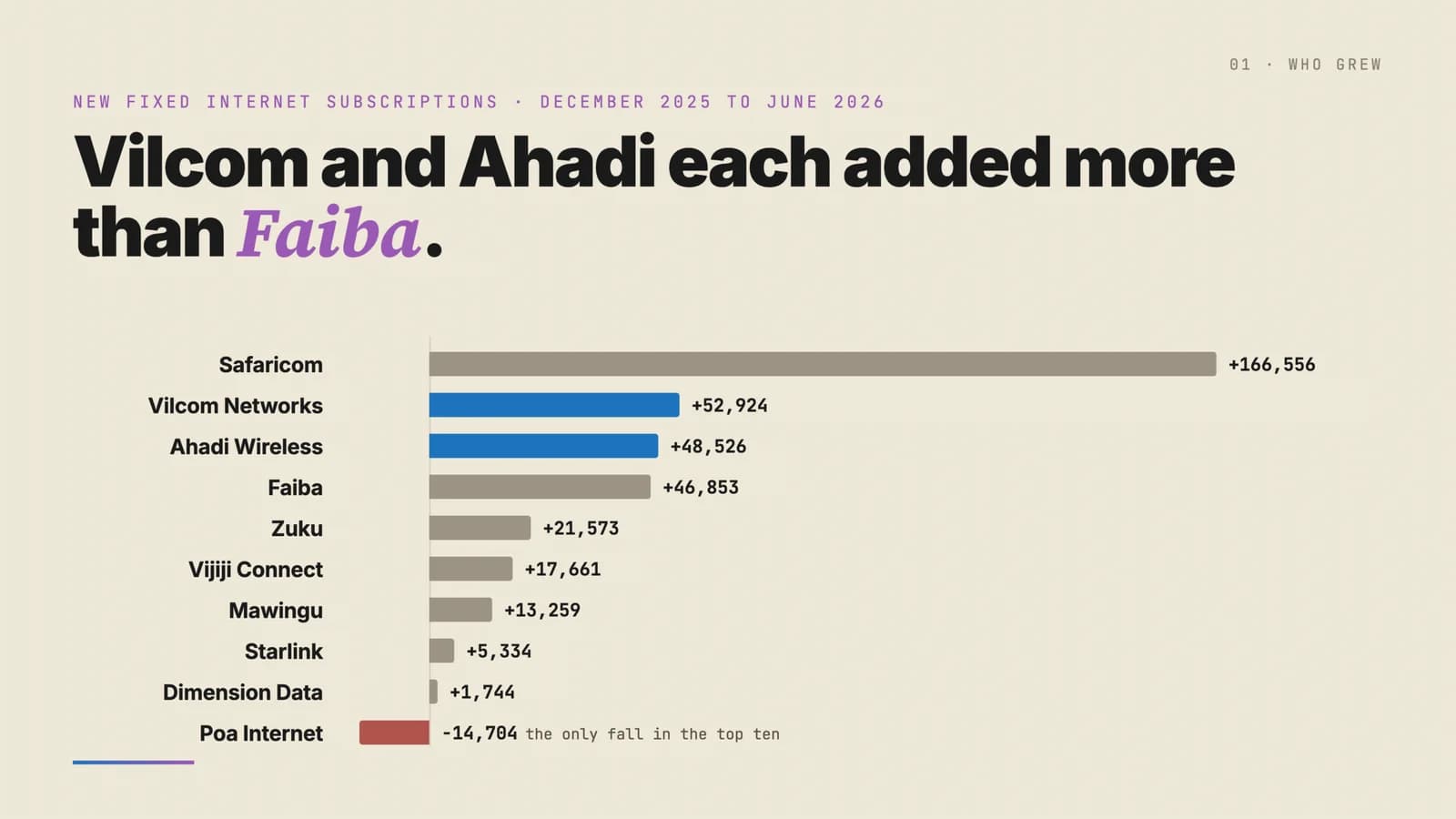
Vilcom Networks added 52,924 fixed internet subscriptions between December 2025 and June 2026. Ahadi Wireless added 48,526. Both added more than Faiba, Kenya’s second-biggest provider, which added 46,853. Poa Internet went the other way: it lost 14,704 subscriptions, the only one of the ten biggest providers to shrink.
The figures are in the Communications Authority of Kenya’s sector statistics report for April to June 2026, which went up on 18 September. Kenya had 2,838,656 fixed internet subscriptions on 30 June, 376,675 more than in December. Safaricom took the biggest slice of that growth, 166,556 subscriptions, and now has more than Faiba and Zuku combined.
Fixed internet is internet delivered to one place, a home or an office, rather than to your phone. It comes in by fibre-optic cable, by a wireless link from a mast to an antenna or router at the building, by satellite, or over Zuku’s cable TV network. The Communications Authority (CA), Kenya’s telecoms regulator, counts subscriptions from returns the providers file every quarter. Mobile data on your SIM is counted separately.
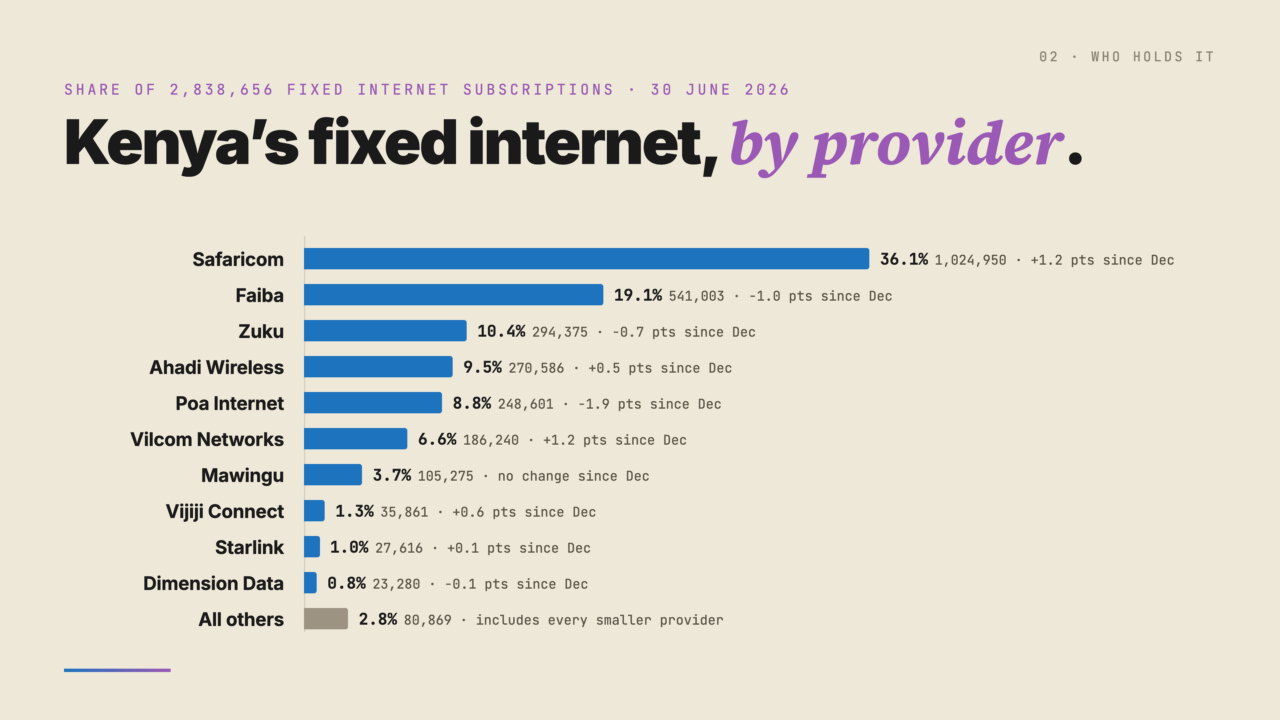
We covered the June 2025 numbers, when the market first passed two million. A year on it’s 32.4% bigger.
| Provider | December 2025 | June 2026 | Change in six months | Share |
|---|---|---|---|---|
| Safaricom | 858,394 | 1,024,950 | +166,556 (+19.4%) | 36.1% |
| Jamii Telecommunications (Faiba) | 494,150 | 541,003 | +46,853 (+9.5%) | 19.1% |
| Wananchi Group (Zuku) | 272,802 | 294,375 | +21,573 (+7.9%) | 10.4% |
| Ahadi Wireless | 222,060 | 270,586 | +48,526 (+21.9%) | 9.5% |
| Poa Internet | 263,305 | 248,601 | -14,704 (-5.6%) | 8.8% |
| Vilcom Networks | 133,316 | 186,240 | +52,924 (+39.7%) | 6.6% |
| Mawingu Networks | 92,016 | 105,275 | +13,259 (+14.4%) | 3.7% |
| Vijiji Connect | 18,200 | 35,861 | +17,661 (+97.0%) | 1.3% |
| Starlink | 22,282 | 27,616 | +5,334 (+23.9%) | 1.0% |
| Dimension Data | 21,536 | 23,280 | +1,744 (+8.1%) | 0.8% |
December figures are from the CA’s report for October to December 2025.
Vilcom is a fibre provider, and it grew 39.7% in six months, the fastest of any provider with more than 100,000 subscriptions. A year ago it had 87,654. It now has 186,240.
Ahadi sells wireless internet as Konnect in underserved Nairobi estates such as Zimmerman and Githurai 44. It grew 21.9% in the half-year and passed Poa for fourth place between April and June.
Further down, Mawingu, which sells home WiFi in rural and peri-urban areas, passed 100,000 subscriptions for the first time. Vijiji Connect almost doubled, from 18,200 to 35,861. Starlink grew 23.9% to 27,616, past the 25,000 we reported in June, and it now has 99.7% of all satellite internet subscriptions in Kenya.
Safaricom’s 166,556 new subscriptions were 44.2% of everything added in the six months, and its share rose from 34.9% to 36.1%.
Faiba grew by 46,853 to 541,003, but its share slipped from 20.1% to 19.1% because the market grew faster. It’s the faster of the two biggest on measured speed: Faiba’s average download was 62.68 Mbps against Safaricom’s 33.96 Mbps in nPerf’s tests for the year to March 2026.
Zuku grew 7.9% to 294,375. Most of that came late: 17,768 of its 21,573 new subscriptions arrived between April and June, the quarter Zuku doubled its speeds without raising prices.
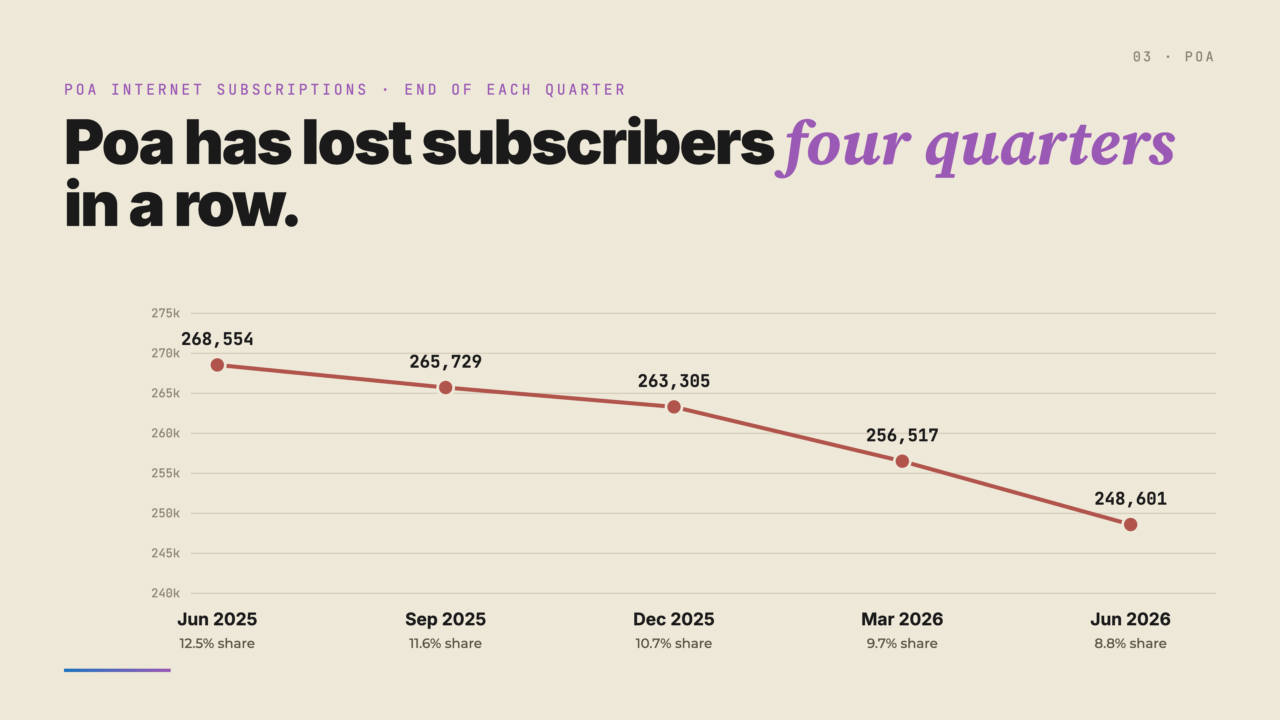
Poa had 263,305 subscriptions in December and 248,601 in June. The fall isn’t new. Poa has dropped in each of the last four quarters, from 268,554 in June 2025, and its share has gone from 12.5% to 8.8% in a year.
It’s happened while Poa has been expanding. In August 2025 it took a USD 4 million loan from Finnfund, or about KES 518 million at the 23 September rate of KES 129.45 to the dollar. The money was for reaching more homes. In March Poa was preparing to launch in Kisumu. The CA report doesn’t say why its count fell.
Fibre is still the biggest way Kenyans connect at home, with 1,566,815 subscriptions and 55.2% of the market. It grew 13.7% in the six months. Terrestrial wireless grew faster, by 20.1% to 1,030,770, and crossed one million for the first time. Between them they took 96% of the half-year’s growth: 50.1% for fibre and 45.9% for wireless.
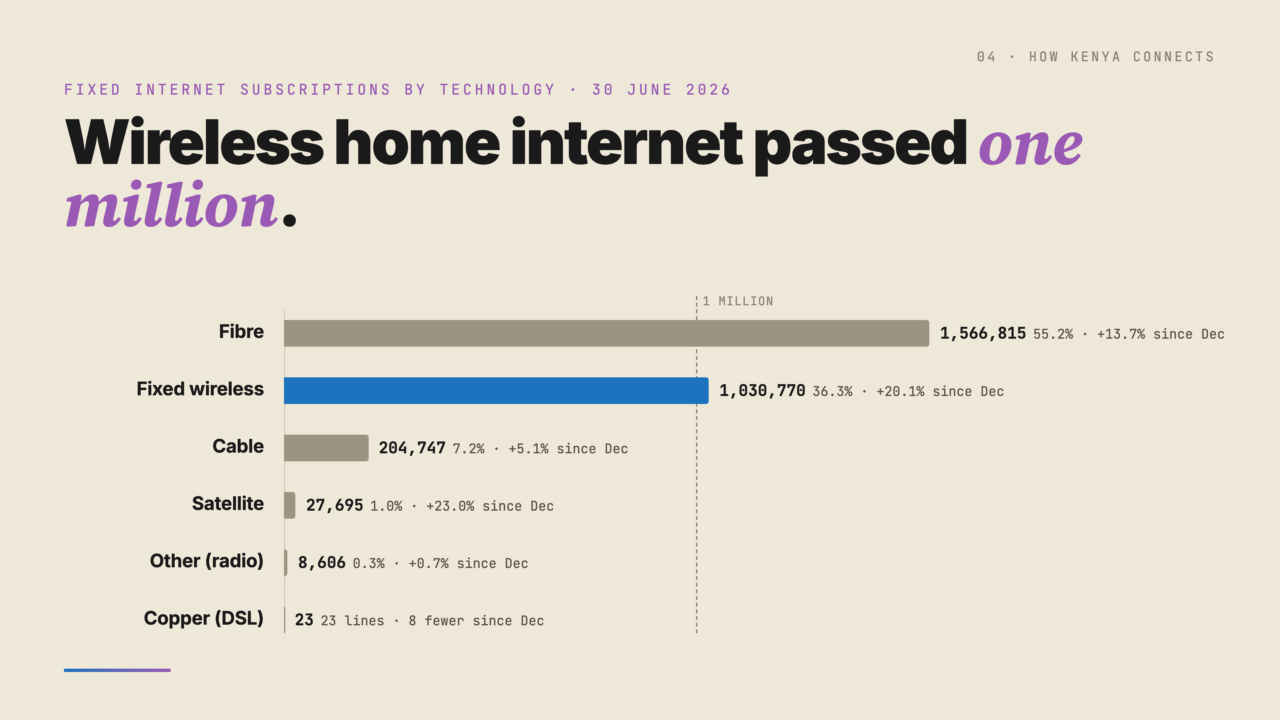
Zuku’s cable network grew 5.1% to 204,747. Satellite grew 23.0% to 27,695. The old copper phone-line broadband, DSL, is down to 23 lines in the whole country.
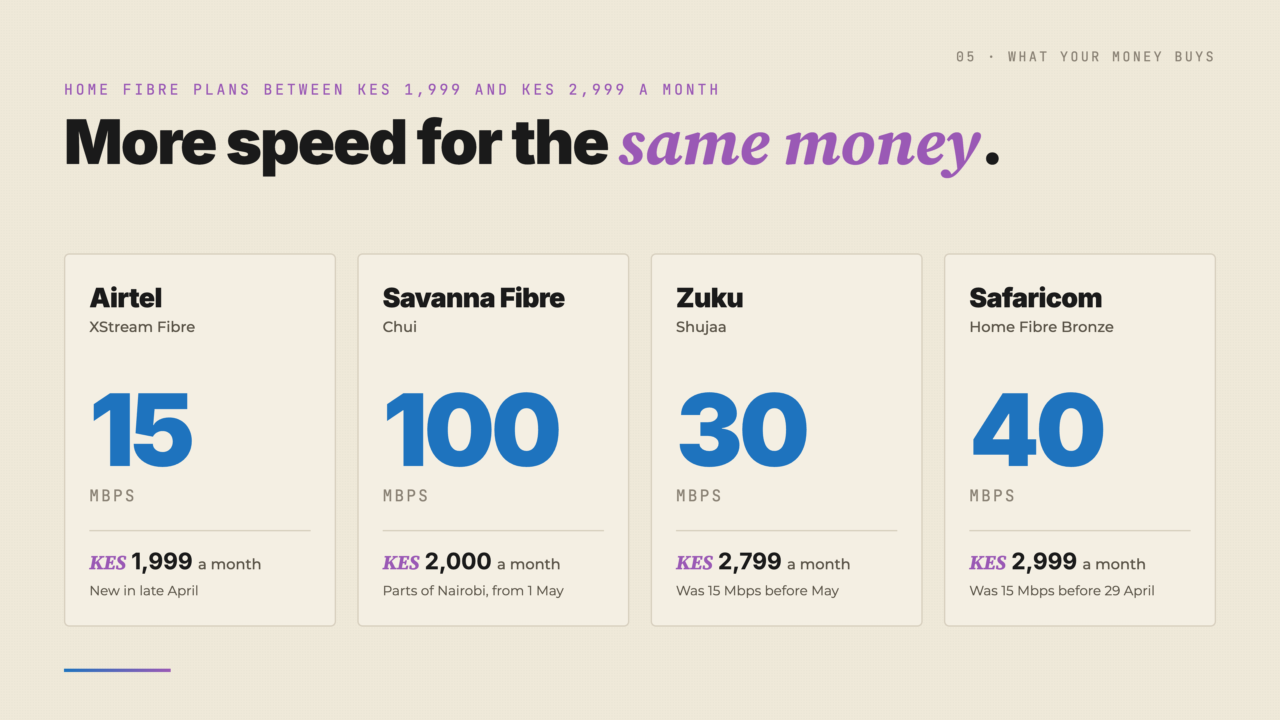
Prices and speeds moved a lot in the half-year. On 29 April Safaricom raised the speed on every Home Fibre plan, so KES 2,999 now buys 40 Mbps instead of 15. Airtel showed XStream Fibre plans the same week, starting at KES 1,999 for 15 Mbps. Savanna Fibre started selling 100 Mbps for KES 2,000 in parts of Nairobi from 1 May. Zuku doubled its speeds in May. Neither Airtel nor Savanna is in the CA’s top ten yet.
So if you’re shopping for home internet, you’re getting more speed for the same money than you were in December, from more providers.
Fixed internet providers employed 3,397 people in June 2026, down from 3,736 a year earlier, while the market added 693,943 subscriptions over the same year. The CA published this breakdown for the first time in this report.



Comments
No comments yet. Be the first to share your thoughts.