
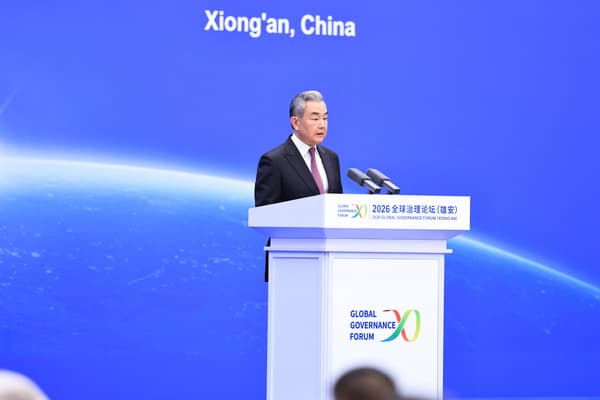
China has called for comprehensive reforms to the global governance system, advocating stronger multilateral cooperation, greater representation for developing countries and renewed commitment to the United Nations amid growing international tensions and shifting geopolitical dynamics.
President Xi Jinping and Foreign Minister Wang Yi presented this position at the 2026 Global Governance Forum in Xiong’an, Hebei Province, where Chinese leadership outlined its vision for a more equitable international order and reaffirmed Beijing’s commitment to working with other countries to address shared challenges.
In a message to the forum, Xi observed that the world was undergoing accelerated transformation on a scale unseen in a century, with deficits in peace, development, security and governance continuing to widen.
“China stands ready to work with all parties to uphold the vision of global governance featuring extensive consultation, joint contribution and shared benefits, pool strength through confidence-building and tackle challenges through cooperation,” he stated
Xi called for the implementation of China’s Global Governance Initiative (GGI), which he introduced in 2025, saying it would help inject greater certainty and positive energy into a world experiencing turbulence and transformation.
Addressing the forum, Wang said the initiative had gained international traction during its first year, with more than 160 countries and international organisations endorsing it and over 60 countries joining the Group of Friends of Global Governance.
He added that elements of the initiative had been incorporated into documents adopted by multilateral platforms, including the G20, BRICS and the Shanghai Cooperation Organisation.
Wang described the initiative as a contribution to multilateralism and an effort to address shortcomings in the existing international system. He argued that countries should strengthen cooperation rather than pursue unilateral approaches that undermine international trust.
United Nations Reform
Wang called for renewed support for the United Nations, arguing that its central role in international affairs was increasingly important amid global uncertainty.
“The more turbulent our world becomes, the more important it is to recommit to the founding mission of the U.N. Charter, hold high the torch of multilateralism, and defend the authority of the U.N,” he said adding that the world “should rally under the U.N. flag to build greater global consensus, better mobilize global resources, and coordinate global actions more actively,”
Wang said the concerns of developing countries should be addressed more effectively, adding that institutional reforms must reflect changes in the international landscape.
China also reiterated its support for expanding the representation of developing countries in the Security Council, with particular attention to Africa’s longstanding demand for greater participation in global decision-making.
Stronger Voice for the Global South
A central theme of Wang’s address was the need to increase the influence of developing countries in international institutions.
He described the rise of the Global South as a major shift in the international system since the Second World War, arguing that this development should translate into greater representation and influence in global affairs.
“The Global South must enjoy greater representation and say in international affairs. This will not only correct a historical injustice, but also provide a wealth of ideas for improving global governance,” he said
He also advocated greater participation by African countries and other developing nations in the Security Council and international decision-making processes.
According to Wang, expanding representation would help address historical inequalities while introducing a wider range of perspectives into efforts to reform global governance.
He urged countries to strengthen cooperation through platforms such as BRICS and the Shanghai Cooperation Organisation to support these reforms.
Trade, Development and International Cooperation
China further also called for stronger international economic cooperation, warning that protectionism could worsen existing global economic imbalances.
Wang argued that international trade remained an important driver of economic growth and urged countries to safeguard the multilateral trading system centred on the World Trade Organization.
He said development should remain central to the international agenda, with countries working towards the 2030 Agenda for Sustainable Development and narrowing the economic divide between developed and developing nations.
Wang also highlighted China’s economic engagement with Africa, noting Beijing’s decision to provide comprehensive zero-tariff treatment for African countries with which it maintains diplomatic relations, alongside least-developed countries enjoying diplomatic ties with China.
Commitments to Global Governance
Wang announced eight practical actions that China intends to pursue in support of its global governance agenda.
They include hosting a successful Asia-Pacific Economic Cooperation Economic Leaders’ Meeting in November, advancing UN reform and encouraging greater participation in the Group of Friends of Global Governance.
China also pledged to support the effective implementation of the Agreement on the Conservation and Sustainable Use of Marine Biological Diversity of Areas Beyond National Jurisdiction, commonly known as the BBNJ Agreement.
Other commitments include promoting reforms in global human rights governance, issuing a position paper on strengthening outer space governance and publishing a progress report on its artificial intelligence capacity-building action plan.
The eighth commitment is the establishment of a Global Governance Research Centre to examine major theoretical and practical questions, publish a Global Governance Index and produce annual reports to inform international discussions on governance reform.
On emerging technologies, Wang called for international rules that would ensure artificial intelligence benefits humanity and remains subject to appropriate human oversight.
He also urged countries to develop governance frameworks for emerging areas such as deep-sea exploration, polar regions and outer space, emphasising peaceful cooperation and shared responsibility.


Comments
No comments yet. Be the first to share your thoughts.