
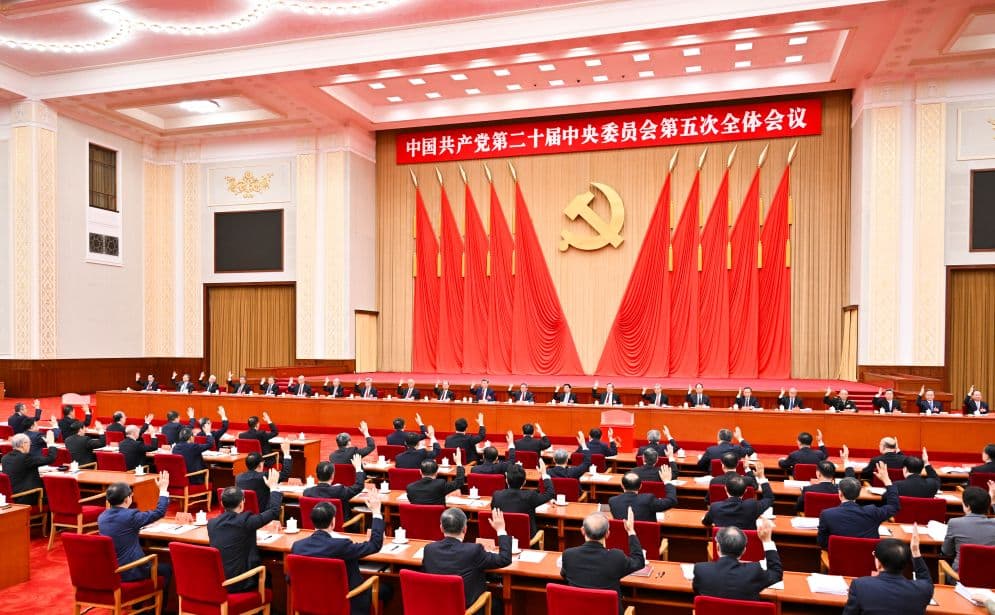
China’s ruling Communist Party has adopted a new resolution to reinforce its long-term governing position by strengthening internal governance, tightening discipline, and intensifying the fight against corruption.
The resolution was adopted this week at the fifth plenary session of the 20th Central Committee of the Communist Party of China (CPC), held in Beijing. The meeting also reviewed the work of the Party’s Political Bureau and established priorities for advancing the Party’s political, organisational, and institutional development.
President Xi Jinping, the CPC Central Committee’s general secretary, addressed the session, presenting remarks on the resolution titled: “Resolution of the Central Committee of the Communist Party of China on Certain Major Issues concerning Persevering with Full and Rigorous Party Self-Governance.”
According to the communique released after the meeting, the Central Committee affirmed the Political Bureau’s work since the previous plenary session. It highlighted progress in economic development, national security, public welfare, environmental protection, military modernisation, and Party governance.
“The 14th Five-Year Plan has been brought to a successful conclusion and the 15th Five-Year Plan period is off to a good start with new progress and results achieved in the cause of the Party and the country,” the communique stated.
Anti-Corruption Measures
A central outcome of the meeting was a commitment to sustain rigorous governance across all levels of the Party. This includes a focus on preventing misconduct, strengthening oversight, and ensuring officials adhere to established rules.
The resolution identifies several priorities, such as strengthening Party spirit, implementing democratic centralism, improving the management of officials, reinforcing organisational structures, and tightening discipline.
It also calls for stronger Party regulations and oversight systems, with responsibility for implementation extending across Party organisations and their members.
Regarding corruption, the communique emphasised a strategy designed to ensure officials do not have the audacity, opportunity, or desire to engage in corrupt practices.
“We must take systematic steps to address both symptoms and root causes of corruption and adopt a holistic approach that combines severe punishment, targeted remedy, and effective prevention, carrying this fight through to the end,” the communique asserted.
The Party also plans to strengthen supervision mechanisms across its political and administrative structures, making internal accountability a shared responsibility among Party members.
The resolution places particular emphasis on the conduct and performance of public officials, describing strict management of cadres as essential to rigorous Party self-governance.
The CPC stated its intention to develop a cadre of officials with strong political commitment, professional competence, disciplined conduct, and the capacity to implement national policies.
Measures will cover the selection, appointment, training, management, and oversight of officials, including efforts to improve the preparation and promotion of younger cadres.
The resolution also highlights democratic centralism, the Party’s stated organisational principle, calling for stronger implementation of decision-making procedures while maintaining the central leadership of the CPC Central Committee.
Party organisations at all levels are expected to strengthen their political and organisational functions to ensure that policies and decisions are implemented consistently.
The document further calls for continuous improvements in official conduct, stronger discipline, and closer alignment between Party-building initiatives and anti-corruption measures.
Economic Development
Alongside internal governance, the plenum outlined priorities for sustaining economic and social development. The communique called for progress towards the year’s economic and social development targets and a strong start to the 15th Five-Year Plan period.
It identified deeper reform and opening up, stronger domestic demand, innovation-led growth, and the effective use of macroeconomic policies among the priorities for the period ahead.
The Party also pledged to improve public services, meet essential needs, and provide support to vulnerable groups.
Other priorities include workplace safety, disaster prevention and relief, food and drug safety, and the maintenance of social stability.
The communique linked these objectives to the broader goal of ensuring security while pursuing development, signalling that economic performance and social welfare remain important elements of the Party’s governing agenda.
The Central Committee announced that the CPC’s 21st National Congress would convene in Beijing in the second half of 2027. The communique described the meeting as an important political event for both the Party and the country, calling on Party members to work towards its successful convening.
The plenum also elected Zhang Shengmin as a member of the CPC Central Committee Political Bureau and confirmed disciplinary decisions involving officials accused of serious violations of Party discipline and the law.
The communique listed multiple officials whose cases the Central Commission for Discipline Inspection and the Central Military Commission had reviewed. It confirmed previous decisions to expel several officials from the Party and remove another from his Party position.
The plenum concluded with a call for Party members to rally around the CPC Central Committee under Xi Jinping’s leadership and fully implement Xi Jinping Thought on Socialism with Chinese Characteristics for a New Era.

Comments
No comments yet. Be the first to share your thoughts.