
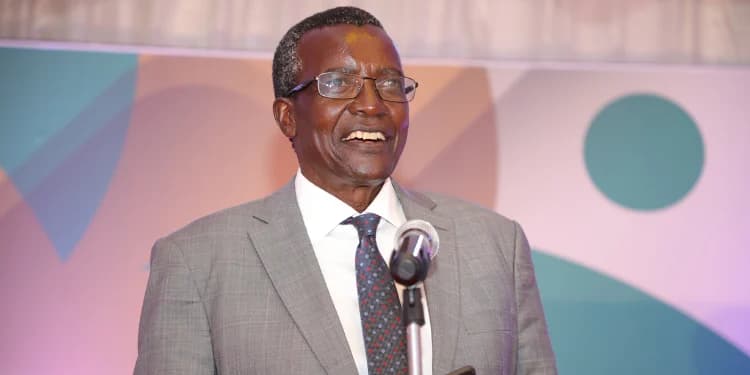
On June 18, 2025, former Chief Justice David Maraga officially declared his intention to run for president in the 2027 General Election.
In announcing his bid, he described himself as the Gen Z presidential candidate, saying that he is a father and shared the concerns of parents whose children belong to the generation seeking greater accountability and change.
“After discussion with friends and after serious reflection, I thought it was time we thought about the leadership of this country. We cannot let some people take our country to doomsday literally.
“As a result of that reflection, I have made up my mind that I will run for the presidency of this country in 2027,” Maraga announced.
But what is the story behind David Maraga?
David Maraga is a Kenyan lawyer and former Chief Justice of Kenya who served as the head of the Judiciary from 2016 to 2021.
David Maraga Early Life and Education
David Kenani Maraga was born on January 12, 1951, in Bonyamatuta, Nyamira County. Maraga began his legal career at the University of Nairobi, where he earned a Bachelor of Laws degree in 1977.
He subsequently completed his postgraduate legal training at the Kenya School of Law and was admitted to the Roll of Advocates in October 1978.
He later returned to the University of Nairobi, where he earned a Master of Laws degree in 2011.
His academic progression provided the foundation for a legal career that would eventually take him to the highest judicial office in the country.
Maraga spent more than two decades in private practice before he was appointed a judge.
According to Judiciary, Maraga is an accomplished trainer and facilitator who has facilitated in several capacity-building workshops at the Judiciary Training Institute and the Law Society of Kenya’s Continuous Legal Education (CLE) workshops
From Private Practice to the High Court
Maraga joined the Judiciary in October 2003 after then-President Mwai Kibaki appointed him as a High Court judge.
His first judicial assignments included service in Mombasa from 2003 to 2007, followed by Nakuru and Nairobi.
He also held leadership positions within the High Court, including serving as Resident Judge in Nakuru and Presiding Judge of the Family Division in Nairobi.
In January 2012, he moved to the Court of Appeal in Nairobi. He subsequently served as the Presiding Judge of the Court of Appeal in Kisumu from October 2014, a position he held before his appointment as Chief Justice.
According to the Judiciary, his legal practice covered civil and criminal litigation as well as conveyancing. He operated in Nakuru and also served as chairperson of the Rift Valley branch of the Law Society of Kenya between 1987 and 1989.
He served as Chairperson of the Tribunal appointed by the President to investigate the conduct of a Judge of the High Court.
The progression from private advocate to High Court judge and then appellate judge gave Maraga experience across different levels of the judicial system.
His elevation to Chief Justice in 2016 placed him at the head of the Judiciary and made him President of the Supreme Court.
Former President Uhuru Kenyatta confirmed his appointment on October 19, 2016, after the Judicial Service Commission and the National Assembly completed the selection and vetting process.
Maraga succeeded Willy Mutunga and became the second Chief Justice appointed under Kenya’s 2010 constitutional dispensation, which established a new framework for governance, judicial independence and the protection of fundamental rights.
Family
He is married to Yucabeth Nyaboke, with whom they have three children; Dr. Edith K. Maraga, Emma I. Maraga-Mangoa, and Moses K. Maraga.
He is also a grandfather of two. He is a staunch Seventh-day Adventist and serves as an elder and a Bible study leader in the church.
2027 Manifesto
Maraga’s campaign is anchored on five key pillars, according to the United Green Movement (UGM) party manifesto.
In education, youth, innovation and technology, he proposes skills development and job creation to harness the potential of young people.
On the economic front, his platform seeks to address public debt, economic stagnation and the misuse of public resources while promoting sustainable development.
Healthcare, equity and social justice form another pillar, with a commitment to treating access to healthcare as a constitutional right and addressing social inequalities.
Good governance is also a key focus, with the campaign pledging to uphold the rule of law, strengthen constitutionalism, fight systemic corruption and promote transparency.
At the international level, Maraga’s agenda embraces Pan-Africanism and seeks to strengthen Kenya’s regional and international cooperation.
The Historic Judgement That Brought Controversy
When Kenya’s Supreme Court nullified the August 2017 presidential election, it placed David Maraga at the centre of one of the country’s most consequential constitutional moments.
The ruling, delivered on September 1, 2017, made Kenya the first African country in which a court annulled a presidential election and ordered a fresh poll.
For Maraga, who had spent decades practicing law and serving in the Judiciary before becoming the country’s 14th Chief Justice, the decision became the defining moment of his tenure.
It also renewed attention to the courts’ role in holding political leaders and electoral institutions accountable under the Constitution.
The then late opposition leader Raila Odinga challenged the declaration of Uhuru Kenyatta as the winner, asking the Supreme Court to examine the conduct of the election and the Independent Electoral and Boundaries Commission’s (IEBC) transmission and verification of results.
On September 1, 2017, the court ruled by a four-to-two majority to nullify the presidential election and ordered a fresh poll within the constitutionally prescribed period.
The court found that the election had not been conducted in accordance with the Constitution and applicable electoral law. The decision established that the declaration of a winner was not, by itself, sufficient to settle questions about the legality of an election.
In the ruling, Maraga delivered a statement that became closely associated with his tenure: “The greatness of any nation lies in its fidelity to the constitution and adherence to the rule of law and above all respect to God.”
“An order is hereby issued directing the 1st Respondent to organize and conduct a fresh Presidential Election in strict conformity with the Constitution and the applicable election laws within 60 days of this determination under Article 140(3) of the Constitution,” read part of the judgement.
The Supreme Court’s decision triggered a fresh presidential election in that same year.
He faced criticism and backlash from Uhuru; he said, “We shall revisit this thing. We clearly have a problem. Who even elected you? We have a problem, and we must fix it,” he said angrily.
The Two-Thirds Gender Rule and the Call to Dissolve Parliament
Another major constitutional moment came in September 2020, when Maraga advised Uhuru to dissolve Parliament over its failure to enact legislation to implement the two-thirds gender principle.
The principle, provided for under Kenya’s Constitution, requires that no more than two-thirds of the members of elective or appointive bodies be of the same gender.
After years of debate and unsuccessful efforts to enact the necessary legislation, Maraga issued his advisory to the President on September 21, 2020.
The recommendation brought renewed attention to Parliament’s constitutional obligations and the question of what should happen when the institution charged with making laws fails to fulfil a constitutional requirement.
The gender rule debate also extended beyond the question of Parliament’s continued existence. At its core was the constitutional requirement for more equitable representation of women in public institutions.
Reforms and the Digitization of the Judiciary
Beyond major constitutional disputes, Maraga’s tenure coincided with efforts to improve the administration of justice and modernize court processes.
During his tenure, the Judiciary expanded the use of electronic filing and virtual court proceedings. These changes helped courts continue handling cases during the COVID-19 pandemic, when restrictions on physical meetings and movement disrupted normal operations.
The expansion of digital processes was intended to make court services more accessible, reduce dependence on physical paperwork and improve the management of cases.
Maraga’s administration also continued work on institutional mechanisms for handling election disputes.
Maraga’s work did not end with his retirement from the Judiciary in January 2021. He later returned to a national public assignment when he was appointed to chair the National Taskforce on Improvement of the Terms and Conditions of Service and Other Reforms for Members of the National Police Service, Kenya Prisons Service and National Youth Service.
The task force examined issues affecting the welfare, working conditions and institutional effectiveness of security personnel.
Its report, submitted to President William Ruto on November 16, 2023, contained recommendations on police recruitment, command structures, remuneration, accountability and the broader operation of the security services.
The proposals aimed to make appointments more competitive and transparent, strengthen institutional independence, and address corruption in recruitment and deployment.
The task force also recommended changes to remuneration, including a proposed phased salary increase framework that prioritized lower-ranking officers.
“The Taskforce was required to review the remuneration and allowances of NPS members and to make recommendations that will enhance the Service’s professionalism, efficiency and effectiveness. The remuneration and allowances payable to NPS officers have been a key issue of public debate and focus in past reforms. There is a perception that low salaries and deplorable living and working conditions of NPS officers are directly linked to the endemic corruption and bribery that afflicts the Service,” read part of the report.
Recognition for His Public Service
Maraga’s career has also attracted recognition outside the Judiciary.
In 2023, the MINTO Foundation awarded him its Lifetime Achievement Award, citing his leadership, contribution to the legal profession, and public service.
The foundation’s recognition highlighted his role in landmark Supreme Court decisions, his commitment to the rule of law, and his efforts to improve judicial administration and access to justice.
Follow our and X Account for real-time news updates and subscribe to our YouTube Channel for in-depth interviews.


Comments
No comments yet. Be the first to share your thoughts.