
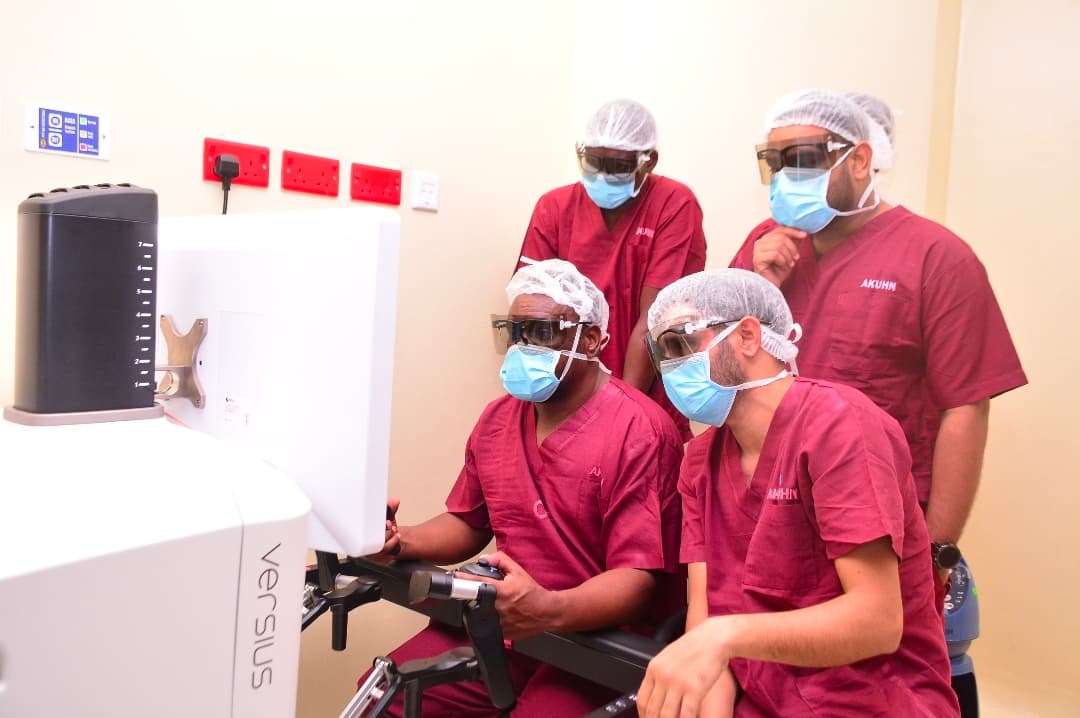
Aga Khan University Hospital, Nairobi (AKUH,N), has performed robotic-assisted surgery to remove an ovarian cyst, extending its robotic surgery programme to gynaecological care and expanding access to advanced minimally invasive treatment.
The procedure, known medically as a robotic-assisted ovarian cystectomy, was performed on a patient with a cyst measuring more than 10 centimetres.
The procedure follows the hospital’s first robotic-assisted surgery, performed in August 2026, to remove a patient’s gallbladder. Known medically as a robotic-assisted laparoscopic cholecystectomy, that operation marked the launch of the hospital’s robotic surgery programme.
“We are proud that we will extend top-of-the-range best surgery to our women right here in Kenya. This milestone advances access to high-quality, minimally invasive surgery and makes it easier to operate on even very complex cases,” said Dr Elkanah Omenge Orang’o, Associate Professor and Consultant Gynaecological Oncologist at Aga Khan University Hospital, Nairobi.
Increasing access to Cancer Surgery will improve Cancer Care and Outcomes
During robotic-assisted surgery, the surgeon controls the camera and specialised instruments from a console. The system provides a three-dimensional view of the surgical area and instruments with an enhanced range of movement, supporting precision and control during delicate procedures. Despite its name, the robot does not perform the operation independently; the surgeon remains in control throughout.
Like conventional keyhole surgery, the robotic-assisted approach uses small incisions rather than the larger incision required for open surgery. For appropriately selected patients, this can mean less postoperative pain, a shorter hospital stay and a quicker recovery.
“Because of the small cut we make, reco/very is quicker. Most patients would go home the same day or the following day,” Dr Omenge explained.
Aga Khan University Hospital has a long tradition of being the first to introduce medical advances that respond to the needs of patients in Kenya and the region.
“Extending robotic-assisted surgery to gynaecological care is another step in that journey. Our investment brings together advanced technology, skilled clinical teams and strong safety standards to give more patients access to specialised, evidence-based care closer to home,” said Rashid Khalani, Chief Executive Officer of Aga Khan University Hospital, Nairobi.



Comments
No comments yet. Be the first to share your thoughts.