
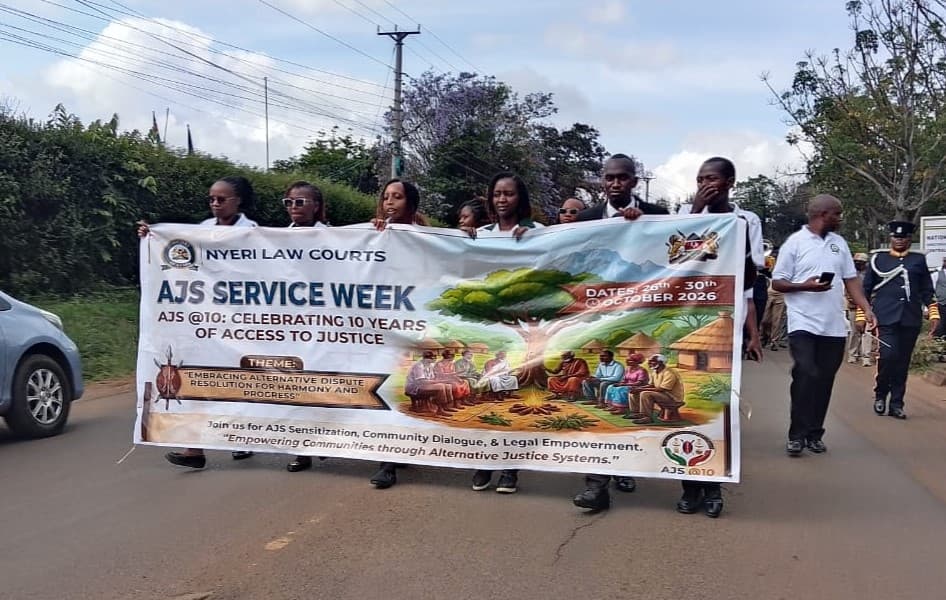
In a move aimed at reducing the backlog of cases, Nyeri residents have been urged to embrace the Alternative Justice System (AJS) as a faster means of resolving disputes outside formal court proceedings.
Nyeri Presiding Judge Maureen Odero said the system provides a faster, less expensive and accessible way of resolving disputes, adding that the system would ease pressure on courts, noting that justice should not be confined to courtrooms.
“It is not only in the courtroom that we can find justice. Let us not get in the habit of using popular phrases like ‘will meet in court’ and ‘you will see my lawyer’ because we are very few judges in courts and the work is so much for us to handle,” she said.
Justice Odero spoke when she presided over the launch of the week-long Alternative Justice System week at the Nyeri law courts on Monday.
She hailed the AJS system as a platform for strengthening the relationship between judicial institutions and the communities they serve.
And while urging communities to take ownership of the initiative, Justice Odero said it is important to embrace dialogue and mediation to resolve disagreements before resorting to litigation.
“If matters are handled in the Alternative Justice System, it will assist us in the Judiciary and the members of the community because they come up with their own solutions, and therefore they are more likely to follow those rulings,” she noted.
Justice Odero further said the Judiciary was committed to working with elders, community representatives, county leaders, religious institutions and other stakeholders to make the system credible and accessible to all.
The Alternative Justice Systems (AJS) policy was first drafted in May 2016 by the Taskforce on Informal Justice Systems gazetted by the retired Chief Justice Dr Willy Mutunga. The task force had been mandated to develop a policy to mainstream traditional, informal justice systems and other informal mechanisms into the formal justice system.
The AJS system aims at enhancing access to justice and supporting expeditious delivery of justice to citizens. It also aims to provide alternative forms of dispute resolution mechanisms, including traditional approaches, as long as they do not contravene the Bill of Rights, are not repugnant to justice or morality or inconsistent with the Constitution or any written law.
The county solicitor Rosemary Wanjiru commended the judiciary for the initiative. In her remarks, she said the system will promote social justice through arbitration and reconciliation.
Wanjiru also said AJS was not merely about resolving disputes outside court but also about rebuilding relationships and strengthening communities.
“We recognise that AJS is not only about resolving disputes away from the courts and litigation, which is lengthy and expensive, but also as a way of fostering good relationships and strengthening communities while living together.
As a county, we promise to work together with the judiciary to give services to our people in promoting access to justice and have a harmonious community,” she said.
On her part, the Secretary of the Law Society of Kenya, Nyeri chapter, Nanjala Simiyu, called for sensitisation of members of the public about the system.
She noted that one of the factors affecting the uptake of the system is the lack of knowledge of the cases that can be adjudicated through AJS.
“There is a need for the public to be informed on which disputes to solve using AJS and which not to solve using it. Many people still do not know that this system is faster and reliable since after the conflicting parties come to an agreement, they just come for the filing of closure of their case in court,” she noted.
Her remarks were echoed by the Nyeri County Director of Children Services, Joseph Mburu, who noted that public education was essential to ensure residents understood the appropriate circumstances for using the system.
Mburu emphasised that children should not be expected to consent to harmful arrangements or practices that violated their rights.
He also warned against using the system to handle serious offences involving children, including defilement, serious physical abuse and child trafficking.
By Silvia Mwangi and George Kabithi

Comments
No comments yet. Be the first to share your thoughts.