

Ethiopia, Rwanda, Tanzania, and Uganda are all at various stages of developing their own nuclear power projects.Yet Kenyan Malthusians claim that a 2000 MWe nuclear plant in Sakwa will, upon completion, transform the shores of Lake Victoria into something resembling a crime scene or a ghost town.
So let us do what they don’t want anyone to do, i.e., look at the surroundings of a real nuclear plant that is next to a nuclear plant on a real coastline, which has operated for 50 years, and see what has actually happened to the fish, the UNESCO Heritage site, tourism, and everything.
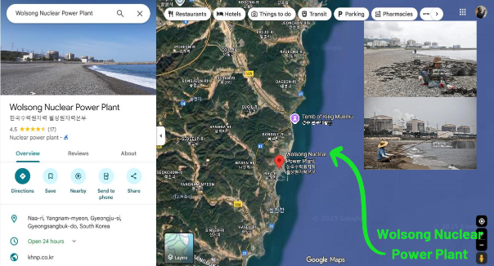
Wolsong on Google Maps
Above is a Google Maps screenshot of the Wolsong Nuclear Power Plant in Gyeongju, South Korea.
Its link is below: https://maps.app.goo.gl/GtC7nDXeM6D4E7MV6
Wolsong has four operating reactors on the Sea of Japan coast, the last of which has been running since 1983.
Alongside the plant, I have included two Getty/Bloomberg-credited photographs of a man and a woman fishing directly on the plant’s shoreline, with the reactor domes clearly visible in the background.
Contrary to everything said about the impact on the population, ordinary people in Wolsong use the coastline adjacent to this operating nuclear power station for the same purpose as they have throughout the ages.
Google’s public review base treats the plant as an unremarkable, well-rated local landmark.
The gentleman in the Getty photograph, fishing rod in hand, reactor dome forty meters behind him, appears not to have received the memos published by anti-nuclear zealots about what proximity to a nuclear plant does to fish.
The Malthusian assumption behind such nonsense about radioactive fish is that any industrial installation near water automatically sterilizes it.
However, this claim was disproven by the completion of the Sondu Miriu project and every single hydroelectric reservoir that also hosts a fishery.
Every port city with a working harbor has a fish market, and the geothermal fields in Kenya’s own Rift Valley, which vent tonnes of sulfur dioxide into the atmosphere, coexist with pastoralism a few hundred meters away.
Besides, modern reactor designs discharge cooling water within limits, releasing no meaningful radioactivity into their surroundings.
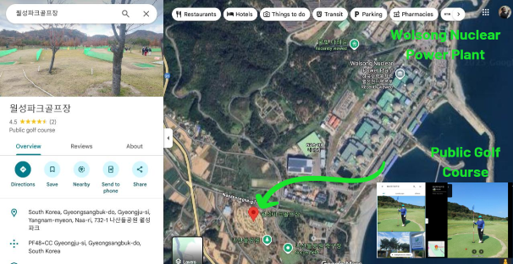
Golf Course next to a Nuclear Plant
Right next to the nuclear plant is Wolsong Park Golf Course, a public par-3 course similar to Migaa Golf Estate in Kiambu.
https://maps.app.goo.gl/BTY2TyNyHtz4wgW98
According to the Google Maps link I provided above, the course is only roughly 700 meters from the closest reactors at Wolsong.
This golf park is open to the public, with visitors giving it 4.5 stars.
To verify, I found visitor photos of ordinary recreational play.
Contrary to everything the anti-nuclear alliance has peddled, land immediately adjacent to a nuclear station can be used, without apparent controversy, for a leisure amenity requiring no protective equipment.
There are no kids with 7 eyes in Wolsong—no fish with no head and tails, and definitely no one-eyed cyclops.
Public Beach next to the Nuclear Reactors
Naa Beach, attached above, is a public pebble beach with the reactor domes visible along the shoreline, but it has 4.2 stars from 75 reviews.
It has no radiological warning of any kind. Instead, it is a public recreational beach that operates, unremarked upon, in close visual and physical proximity to an active nuclear plant that has operated for 50 years.
https://maps.app.goo.gl/YVHxdcqi6SzWh8qi9
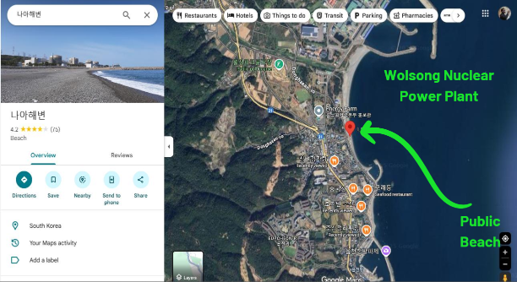
The beach hosts some restaurants. Here they are: https://maps.app.goo.gl/SCpGqxDNfctHySLX6.
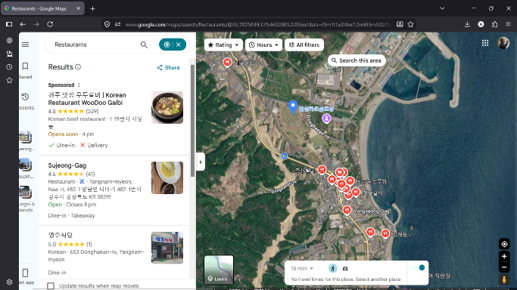
All the red icons are restaurants.
Hochimin Susan is one such restaurant rated 4.7 from 28 reviews. It sits among a cluster of similar restaurants all within a few hundred meters of the plant.
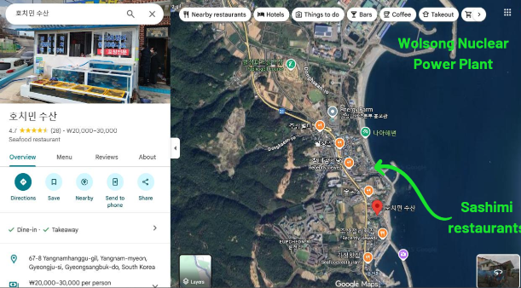
The seafood is as fresh as it can be, served with soy sauce and kimchi. If the plant were to kill fishing, the local economy would not be made up.
Hochimin Susan has not merely survived its plant’s construction.
It now operates as a visible, thriving retail cluster selling fish caught in local waters for immediate local consumption, by people whose livelihoods depend on customers trusting that fish.
There is actually a seafood restaurant 600 m from the nuclear plant. It is here next to Yangnam Catholic church.
https://maps.app.goo.gl/gPKnEnBBUHiJ7PVv5
Cultural Heritage next to a Nuclear Plant
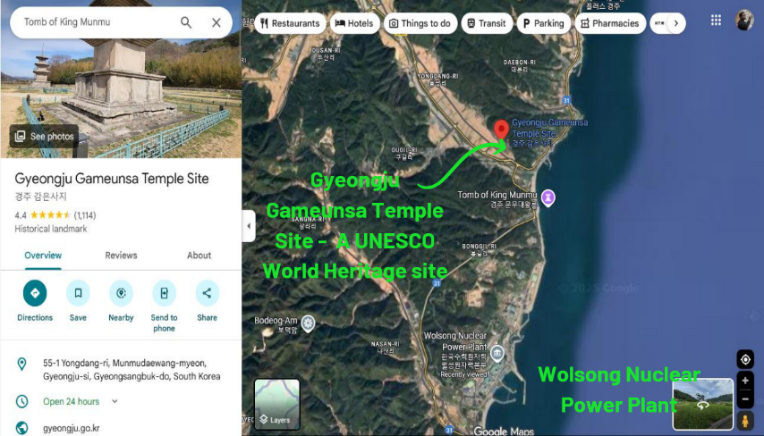
Hundreds of UNESCO Heritage sites, including the Gyeongju Gameunsa Temple Site and the Tomb of King Munmu, are near the Wolsong Nuclear Power Plant.
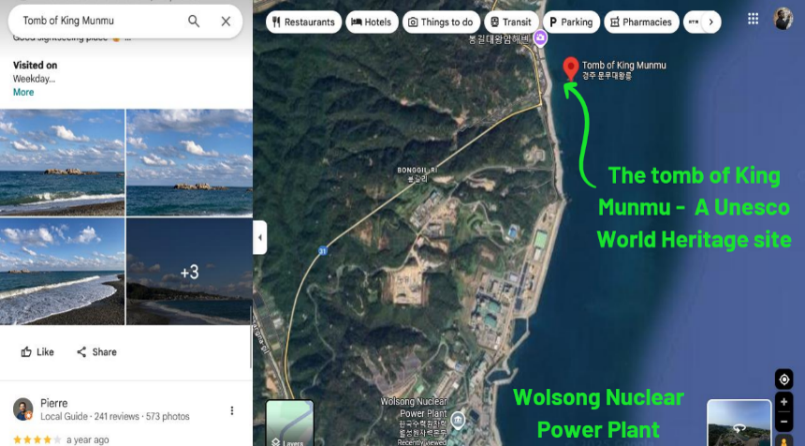
Tomb of King Munmu – https://maps.app.goo.gl/hHib3stHQhQGujqy8
Gyeongju Gameunsa Temple Site – https://maps.app.goo.gl/tZjHg1E6SU8rWkhf9
It is a curious theory from the Malthusian Zealot that tourists will flee the Lake Victoria Basin Counties they cannot see the plant from, while apparently the Wolsong nuclear plant has coexisted with actively visited UNESCO World Heritage-associated sites for four decades without those sites being abandoned, delisted, or emptied of visitors.
Heritage sites are destroyed by neglect, looting, conflict, and poor conservation funding far more often than by nearby industrial infrastructure, and an energy-wealthy state tends to conserve heritage better, not worse.
Concerning Emergency Planning Zones, conflating “a plan exists in case something goes wrong” with “something has gone wrong” is rather like confusing a fire drill with an actual fire.
That would mean airports, dams, and chemical plants shouldn’t exist.
Besides, peer-reviewed comparative mortality data (Our World in Data) puts nuclear power at roughly 0.03 deaths per terawatt-hour of electricity generated, including Chernobyl and Fukushima in the count, against roughly 25 deaths per terawatt-hour for coal and around 18 for oil, driven overwhelmingly by air pollution rather than accidents.
Nuclear’s record is comparable to wind and solar, and vastly safer than any fossil fuel it would actually displace on Kenya’s grid.
Nuclear Power in Siaya
The curious thing about such racist Malthusianism is that they always enjoy a magnificent record of confidence and a considerably less magnificent record of accuracy.
Any time an anti-nuclear zealot tries to sell you delusion, check what they said about the Sondu Miriu?
50 years of Wolsong being a thing has not produced any visible ecological collapse. These anti-nuclear zealots have no idea what they are talking about.
Francis Agar is a director, an engineer, and a teacher of nuclear science, Quantum Electronics, and emerging Technologies.
Follow our WhatsApp Channel and X Account for real-time news updates.


Comments
No comments yet. Be the first to share your thoughts.