
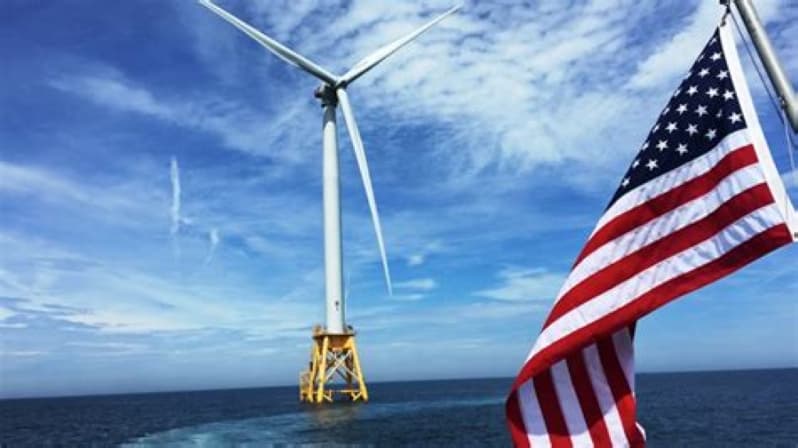
The US offshore wind industry is approaching a defining moment. After years of ambitious development targets, billions of dollars in investment and a growing pipeline of projects along the Atlantic coast, the industry is now confronting a much more difficult question. Can offshore wind construction remain viable in a market where political support, regulatory certainty and project economics are increasingly unpredictable?
Few developments illustrate this challenge better than Dominion Energy’s Coastal Virginia Offshore Wind (CVOW) project. With a planned generating capacity of 2.6 GW, the project is set to become the largest commercial offshore wind farm in the United States. Yet its significance extends well beyond the electricity it is expected to produce. It is increasingly becoming a measure of whether the country’s offshore wind ambitions can survive the changing conditions surrounding the sector.
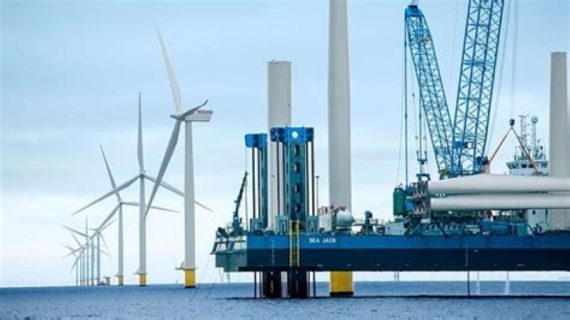
As of October 2026, CVOW is approximately 85% complete, according to Dominion Energy’s third-quarter earnings update. All 176 monopile foundations have been installed, and manufacturing of the project’s turbine nacelles, towers and blades has been completed. However, only 44 of the planned 176 turbines had been installed, with the 45th installation underway at the time of the update. Dominion Energy continues to target completion by the end of 2027, while maintaining a project budget of US$11.65 billion.
These figures demonstrate the scale of the construction undertaking. They also reveal the difference between completing the major offshore infrastructure and bringing an entire wind farm into commercial operation.
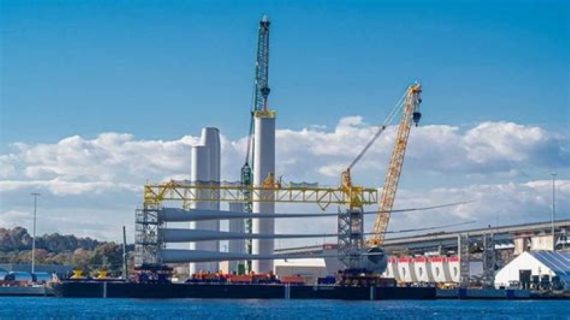
A project that has survived more than construction challenges
CVOW’s development has not followed a straightforward path. In December 2025, the US government ordered construction to stop on five offshore wind projects, including CVOW. Donald Trump’s government cited national security concerns involving offshore wind infrastructure. Dominion challenged the order in court, and a federal judge allowed construction to resume in January 2026.
The episode exposed a major risk for developers investing in large infrastructure projects. Regulatory and political uncertainty became just as consequential as engineering and construction challenges.
Offshore wind projects require years of planning, specialized installation vessels, complex marine logistics, subsea electrical infrastructure and extensive supply-chain coordination. Their financial structures also depend on long-term assumptions about electricity demand, financing costs, permitting and revenue.
When a government changes its approach after a project has secured approvals and entered construction, the consequences extend beyond the developer. Contractors, equipment manufacturers, port operators, suppliers and workers can all face uncertainty.
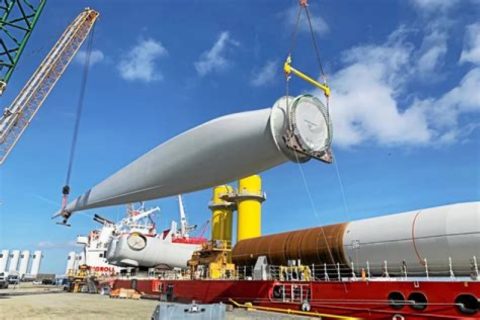
CVOW has managed to keep moving, but its experience raises questions about the investment environment facing other US offshore wind developments.
The construction industry has more at stake than turbine installation
One of the most important aspects of CVOW is the industrial system required to deliver it.
The project involves 176 large offshore turbines, submarine cable networks and offshore substations. It also includes monopile foundations and extensive onshore electrical infrastructure. Each of these components require specialized manufacturing, transportation, installation and engineering expertise.
The arrival of Charybdis, the first US-built Jones Act-compliant offshore wind turbine installation vessel, at the Port of Virginia in September 2025 was particularly significant. The vessel was developed to support the installation of offshore turbines.
This is important because offshore wind is not just a renewable energy business. It is also an opportunity to develop domestic capabilities in heavy manufacturing, marine engineering, shipping, port construction and electrical infrastructure.
However, developing these capabilities requires a dependable project pipeline. Manufacturers are unlikely to invest heavily in new production facilities and equipment if future projects remain exposed to abrupt policy reversals or uncertain permitting processes.
This is where the current US offshore wind slowdown could have consequences beyond individual project cancellations. Even developments that remain technically viable may struggle to attract the supply-chain investment needed to reduce costs and accelerate future construction.
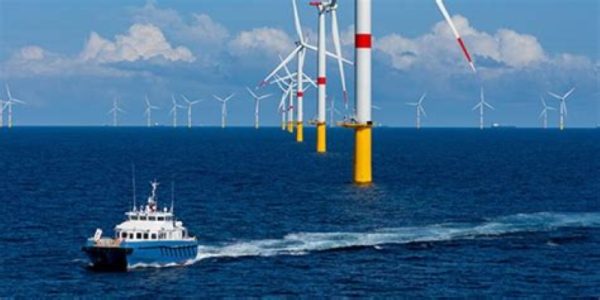
The policy environment in the US offshore wind industry is becoming a construction risk
The challenges facing US offshore wind are also no longer limited to the familiar problems of inflation, high interest rates, supply-chain constraints and installation delays.
Federal policy has become another major risk.
The Trump administration’s restrictions on new offshore wind leasing and permitting have weakened the industry’s development pipeline. Meanwhile, negotiated lease termination agreements involving several developers demonstrate just how dramatically the investment landscape has changed.
Additionally, the Congressional Research Service‘s October 2026 assessment of offshore wind identifies the suspension of new leasing and changes to federal clean-energy incentives as major issues confronting the industry. This is alongside permitting uncertainty and litigations.
For construction companies, the implications are significant. A project pipeline provides the visibility required to justify investment in equipment and manufacturing capacity. Workforce development and port infrastructure are also affected. Without that visibility, the US wind power sector risks losing some of the capabilities it has spent years developing.
There is also a wider competitiveness question. Countries seeking to expand offshore wind capacity are competing for the same specialized vessels, engineering expertise, turbine manufacturing capabilities and investment capital. Uncertainty in one market can redirect investment and supply-chain opportunities elsewhere.
Rising electricity demand makes America’s wind industry’s test more complicated
The United States is currently entering a period of substantial electricity infrastructure investment.
Data centers, artificial intelligence (AI) infrastructure, industrial electrification and population growth are increasing pressure on electricity networks. Utilities are now, not only securing additional generation, but also investing in transmission, distribution and energy storage.
Dominion Energy has also itself highlighted growing electricity demand in Virginia. Its third-quarter 2026 update placed CVOW within a broader strategy for expanding generation capacity. This also includes additional solar and battery storage.
The company also estimates that CVOW could generate approximately US$5 billion in fuel savings for customers during its first ten years of operation.
Offshore wind also offers a generation resource located relatively close to major coastal electricity demand centers. This can make it relevant in regions where securing additional generation and expanding transmission infrastructure are increasingly important.
Nevertheless, offshore wind cannot independently resolve America’s electricity supply challenges. Its contribution must be assessed alongside natural gas, nuclear power, solar, storage and transmission upgrades.
CVOW could become a turning point for the US offshore wind industry, but completion is only part of the story
The completion of Coastal Virginia Offshore Wind project in 2027 would represent a major achievement for the US construction and energy industries. It would demonstrate that a large-scale offshore wind project can be delivered in American waters despite political, regulatory, logistical and financial challenges.
However, the real test will be what happens after CVOW.
Will its construction experience support a new generation of offshore wind projects? Will domestic suppliers secure enough future orders to justify continued investment? Can the industry achieve greater cost certainty and develop a more resilient supply chain? And will future federal administrations provide a regulatory environment in which developers can confidently commit billions of dollars to long-term infrastructure?
These questions matter more than the headline generating capacity of any single wind farm.
For now, CVOW is progressing towards its 2027 completion target. This is while much of the wider US offshore wind projects face uncertainty.
America’s offshore wind ambitions will ultimately be judged not only by how many turbines it installs, but also by whether it can build a stable industrial and regulatory foundation capable of sustaining the sector beyond a handful of major projects.

Comments
No comments yet. Be the first to share your thoughts.