
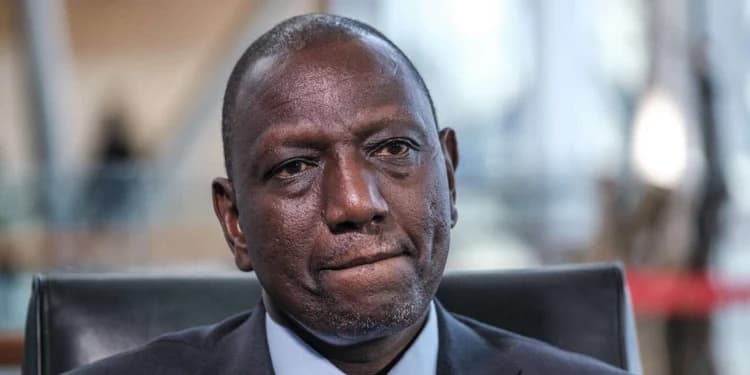
Watching Kenya’s political conversation over the last few days, you can almost see a deliberate shift in strategy. For months, President William Ruto has been forced to defend his administration against uncomfortable questions about taxation, public debt, the cost of living, healthcare, unemployment, corruption, and the promises that carried him into State House.
Those questions have not disappeared. If anything, they have become louder. Yet instead of answering them, the President increasingly appears determined to change the subject.
Suddenly, a retired President Uhuru Kenyatta is being resurrected as the great political villain lurking somewhere behind the opposition.
Ruto’s New Political Target
This is politically convenient. If you cannot win the argument about your record, change the argument. If citizens are asking about unga, talk about Uhuru.
If they ask about taxes, find a political enemy. If they ask about healthcare, manufacture a conspiracy. If they ask about debt, discuss yesterday’s politicians. And if the public wants an audit of four years in office, turn the election into a quarrel between personalities.
It is classic political deflection. The objective is to transform what is increasingly becoming a Government-versus-the-People referendum into the much more comfortable theatre of Ruto versus the old political establishment.
The opposition must not take the bait. President Ruto’s greatest political threat is not Uhuru Kenyatta. It is not Rigathi Gachagua. It is not Edwin Sifuna. It is not Kalonzo Musyoka. His most formidable opposition is the Kenyan people themselves.
It is the mother standing in a supermarket calculating what she must return to the shelf because her money cannot buy everything her family needs.
It is the salaried Kenyan studying a payslip crowded with deductions and wondering why working harder increasingly produces less disposable income.
It is the trader facing taxes, licenses, expensive electricity, and customers whose purchasing power has collapsed. It is the graduate carrying certificates from office to office without finding meaningful employment.
It is the patient who does not care about government acronyms but wants healthcare that works when sickness strikes. It is the family demanding justice after losing a loved one in circumstances involving alleged police brutality.
These people require no political sponsor. Their suffering sponsors their anger. Their taxes sponsor their questions. Their unemployment sponsors their impatience. Their empty pockets sponsor their demand for change.
That is why the opposition should resist being dragged into endless arguments about personalities.
It should neither become Uhuru Kenyatta’s defense team nor spend precious political energy answering every accusation emerging from government podiums.
The most devastating response requires only one sentence: When a President approaching the end of his fourth year in office blames a retired citizen for why unga, fuel and healthcare are unaffordable today, he is not demonstrating leadership; he is advertising the inadequacy of his own answers.
Then move on. Return immediately to the Kenyan household.
Who governs Kenya today? Who controls the Treasury today? Who determines taxation policy today? Who appoints Cabinet Secretaries today? Who is responsible for implementing healthcare policy today? Who must account for government expenditure today?
The answer cannot indefinitely be Uhuru Kenyatta. Leadership comes with authority, but authority comes with responsibility.
You cannot enthusiastically claim credit for every ribbon cut, every road launched, every housing project announced and every favorable economic statistic, then outsource responsibility for every failure to somebody who left office years ago.
The Burden of Incumbency
Government cannot operate on the principle that successes belong to the incumbent while failures belong to his predecessor.
The opposition therefore needs a disciplined political vocabulary built around three things: anger, disillusionment and hope.
First, validate the legitimate anger arising from the daily economic squeeze. Politics must speak to what people actually experience, not merely what politicians discuss at rallies.
Second, articulate the growing exhaustion with excuses. Kenyans understand that governments inherit problems. But presidents are elected precisely to solve inherited problems.
After years in power, blaming predecessors increasingly sounds less like explanation and more like confession.
Third, offer hope grounded in credible alternatives. This is crucial. Opposition politics cannot survive on anger alone.
Kenyans must be shown how another government would reduce waste, confront corruption, audit public debt, create predictable taxation, restore confidence in healthcare, encourage manufacturing and agro-processing, protect constitutional government and create conditions in which enterprise can generate jobs.
Accountability must eventually meet an alternative. And when government talks about political “sponsors,” perhaps the opposition should reclaim the word. Yes, there are sponsors.
The opposition is sponsored by the Kenyan whose business is collapsing. It is sponsored by the parent struggling with school fees. Unemployed graduates sponsor it.
Farmers demanding functioning markets sponsor it. Overtaxed workers sponsor it. It is sponsored by patients demanding healthcare worthy of their taxes. Millions of citizens sponsor it, asking one elementary democratic question: Are we better off than we were four years ago?
That is the battlefield on which the next election should be fought. Never allow an incumbent to choose both the questions and the answers.
Never abandon the government’s record to chase the distraction it has conveniently placed before you. And never let political personalities become bigger than the lived experiences of millions of citizens.
Starve the distraction. Flood the national conversation with accountability. Every accusation designed to drag the country backward should be answered by pointing Kenyans forward, to their payslips, hospitals, businesses, farms, taxes, jobs and household budgets.
Let the government shadow-box with yesterday. The opposition should speak about tomorrow. Because ultimately, elections are not referendums on retired presidents. They are judgments on those exercising power.
The politics of scapegoating is therefore futile. You can manufacture an enemy. You can invent a conspiracy. You can resurrect yesterday’s battles. But you cannot indefinitely distract a hungry population from the price of food.
You cannot persuade an overtaxed worker that his payslip is an opposition conspiracy.
And you cannot govern for years, arrive before citizens seeking another mandate, point backward, and expect nobody to ask: But Mr President, what did you do with the power we gave you? That is the question no politics of deflection can bury.
This article was written by Prof. Gitile Naituli.
Follow our WhatsApp Channel and X Account for real-time news updates.


Comments
No comments yet. Be the first to share your thoughts.