
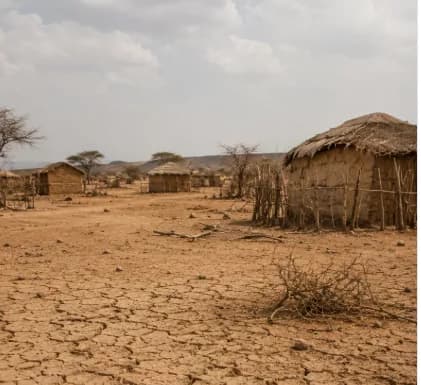
An estimated 309 million people in Africa faced hunger in 2025, according to the United Nations Food and Agriculture Organization (FAO), while 56.6 per cent of the continent’s population experienced moderate or severe food insecurity. In Kenya’s arid and semi-arid lands, about 2.7 million people faced crisis-level or worse food insecurity between July and October 2026.
For Adhe Wario Guyo, the Member of Parliament for North Horr in Marsabit county, the figures reflect a reality he has witnessed among pastoralist communities struggling with recurrent drought, hunger and livestock losses.
During the severe drought of 2022, Guyo says, families in his constituency struggled to find food, children and older people suffered from hunger and malnutrition and livestock died in large numbers.
The experience forced him to reconsider how communities in northern Kenya could withstand increasingly unpredictable weather without remaining heavily dependent on emergency food assistance from the government and humanitarian organisations.
His response was to explore whether agriculture, education and technology could offer alternative sources of livelihoods in a region where livestock keeping has traditionally sustained families.
Now, Guyo is working with Israeli ecologist and conservation biologist Professor Yaron Ziv of Ben-Gurion University of the Negev to develop the proposed Desert Stars Innovation and Sustainability Hub in Turbi, Marsabit County.
In exclusive interviews with Radio Africa Group newsreader Mark Gitau, Guyo and Ziv outlined how the proposed initiative seeks to connect agricultural innovation, digital skills and environmental education in one of Kenya’s most drought-prone regions.
The initiative is intended to combine digital skills training, agricultural innovation, livestock improvement and climate education. Its first school-based educational activities are planned for February 2027, with students expected to investigate environmental challenges through practical scientific exercises.
For Guyo, the idea began with a question about what could happen after the next drought.
“I was asking myself whether we could continue depending on relief food every time there was a drought,” he says, recalling the months he spent seeking assistance after taking office.
With a background in humanitarian and development work, the MP says he initially approached government agencies, humanitarian organisations and other institutions to help families affected by the crisis.
He sought assistance from organisations including the Kenya Red Cross, the Lions movement and the Hindu Council of Kenya.
While emergency supplies were necessary to save lives, Guyo became concerned that repeated relief interventions could not, on their own, address the underlying vulnerability of communities whose livelihoods depended heavily on livestock.
He began exploring whether parts of North Horr could support crop production, despite the area’s dry conditions and limited rainfall.
Guyo approached researchers at Jomo Kenyatta University of Agriculture and Technology to assess the soils in six locations across the constituency. He says the sites were deliberately selected from areas considered particularly dry, rocky or saline.
According to the MP, the findings indicated that some of the sampled soils could support about 15 crop varieties, including drought-resistant and fast-maturing crops.
Encouraged by the results, he says he sourced certified seeds from Cairo ahead of the short rains in 2023. The seeds included maize, beans, sorghum and green grams, while castor was also considered in the farming pilot.
The experiment was undertaken at Tigo Primary School, an institution Guyo says he established to serve children from pastoralist families living between Marsabit and Turbi.
He says about 40 acres were prepared for cultivation, a task that required transporting a tractor over a distance of approximately 460 kilometres.
The undertaking attracted scepticism from some residents who questioned whether farming could work in a landscape where pastoralism had long been the mainstay of livelihoods.
But Guyo says the crops began emerging after the rains, strengthening his belief that agriculture could supplement livestock keeping and provide another source of food and income.
The pilot did not mean that farming could replace pastoralism across the region. Instead, it encouraged him to consider how communities could diversify their livelihoods and become better prepared for periods of prolonged drought.
“We need to think in terms of sustainability and the long term,” he says.
The experience also shaped his ambition to equip young people with skills that could help them respond to environmental pressures and identify opportunities beyond traditional employment.
That ambition eventually led him to explore a partnership with Ben-Gurion University, drawing on its experience in ecology, environmental research and sustainability education.
Guyo says community members have provided land for the proposed Desert Stars Innovation and Sustainability Hub in Turbi. The land has been fenced, while preparations for facilities to support digital and sustainability training are under way.
The planned programme is expected to cover agricultural innovation, animal husbandry, livestock breed improvement and value addition of livestock products. Digital training could include emerging technologies such as artificial intelligence, the Internet of Things, geographic information systems and data science.
The intention is to connect skills development with the needs of communities facing environmental challenges, while helping young people explore opportunities in technology, agriculture and other emerging fields.
A group of 25 young people from the region has also visited the Learning Lions digital skills centre in Turkana for benchmarking, Guyo says.
However, the hub’s longer-term impact will depend on the resources available, the implementation of the proposed activities and whether local institutions can sustain the programmes.
For Ziv, the partnership offers an opportunity to introduce environmental research and scientific thinking to students living in a region where climate and ecological changes affect everyday life.
The professor, who has worked at Ben-Gurion University for nearly three decades, specialises in ecology and conservation biology. His interests also extend to environmental education and helping young people understand the relationship between human activity and the natural environment.
About six years ago, he established the university’s School of Sustainability and Climate Change, bringing together researchers working on subjects including soil, water, agriculture, ecology and environmental education.
Ziv says he first engaged with Guyo about two years ago. Their discussions focused on the environmental challenges facing communities around the Chalbi Desert and possible ways of supporting livelihoods beyond dependence on livestock.
A delegation comprising five professors and two other Israeli professionals subsequently visited the region to learn about its environmental conditions and explore areas for cooperation.
The proposed school programme is expected to involve Chalbi Boys High School, Kalacha Boys High School, Turbi Girls High School and Tigo Primary School.
Activities planned for February 2027 will introduce learners to the process of conducting scientific investigations. Students will be encouraged to formulate research questions, develop hypotheses, collect information from their surroundings and analyse the results.
Rather than simply learning about climate change from textbooks, they will be expected to examine the environment around them and draw conclusions from evidence.
For instance, students could investigate why some acacia trees grow larger than others, compare soil conditions in different locations or examine variations in plant diversity.
The workshops are expected to use field equipment, soil measurement tools and computers to introduce learners to practical research methods.
“We want to start with simple questions,” Ziv says, explaining that the objective is to help students develop critical thinking skills by testing ideas and examining evidence rather than accepting explanations without investigation.
The initial activities are intended to lead to longer-term school projects. Participating teachers and students are expected to collect environmental data throughout the year, with a weather station planned to support regular observations.
Ziv says he hopes to return periodically to guide the research and help learners interpret their findings. Students from the participating schools are expected to meet at the Turbi hub at the end of the year to present their work and exchange ideas.
He estimates that between 50 and 80 students from each school could participate directly in the initial activities, potentially reaching about 320 learners across the four institutions. The programme’s influence could extend further if teachers share the methods and knowledge with other students.
Ziv also hopes the approach can be replicated in other schools, allowing local teachers to continue the work beyond the initial workshops.
He argues that environmental education should receive greater attention in Kenya’s school curriculum, particularly as communities face increasing pressure from climate-related challenges.
The longer-term ambition includes possible exchanges between students from Marsabit and learners in Israel’s Negev Desert, where communities also contend with arid conditions and questions around sustainable use of natural resources.
For Guyo, the proposed hub represents an attempt to connect the immediate challenge of food insecurity with investment in education, technology and livelihood diversification.
He hopes young people in northern Kenya will gain practical skills to help their communities adapt to environmental change while exploring new economic opportunities.
But the initiative’s promise will ultimately be measured by what happens beyond the plans: whether the facilities become operational, schools can sustain the research activities and the skills acquired translate into lasting benefits for local communities.
In a region where drought can threaten both food supplies and pastoral livelihoods, the partnership is an effort to move the conversation beyond emergency assistance towards knowledge, innovation and long-term resilience.


Comments
No comments yet. Be the first to share your thoughts.