
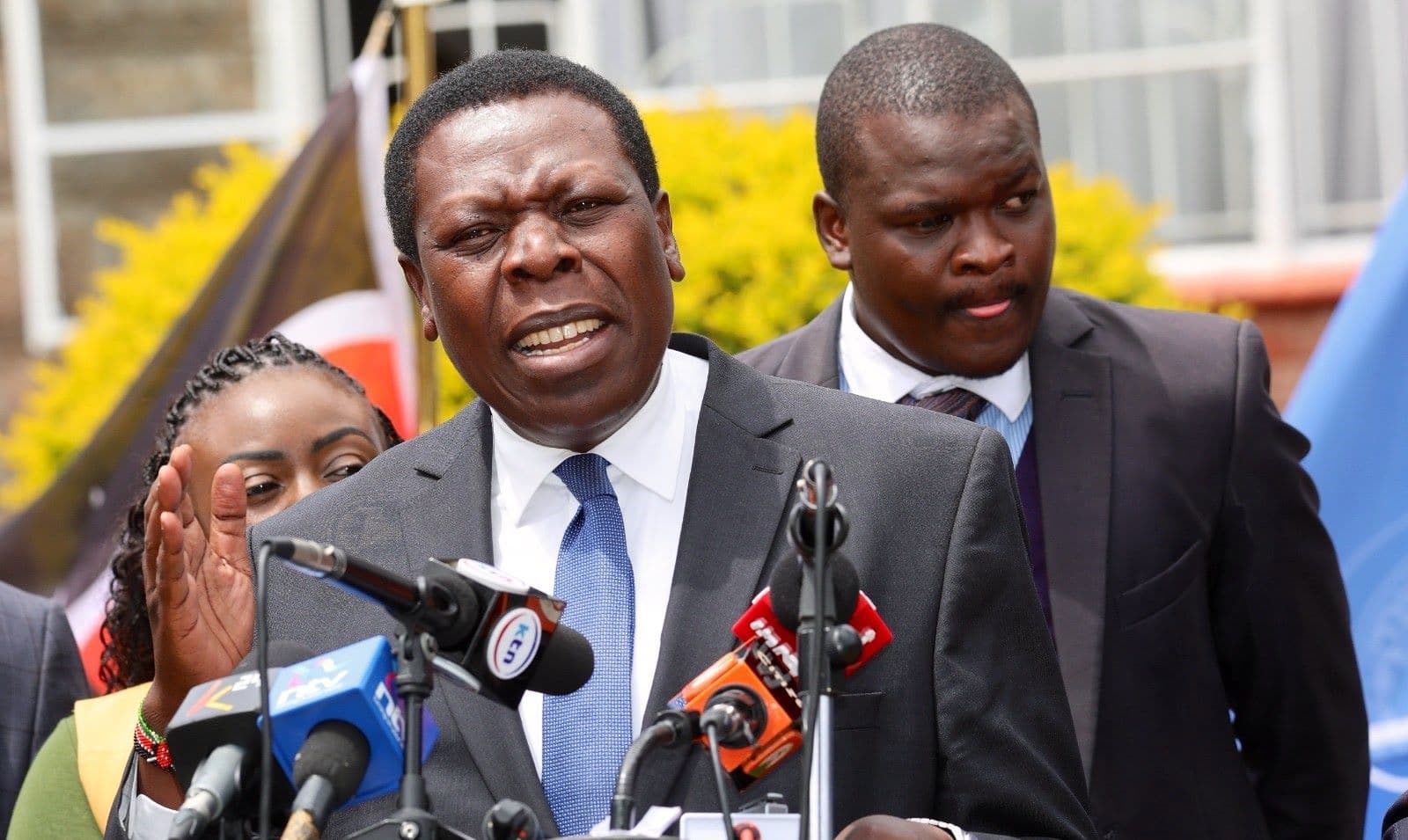
Uasu secretary general Dr Constantine Wesonga addresses the press at the University of Nairobi grounds, Nairobi on October 15, 2026. /LEAH MUKANGAI

University lecturers and non-teaching staff on strike have petitioned Parliament to intervene in the negotiations, signing and implementation of the 2025–2029 Collective Bargaining Agreement (CBA), urging MPs to compel the government to honour the pay deal.
In the petition to the National Assembly, the Universities Academic Staff Union (Uasu), Kenya Universities Staff Union (Kusu) and Kudheiha want lawmakers to compel the National Treasury and the Ministry of Education to table an adequate counter-offer backed by a written, binding commitment guaranteeing exchequer funding for the new CBA.
The unions contend that negotiations reached a deadlock after the Inter-Public Universities Consultative Forum (IPUCCF), representing the government, unilaterally settled on a counter-offer that does not adequately address the expanded components of the new agreement.
University staff went on strike on October 2 after the lapse of a seven-day strike notice, demanding that the government finalise, sign and implement the 2025–2029 CBA.
They are also demanding the full settlement of Sh7.9 billion in outstanding salary arrears accumulated under previous agreements, including the 2017–2021 CBA.
Beyond basic salary increments, the unions are seeking harmonisation of allowances, improved medical cover, car loans and mortgages, an end to unremitted pension deductions, and the recruitment of additional staff to address existing shortages.
“Hon Members, I wish to report to the House that my office is in receipt of a petition from Dr Constantine Wasonga Opiyo, PhD, national secretary-general of Uasu; Dr Charles Mukhwaya, national secretary-general of Kusu; and Mr Odoyo Genga, national trustee of the Kenya Union of Domestic, Hotels, Educational Institutions, Hospitals and Allied Workers (Kudheiha),” National Assembly Speaker Moses Wetang’ula told the House on Thursday.
The petition outlines three key issues the unions want MPs to compel the relevant government agencies to address urgently.
At the centre of their grievances is what they describe as the government’s failure, through the Ministry of Education, to honour a return-to-work formula signed on September 23, 2024, which committed the parties to concluding negotiations and implementing the CBA.
The unions say the agreement required negotiations for the 2025–2029 CBA to be concluded in time for implementation in July 2025.
They add that the failure to honour the commitment triggered another industrial action, leading to the signing of a second return-to-work formula on October 5, 2025.
Under the agreement, the parties again undertook to conclude negotiations and implement the CBA within 30 days.
“The commitments made were not honoured by the Ministry of Education and the IPUCCF,” the unions told Parliament.
They further said the Salaries and Remuneration Commission (SRC) informed them on September 21, 2026, that neither the ministry nor the National Treasury had provided written commitments guaranteeing that the financial obligations arising from the new CBA would be met through the national exchequer.
The unions have rejected reliance on student fees and universities’ own-source revenue to finance salary obligations, insisting that staff remuneration should be drawn from the Consolidated Fund and approved by the National Assembly, as is the case for other public servants.
“The petitioners contend that in the absence of exchequer funding for the remuneration and other employment obligations of public university staff, reliance on alternative funding mechanisms, including student fees and market-based funding models, would result in the discriminatory treatment of university employees,” Wetang’ula said.
The unions want negotiations on the new pay deal concluded and the agreement implemented urgently, a legally binding funding framework established, and Parliament to make any other recommendations it considers appropriate to resolve the dispute.
Wetang’ula committed the petition to the Public Petitions Committee, directing it to consider the issues raised and report its findings to the House and the petitioners.
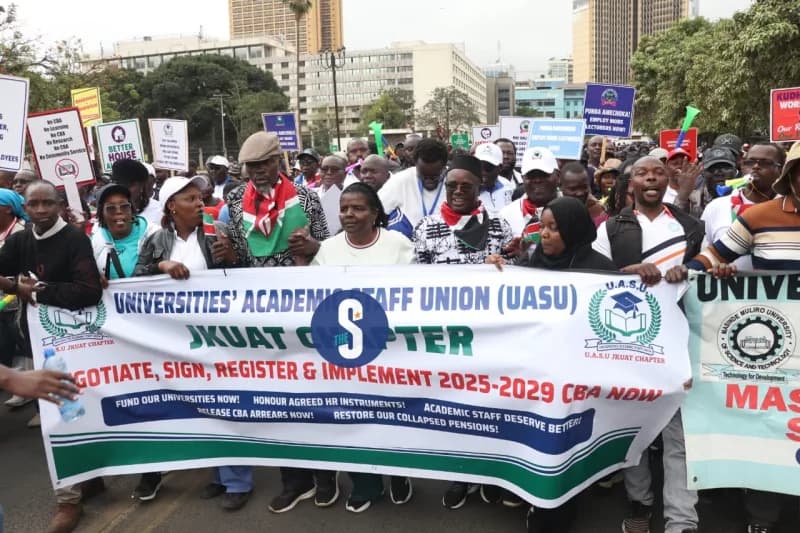
Striking university lecturers march through the streets of Nairobi to demand implementation of the 2025-2029 CBA, October 15, 2026. /LEAH MUKANGAI

National Assembly Majority Leader Kimani Ichung’wah urged the committee to consult the Education and Labour committees, whose members have been involved in previous negotiations and are familiar with the issues.
He also appealed to the unions to abandon what he described as a hardline position and embrace dialogue, arguing that dismissing the SRC’s professional guidance during negotiations was counterproductive.
“In the last two weeks or so, I saw some of the union leaders assert that they have no business whatsoever with the SRC. Hon Speaker, even the members of the Petitions Committee to which you are committing that petition are subject to the SRC,” he said.
Ichung’wah added that the unions’ demand for university staff salaries to be drawn from the Consolidated Fund would also require the SRC’s approval.
“I want to ask our learned colleagues in our public universities to exercise some level of sobriety to give dialogue a chance,” he said.
The unions submitted the petition on Thursday, October 15, after marching from the University of Nairobi’s Graduation Square following the collapse of salary negotiations with the IPUCCF.
The dispute has also drawn students into the standoff.
On Wednesday, University of Nairobi students protested along Waiyaki Way and Uhuru Highway after the lapse of a 72-hour ultimatum for the government to intervene and end the strike, which has now entered its fourth week.
The students threatened to join the lecturers’ industrial action, which has disrupted learning, delayed examinations and put graduation schedules at risk.
With the unions rejecting a phased payment plan for the CBA and students threatening further protests, the dispute could escalate as Parliament considers the petition.


Comments
No comments yet. Be the first to share your thoughts.