
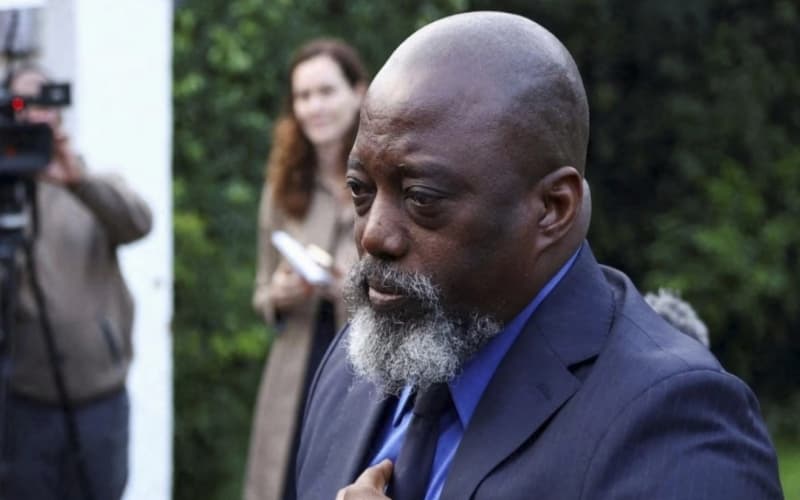
Joseph Kabila defends new military coalition, accuses Tshisekedi of 'dictatorship'

Joseph Kabila, who left office in 2019 after 18 years as president, is now leading the FRN, a politico-military coalition launched in Goma on October 12 that succeeded the AFC/M23 movement.
Former DR Congo President Joseph Kabila has defended his decision to lead the new rebel movement called the Front for the Refoundation of the Nation (FRN), saying the country needs a fundamental political transformation to end what he called a dictatorship and the shrinking of democratic space under President Félix Tshisekedi.
Kabila said dialogue remained a possible route to resolving the conflict but argued that Tshisekedi's pursuit of military means had left Congolese people with the option to take up arms.
“Congo needs to have proper and inclusive governance,” he said in an interview with Conspiracy Tracker Great Lakes (CTGL), published on Wednesday, October 28. “The main question that people should be asking themselves is: Does the Congo need an election or a revolution?”
Kabila, who left office in 2019 after 18 years as president, is now leading the FRN, a politico-military coalition launched in Goma on October 12 that succeeded the AFC/M23 movement.
Kabila said his concerns about Tshisekedi’s leadership began before the M23 resumed its military operations, pointing to the end of the governing coalition between their political camps in late 2019 and early 2020.
He argued that ending their coalition weakened political checks and balances and paved the way for what he considers an increasingly authoritarian rule.
Latest Stories
- EPRA to introduce digital clearance system for fuel, LPG consignments
- Africa CDC commends Kenya's Ebola containment measures, pledges support
- MPs want EPRA to use vernacular radio stations to explain fuel prices, shortages
- MPs propose housing state commissions in one building to cut Sh3.2 million monthly rent bill
“When I raised this particular issue two years ago, the dangers that I was talking about were, one, we were already in a situation where you have a tyrant who wants to impose and dictate what he thinks is right and not necessarily following the constitution,” he said.
He also accused the government of targeting people from particular geographical and linguistic backgrounds, including within the security services, warning that such practices could undermine state institutions.
Kabila criticised the reinstatement of the death penalty, saying it could be used to intimidate political opponents, military personnel and other critics.
He said more than 300 people, including himself, were on death row for “baseless” cases against them.
“These are the tendencies of a regime that wants to instil fear in people, in the population,” he said. “They believe that with the death sentence everybody will be afraid to raise their voice and ask for what is rightly theirs: peace, security, stability, and to live as Congolese.”
Why he joined the armed resistance
Kabila said he had previously advocated dialogue as an alternative to military confrontation but decided to support the resistance after concluding that the government was unwilling to negotiate.
“When you close the political space and when you decide that the only solution according to Kinshasa is to fight to the last man, what are the other options that you leave the Congolese people? Sit down and accept being slaves and being dominated by this particular regime, or pick up arms and fight back?” he asked.
He said the FRN was intended to help end the country's political crisis and rebuild state institutions.
Kabila rejected Tshisekedi's allegations that the coalition intends to 'balkanise' DR Congo or that it was a tool of Rwanda, pointing to the country's history of resistance movements that have emerged since the 1960s in response to political repression.
“Balkanisation ... has not happened. I don't think it's going to happen, because nobody has the intention to balkanise anything... At my level, not at all. So, people should be very, very calm as far as that's concerned,” he said.
He nevertheless acknowledged that the country's system of government remained open to debate, including whether greater federalism would improve governance.
Kabila argued that the current constitution already gives provinces substantial powers through elected governors, provincial parliaments and budgets, but said decentralisation needed to be strengthened.
Need for inclusive national dialogue
Kabila said inclusive national dialogue was necessary to address the country's political and security challenges, but questioned whether Tshisekedi's administration was willing to organise talks that could produce meaningful change.
He said the dialogue should bring together major stakeholders with different views and allow the Congolese to discuss governance issues, the conflict and the future of relations with neighbouring countries. He also called for an independent body to preside over the process and guarantors to ensure that any resolutions are implemented.
“A national dialogue has to include all the stakeholders, if not, major stakeholders,” he said.
Kabila dismissed Tshisekedi's proposed dialogue as a “monologue”, arguing that it was designed to serve the incumbent president's interests rather than resolve the country's problems.
“He wants to talk to himself and his people and his clan and, through that, change the constitution and impose those resolutions on everybody else,” he said.
He also defended the Doha peace process, saying agreements could only deliver results if the parties had the political will to implement them.
Kabila recalled that while hundreds of people had been transferred from Goma to Kinshasa, only about 10 to 15 prisoners had been released by the government in line with prisoner exchange under the Qatar-mediated peace process. He reiterated that drone attacks had continued despite ceasefire commitments.
“[Negotiation] is not the only option, but it's one of the options on the table,” he said.
Kabila also said combating tribalism, hate speech and incitement to violence was among the reasons for establishing the FRN. He accused the government of promoting divisive rhetoric and said the coalition would act against such practices in areas under its control.
Mercenaries, Burundi and regional security
Kabila criticised Kinshasa's use of foreign mercenaries, arguing that the government had weakened its own military by arresting officers and sidelining experienced personnel.
“The question as to how much Kinshasa is spending on these mercenaries, I believe they definitely might be spending more on the mercenaries than they are spending on the defence budget itself,” he said.
“We don't agree with the use of mercenaries in this country, especially since the UN and especially the AU... We have an AU resolution against the use of mercenaries on the continent. But this has not been taken into account by the regime in Kinshasa.”
He also warned that the presence of foreign troops, including Burundian forces, could heighten the risk of a wider regional conflict.
On armed groups operating in eastern DR Congo, including the Kinshasa-backed FDLR genocidal militia and the ADF, he said the country needed to build its own capacity to address security threats while tackling the ideologies that sustain recruitment and violence.
Kabila described the FRN's emergence as an existential issue for the country, questioning whether credible elections would be held in 2028.
He said a revolution should not necessarily mean an armed struggle but should involve fundamental changes to the way the country is governed and elections are organised.
“My biggest regret is seeing the country go back 20, 30 years down the line,” he said.
“Seeing the Congo lose its independence and the people of the Congo getting poorer by the day when you have this elitist class, putting all their money or whatever money they've been stealing in Belgium and elsewhere, that's not the Congo that we fought for.
“But that's the Congo we have to fight for in order to bring back sanity, at least bring back sanity to what you might call the ruling class administration and the nation as a whole.”

Comments
No comments yet. Be the first to share your thoughts.