
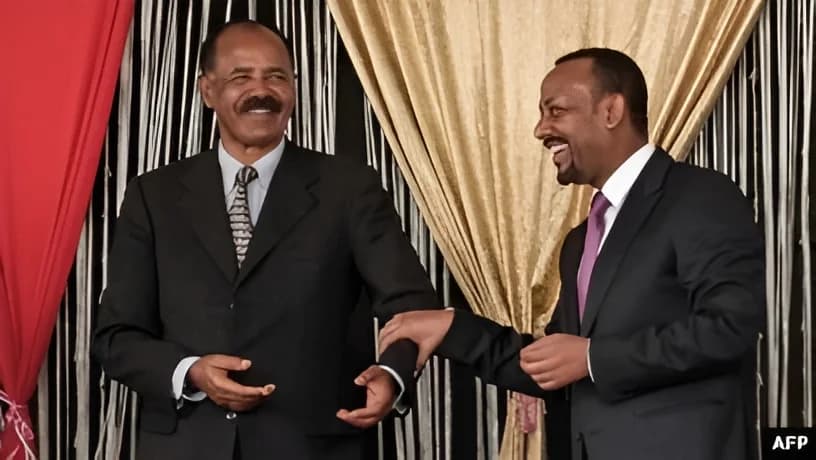
Moscow paradox: Abiy and Isaias set for awkward Russia-Africa Summit meeting

Analysts note that Russia does not necessarily care about healing the internal fractures of the Horn of Africa; it cares about projecting influence and securing strategic partnerships on the continent.
It is one of the most awkward diplomatic choreographies of the year.
Eritrean President Isaias Afwerki and Ethiopian Prime Minister (PM) Abiy Ahmed, leaders of nations that just severed all diplomatic ties, will both be in the same venue at the same time this week for the Russia-Africa Summit in Moscow.
It is a scenario that would be unthinkable in Addis Ababa or Asmara. But in Moscow, Vladimir Putin is playing host to both.
The presence of the two bitter rivals highlights the bizarre realities of global summitry. Just weeks ago, Ethiopia expelled ten Eritrean diplomats and closed its embassy in Asmara.
Eritrea retaliated by formally severing ties, effectively killing the 2018 peace agreement that once won Abiy the Nobel Peace Prize.
Since then, Ethiopia has accused Eritrea, Egypt, and Sudan of backing a rebel coalition aimed at toppling Abiy, and the two nations remain locked in a tense standoff over Red Sea access and unresolved borders.
Latest Stories
- Vocal Africa moves to court over abduction of Tanzanian activist Twaha Mwaipaya
- Matatu driver who pulled Manyoka stunt in crash that killed three to remain in custody
- Dangote Refinery IPO attracts investors from 120 countries globally including all African nations
- Over 2.6 billion cyber threats detected in three months as hackers exploit weak passwords
The Kremlin’s calculations
Why would Russia invite two adversaries to the same summit? The answer lies in the Kremlin’s broader African strategy.
By bringing Abiy and Isaias to the same table, Putin is making a calculated point: Moscow remains a global power capable of convening bitter rivals, even as the West attempts to isolate it, and this is a diplomatic flex.
Analysts note that Russia does not necessarily care about healing the internal fractures of the Horn of Africa; it cares about projecting influence and securing strategic partnerships on the continent.
Moscow has deep ties with both leaders. Isaias’ government is fiercely anti-West and has long been diplomatically isolated, while Abiy’s administration is forging alliances with Russia under the BRICS umbrella.
Both nations have consistently backed Russia in international forums, including voting against UN General Assembly resolutions calling for the withdrawal of Russian troops from Ukraine.
Furthermore, the military-technical cooperation is substantial. Both Ethiopia and Eritrea run significant portions of their air forces on Russian-made Sukhoi fighter jets.
The peacemaker’s suit
But Moscow isn't stopping at a photo-op. The Kremlin has announced it is ready to utilise its "good offices" to mediate the restoration of relations between the two rivals.
“If they show interest, whether now, tomorrow, or the day after tomorrow, Russia will strive to host and facilitate the meeting,” Russian long-serving foreign minister Sergey Lavrov was quoted as saying by Russian state media.
He recalled that Russia had previously offered to serve as a neutral platform for Ethiopia and Eritrea to discuss their bilateral relations.
The offer transforms the Russia-Africa Summit from a standard economic forum into a high-stakes geopolitical chessboard.
By positioning itself as a peacemaker in the Horn of Africa, Moscow is executing a play to prove it is not isolated by the West and to secure strategic leverage in one of the world’s most critical maritime corridors.
However, the reality on the ground is treacherous.
The rift between Abiy and Isaias is deeply personal and highly structural. Ethiopia is demanding sovereign access to the Red Sea - a core national security issue.
Eritrea, which fought a devastating war with Ethiopia from 1998 to 2000, views any Ethiopian naval ambition as an existential threat. The recent collapse of their peace deal means the trust deficit is absolute.
Furthermore, Eritrea is currently aligned with the El-Alamein quartet, Egypt, Sudan, and Somalia, an alliance explicitly formed to contain Ethiopia. Pulling Asmara away from that bloc will not be easy.
To succeed, Putin would have to offer both leaders something they cannot refuse: ironclad security guarantees, massive arms deals, or economic lifelines.

Comments
No comments yet. Be the first to share your thoughts.