
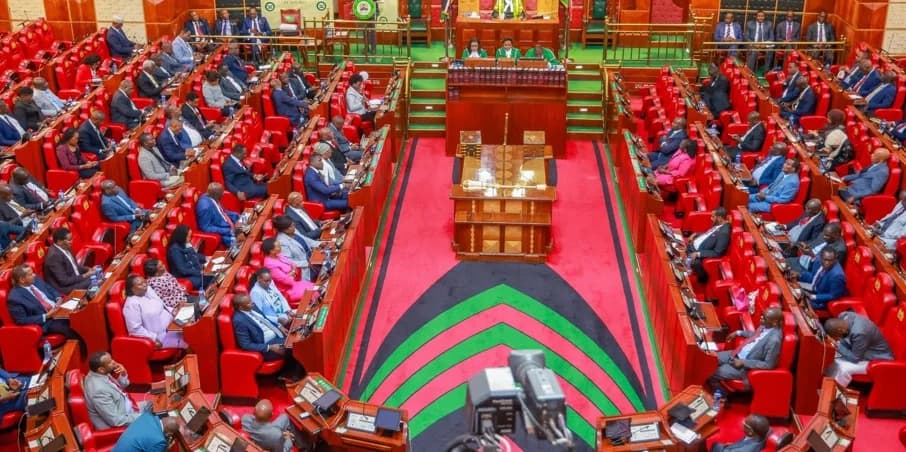
MPs propose housing state commissions in one building to cut Sh3.2 million monthly rent bill

Committee Chairperson Kuria Kimani questioned why the Commission pays Sh700,000 every month in service charges, calling for measures to reduce the cost of running public institutions.
Members of Parliament have proposed setting up a task force to identify and purchase a building that can house constitutional commissions and independent offices, in a move aimed at saving public funds.
This comes after the Commission on Revenue Allocation (CRA) revealed that it spends more than Sh3.225 million monthly on rent and service charges.
The Departmental Committee on Finance and National Planning raised concerns over the expenditure during a review of the Commission’s budget implementation for the 2025/2026 financial year, with legislators questioning the amount spent on office space.
Committee Chairperson Kuria Kimani questioned why the Commission pays Sh700,000 every month in service charges, calling for measures to reduce the cost of running public institutions.
“We don’t think this is a very prudent use of public resources. Why should the Commission spend Sh700,000 on service charges alone, yet these are not premises that commission staff live in?” Kimani posed.
He said the committee wanted a team to identify a building where constitutional commissions and independent offices currently operating from rented premises could be accommodated.
Latest Stories
- ODM set to issue fresh ultimatums to Ruto at Nairobi rally as coalition tensions escalate
- Researchers urge climate change to be declared global health emergency
- UK maritime security agency warns of possible piracy in Gulf of Aden
- UoN given 14 days to account for Sh1.4 billion in unpaid pensions, Sh50 million in taxes
“We want to propose the establishment of a team to scout out for a building where all constitutional commissions and independent offices that are currently renting out can operate from. This will ultimately help us save a lot public money,” he added.
During the review, CRA Chairperson Mary Wanyonyi told the committee that the Commission spent Sh452.5 million out of its approved Sh488.2 million budget in the 2025/2026 financial year, translating to a budget absorption rate of 92.7 per cent.
Commission Secretary and Chief Executive Officer CPA Roble Nuno said the unspent balance of Sh35.7 million was mainly due to savings under employee compensation.
Despite financial challenges that affected targets in several programme activities, the Commission reported clean, or unqualified, audit opinions for its three accounts for the 2024/2025 financial year. These were the Main Account, Staff Mortgage Account and Staff Car Loan Scheme Account.
The Commission also maintained its record of institutional performance, winning the Constitutional Commissions and Independent Offices category at the Institute of Internal Auditors (IIA) Kenya Awards for the third consecutive year. It also finished second runner-up at the 2025 Financial Reporting (FiRe) Awards.
“The recognition further demonstrates the effectiveness of the Commission’s internal control and assurance mechanisms and its commitment to continuous improvement and adherence to professional internal audit standards,” the report noted regarding its internal audit triumphs”, CPA Wanyonyi said.
To address operational funding gaps, CRA made two budget reallocations totalling Sh12.405 million to cover shortfalls in key expenditure areas. It also reported one pending bill exceeding 90 days, valued at Sh659,300.
The committee later held a separate meeting with the Office of the Controller of Budget (OCoB), where Director General of Corporate Affairs FCPA Jacinta Masila asked for more funding to strengthen the office’s oversight work.
“We’re requesting that this Committee help us with an enhanced budget which will help strengthen our monitoring and evaluation role,” Masila said.
The CoB reported spending Sh933,092,538 out of its approved budget of Sh948,093,754 for the financial year ending June 30, 2026, representing an absorption rate of 98 per cent. The remaining balance was Sh15,001,216, while total exchequer releases stood at Sh937,684,023.
Masila said the office had requested Sh64.995 million in budget reallocations to support monitoring and evaluation, motor vehicle maintenance and office supplies, but the National Treasury approved only Sh28.2 million.
The office also reported an outstanding bill of Sh4,418,566.70 that had remained unpaid for more than 90 days. The amount arose from a Kenya Revenue Authority tax assessment on staff gratuity payments covering November 2015 to June 2023.
It further recorded Sh9,253,127.47 in unpaid liabilities for goods and services received by the end of the financial year, which it plans to settle in the 2026/2027 financial year.
Despite funding and operational challenges that affected public awareness forums and staff recruitment targets, the CoB said it continued to carry out its core duties. These included processing 13,069 County Revenue Fund requisitions, reviewing 233 legislative bills and preparing eight technical reports for Parliament on sovereign debt, privatisation and public finance.
The committee also questioned the management of county funds, particularly counties holding idle bank balances that could limit access to resources by other entities.
“Please furnish us with a list of counties with ideal balances and the measures you’re putting in place to address this challenge,” Kimani said.
Committee member Julius Rutto called on the CoB to closely monitor counties that rely on bank overdrafts and incur high interest charges, saying the practice leads to serious delays in staff salary payments.
In response, Masila urged the committee to ask the National Treasury to sanction government agencies and county governments engaging in such practices, in line with the Public Finance Management Act.
Comments
No comments yet. Be the first to share your thoughts.