
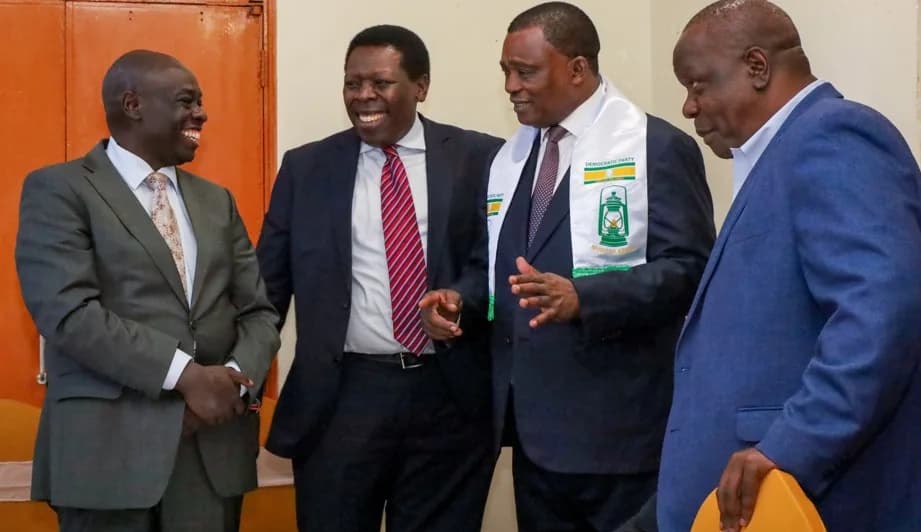
Muturi turns up heat on Gachagua as opposition divisions threaten 2027 State House bid

The Democratic Party leader questions Gachagua’s commitment to opposition unity, warning that ethnic power-sharing demands and political supremacy could derail efforts to defeat President William Ruto in 2027.
Barely hours after Jubilee Party presidential candidate Fred Matiang’i accused former Deputy President Rigathi Gachagua of arrogance and pride that could fracture the United Opposition, Democratic Party of Kenya leader Justin Muturi has launched a fresh attack on the former DP, accusing him of political bullying, double-speak and undermining efforts to unite the opposition ahead of the 2027 General Election.
In a statement on Monday, Muturi questioned Gachagua’s commitment to the opposition’s shared ambition of capturing State House, warning that his continued push for a tripartite political arrangement could undermine efforts to build a united coalition capable of defeating President William Ruto.
Gachagua had proposed that the alliance bring together the voting blocs of Mt Kenya, Western Kenya and Ukambani to secure more than the constitutional 50 per cent plus one threshold required to win the presidency.
Under the proposed arrangement, Gachagua said he would anchor the coalition alongside Wiper leader Kalonzo Musyoka and Nairobi Senator Edwin Sifuna. He argued that his wing would deliver the Mt Kenya and Maasai vote, which he estimated at 35 per cent of the national electorate, while Sifuna and Musyoka would mobilise support in Western and Ukambani, respectively.
However, Muturi dismissed the proposal, arguing that no single community could deliver the presidency. He maintained that winning the country's top seat required nationwide support, strategic partnerships and the ability to unite Kenyans across ethnic and regional lines.
He also put the United Opposition on notice over what he described as Gachagua's attempts to weaken existing political cooperation, warning that the former Deputy President risked creating the impression that he was more interested in negotiating political positions after the elections than winning the presidency.
Latest Stories
- Colorectal cancer drug linked to rare skin condition that mimics potentially deadly skin cancer
- Forgotten flint tools in museum boxes reveal how Egypt’s early farmers paved way for pharaohs
- No strong evidence testosterone therapy improves menopausal brain fog, study finds
- Sudan takes Ethiopia to UN over alleged drone attacks launched from its territory
Muturi questioned whether the opposition was genuinely focused on capturing State House or merely seeking control of parliamentary seats and devolved government positions at the expense of its broader national ambition.
He maintained that building a winning coalition required compromise, maturity and strategic thinking, adding that a tripartite arrangement was not an automatic pathway to the presidency.
The DP leader further warned that attempts to divide an opposition movement that needed unity raised questions about the political direction its leaders were pursuing.
“Let it be clear: No individual owns the United Opposition, and no community has a monopoly on Kenya’s presidency. Political partnerships must be built on mutual respect, not ultimatums, political bullying or supremacy contests,” he stated.
Muturi also invoked Gachagua's family political history, recalling how his late brother, Nderitu Gachagua, defeated TNA in the gubernatorial contest despite GNU supporting former President Uhuru Kenyatta, who was produced by the party.
He said the outcome demonstrated the complexity of political alliances and showed that no political formation belonged to one individual.
Muturi also challenged the assumption that three separate political formations could automatically secure a presidential victory for the Wantam movement, warning against reducing the country's presidential contest to ethnic numbers, regional strongholds and individual bargaining power.
He urged opposition leaders to decide whether they were building a single national movement with a common presidential ambition or creating separate political kingdoms whose leaders would pursue individual interests after the elections.
“Komboa Kenya is not child’s play,” he said, describing the initiative as a national undertaking requiring sacrifice, discipline, strategic thinking and genuine commitment to a shared objective.
Muturi maintained that individual political ambitions should not take precedence over the aspirations of millions of Kenyans.
He said the Democratic Party remained willing to engage in dialogue with leaders committed to meaningful discussions and constructive solutions but would not yield to intimidation, political mischief or attempts to undermine its principles.
“Kenya is bigger than any one politician. State House is the national prize. Unity must not be sacrificed at the altar of individual political survival,” he said.
Muturi's remarks came hours after Matiang’i, during a Sunday interview with NTV, warned that Gachagua's arrogance, pride and political ambitions could weaken the opposition's chances of defeating Ruto.
Matiang’i argued that the country's leadership should be determined through competition based on ideas, development platforms, track records, competence and qualifications rather than ethnic mobilisation.
“That majoritarian arrogance and that particular pride is precisely what is going to split the opposition and make it very difficult for the opposition to come together. The leadership and future of our country is not to be decided on ethnic balkanisation. I thought that this was a competition of ideas, platforms, track records, competence and qualifications,” Matiang’i said.
He also questioned the argument that anyone could replace Ruto, saying the opposition needed to present a credible alternative rather than simply focus on taking over State House.
“When you wake up and tell me anybody can replace Ruto, it means the problems we have with Ruto are that we are not sitting in that seat ourselves,” he said.
Matiang’i said he would support any candidate selected through an inclusive and acceptable process but opposed attempts by a handful of politicians to force others to support their preferred candidate.
“I will support anyone picked through an inclusive, acceptable, and respectful process. I have a serious problem with two or three people frogmarching everybody to a particular corner,” he said.
He further cautioned that opposition unity alone did not guarantee electoral victory, citing Brazil, where a united opposition candidate had recently lost to an incumbent president.
“A united opposition candidate has just lost an election to an incumbent president in Brazil. Politics is very dynamic,” he said.
Despite his concerns, Matiang’i maintained that Ruto's chances of retaining power depended largely on whether his challengers remained divided.
“The latest credible survey demonstrates very clearly that President Ruto only has one pathway – a split opposition,” Matiang’i said.


Comments
No comments yet. Be the first to share your thoughts.