
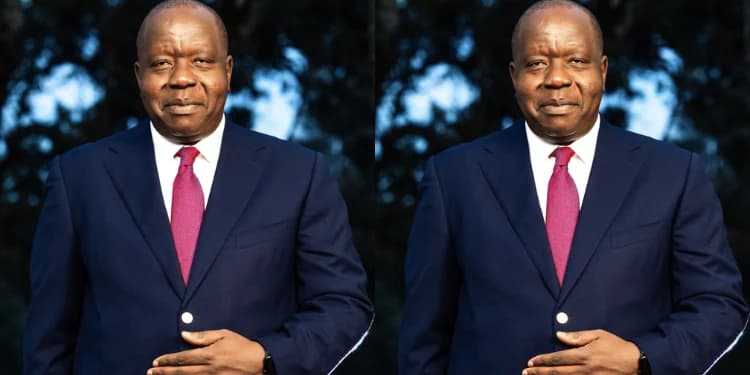
Dr Fred Matiang’i Okeng’o is a Kenyan academic, former Cabinet Secretary and current Jubilee Party leader seeking the opposition’s presidential ticket ahead of the 2027 General Election.
He rose to national prominence as Education CS before serving as Interior and Coordination of National Government CS under President Uhuru Kenyatta, where he was widely regarded as the administration’s most powerful minister and chief government coordinator.
At a Glance
- Full name: Fred Okeng’o Matiang’i
- Birthplace: Borabu, present-day Nyamira County, in the wider Kisii region
- Reported year of birth: 1968, although some biographical reports cite 1967
- Profession: Academic, public administrator and politician
- Current political role: Jubilee Party leader and presidential aspirant
- Former Cabinet roles: ICT CS, Education CS and Interior and Coordination of National Government CS
- Education: Bachelor of Education, Kenyatta University; Master of Arts, University of Nairobi; PhD, University of Nairobi
- Political ambition: Seeking the opposition coalition’s presidential ticket for the 2027 election
- Major vulnerability: Human-rights concerns linked to his Interior tenure and an EACC recovery order reportedly involving Ksh1.5 billion
Academic foundation and early career
Fred Okeng’o Matiang’i was born in Borabu, in present-day Nyamira County, in 1968.
At the time, the area formed part of the larger Kisii District.
He attended a local primary school in Nyamira before joining Kiabonyoru Mixed Secondary School between 1981 and 1984 to take the Kenya Certificate of Secondary Education (O-level).
He then attended Kisii School for his advanced-level (A-level) education.
Matiang’i joined Kenyatta University, where he earned a Bachelor of Education degree.
His undergraduate training specialised in English and Literature.
He then moved to the University of Nairobi for postgraduate studies.
Matiang’i earned a Master of Arts in English, focusing on comparative literature.
He later completed a PhD in Communication and Comparative Literature at the University of Nairobi (UoN).
Teaching career
Matiang’i began his professional career as a teacher. He taught at Menyenya School in the late 1980s and early 1990s before leaving classroom teaching for university and consultancy work.
He later joined Egerton University as a lecturer and subsequently taught at the University of Nairobi.
That experience became politically useful when he was appointed Education Cabinet Secretary in 2015.
Unlike many political appointees, he entered the ministry with first-hand knowledge of schools, universities, examinations and the challenges facing teachers and students.
Consultancy and International Work
After his university teaching career, Matiang’i moved into consultancy and development work.
He consulted for major international organisations, including the World Bank, the Commonwealth Parliamentary Association, the Inter-Parliamentary Union, the United Nations Development Programme, USAID, the Canadian International Development Agency and Transparency International.
He also worked at the Centre for International Development and the Rockefeller College of Public Affairs and Policy at the State University of New York.
There, he served as Eastern Africa regional representative and later as chief of party for Kenya’s Parliamentary Strengthening programme.
ICT Cabinet Secretary, 2013–2015
Uhuru Kenyatta appointed Matiang’i Cabinet Secretary for Information, Communications and Technology in April 2013.
His tenure covered Kenya’s migration from analogue to digital television broadcasting.
The process faced resistance from media houses and was marked by court battles over signal-distribution licensing.
Fred Matiang’i also oversaw expansion of digital government services and ICT infrastructure.
His ministry worked on the national digital identity agenda and supported the rollout of e-government platforms.
He served in the role until November 2015, when Kenyatta moved him to the Ministry of Education, Science and Technology.
Education CS, 2015–2017
Uhuru Kenyatta appointed Matiang’i Cabinet Secretary for Education, Science and Technology in November 2015.
His first major task was restoring credibility to national examinations.
In 2015, widespread cheating had compromised the Kenya Certificate of Primary Education and Kenya Certificate of Secondary Education examinations.
Matiang’i overhauled the Kenya National Examinations Council, tightened examination security and changed the process for setting, printing, distributing and administering national tests.
His ministry also revised the school calendar to reduce opportunities for leakage.
The reforms sharply reduced examination cheating.
The number of candidates scoring grade A in KCSE fell dramatically in 2016, a sign that results had been tightened rather than inflated.
He also expanded access to secondary education and introduced free textbooks for public schools.
His ministry began implementing the Competency-Based Curriculum, which replaced the 8-4-4 system’s content-heavy approach with continuous assessment and competency-based learning.
Matiang’i’s handling of teacher-service disputes and school administration also raised his national profile.
By 2017, he was regarded as one of Kenyatta’s most effective Cabinet Secretaries.
Kenyatta appointed him Interior and Coordination of National Government CS in July 2017 following the death of Interior CS Joseph Nkaissery.
Interior CS and the ‘Super Minister’ Years
Uhuru Kenyatta appointed Matiang’i Cabinet Secretary for Interior and Coordination of National Government in July 2017, following the death of Joseph Nkaissery.
The ministry oversaw policing, immigration, civil registration, national identity systems, disaster management, and the coordination of government operations.
Matiang’i took charge weeks before the August 2017 General Election.
In 2019, his authority expanded through Executive Order No. 1.
The order made him chair or overseer of all Cabinet sub-committees, effectively placing him at the centre of government implementation across ministries.
The arrangement earned him the titles “super CS” and “Mr Fix It.”
He coordinated major government programmes, supervised delivery of presidential priorities and became the most powerful unelected official in Uhuru Kenyatta’s second term.
Fred Matiang’i’s Interior tenure included the 2017 election period, the repeat presidential election, the 2018 handshake between Uhuru Kenyatta and Raila Odinga, the Building Bridges Initiative and the COVID-19 pandemic response.
His ministry also implemented the Huduma Namba registration drive, which sought to create a single digital identity for Kenyans.
The programme faced court challenges over data protection, consent, and risks of exclusion.
Security record and human-rights scrutiny
Matiang’i led the Interior Ministry during the 2017 General Election, its disputed aftermath, and the October 2017 repeat presidential election.
Security operations during the 2017 post-election period in Kisumu, Nairobi and other opposition strongholds attracted allegations of excessive force, extrajudicial killings, sexual violence and torture.
The killing of six-month-old Samantha Pendo in Kisumu became the defining case.
She was injured during a police operation at Kilo Junction in Nyalenda on August 12, 2017, and died days later.
A public inquest found that senior police commanders were culpable under command responsibility.
The magistrate described the operations as part of a systemic campaign of murder, rape and torture.
Fred Matiang’i was Interior CS at the time, but the inquest did not result in a personal criminal conviction against him.
The case remains central to criticism of his record because it raised questions about command responsibility and police accountability under his ministry.
Human-rights groups have also linked his tenure to the deaths of the Kianjokoma brothers in 2021 and bodies recovered from River Yala.
These cases remain allegations and calls for accountability, not established court findings against Matiang’i personally.
Miguna Miguna Deportation Saga
One of the most controversial episodes of Fred Matiang’i’s tenure in government was the 2018 deportation of lawyer and opposition figure Miguna Miguna.
The incident became a major test of the relationship between the Executive and the Judiciary and remains one of the most cited criticisms of Matiang’i’s record as Interior Cabinet Secretary.
The dispute began after Miguna Miguna’s involvement in the symbolic swearing-in of opposition leader Raila Odinga as the “people’s president” following the contested 2017 General Election.
The government responded by arresting Miguna and later deporting him to Canada, arguing that he lacked valid Kenyan citizenship documentation.
Miguna’s deportation triggered a prolonged legal battle, with Kenyan courts repeatedly ordering the government to facilitate his return to the country.
The Interior Ministry, under Matiang’i’s leadership, became the focus of intense criticism after authorities failed to comply immediately with a series of court orders.
The standoff escalated into a constitutional debate over the rule of law, separation of powers and the obligation of state agencies to obey court rulings.
In March 2018, High Court Judge George Odunga found Matiang’i in contempt of court after ruling that government officials had disobeyed orders relating to Miguna’s return to Kenya.
Exit from Government and Political Return
Fred Matiang’i left government in October 2022 when Uhuru Kenyatta’s term ended and William Ruto was sworn in as president.
He maintained a low public profile after leaving Cabinet.
He re-entered active politics in 2025, emerging as a potential opposition presidential candidate.
In July 2025, Matiang’i declared his intention to run for president in 2027.
In October 2025, Jubilee’s National Executive Council appointed him deputy party leader and endorsed him as the party’s presidential candidate for 2027.
His position within Jubilee strengthened in September 2026, when Uhuru Kenyatta handed him the party leadership ahead of Jubilee’s National Delegates Convention.
Matiang’i is also part of the United Opposition negotiations alongside Kalonzo Musyoka, Rigathi Gachagua, Martha Karua, Eugene Wamalwa, Justin Muturi, Edwin Sifuna and Ndindi Nyoro.
The opposition has pledged to back one candidate against President William Ruto in 2027, but has not agreed on a flagbearer.
Matiang’i has acknowledged that forming an opposition coalition will not be easy.
He also said negotiating a coalition government after an election may be harder than agreeing on an electoral alliance beforehand.
Fred Matiang’i’s Family
Former Interior Cabinet Secretary Fred Matiang’i keeps his family life largely private. Public reports say he is married and has two children: a son and a daughter.
Both children are married.
Matiang’i’s daughter is identified as Wendy Bochere Okengo.
Wendy married Frankline Kashindi Luseno at a ceremony held in Nairobi on 27 December 2024.
Former President Uhuru Kenyatta attended as the chief guest.
Other guests included Wiper leader Kalonzo Musyoka, Nyamira Governor Amos Nyaribo, former Cabinet Secretary Joe Mucheru and former Interior Principal Secretary Karanja Kibicho.
Wendy’s wedding is among the most extensively documented public events involving Matiang’i’s immediate family.
One of the few publicly known relatives is his brother, John Matiang’i, a longtime education official and former leader in the Kenya National Union of Teachers (KNUT).
Fred Matiang’i’s net worth is estimated at Ksh650 million.
Follow our WhatsApp Channel and X Account for real-time news updates.

Comments
No comments yet. Be the first to share your thoughts.