
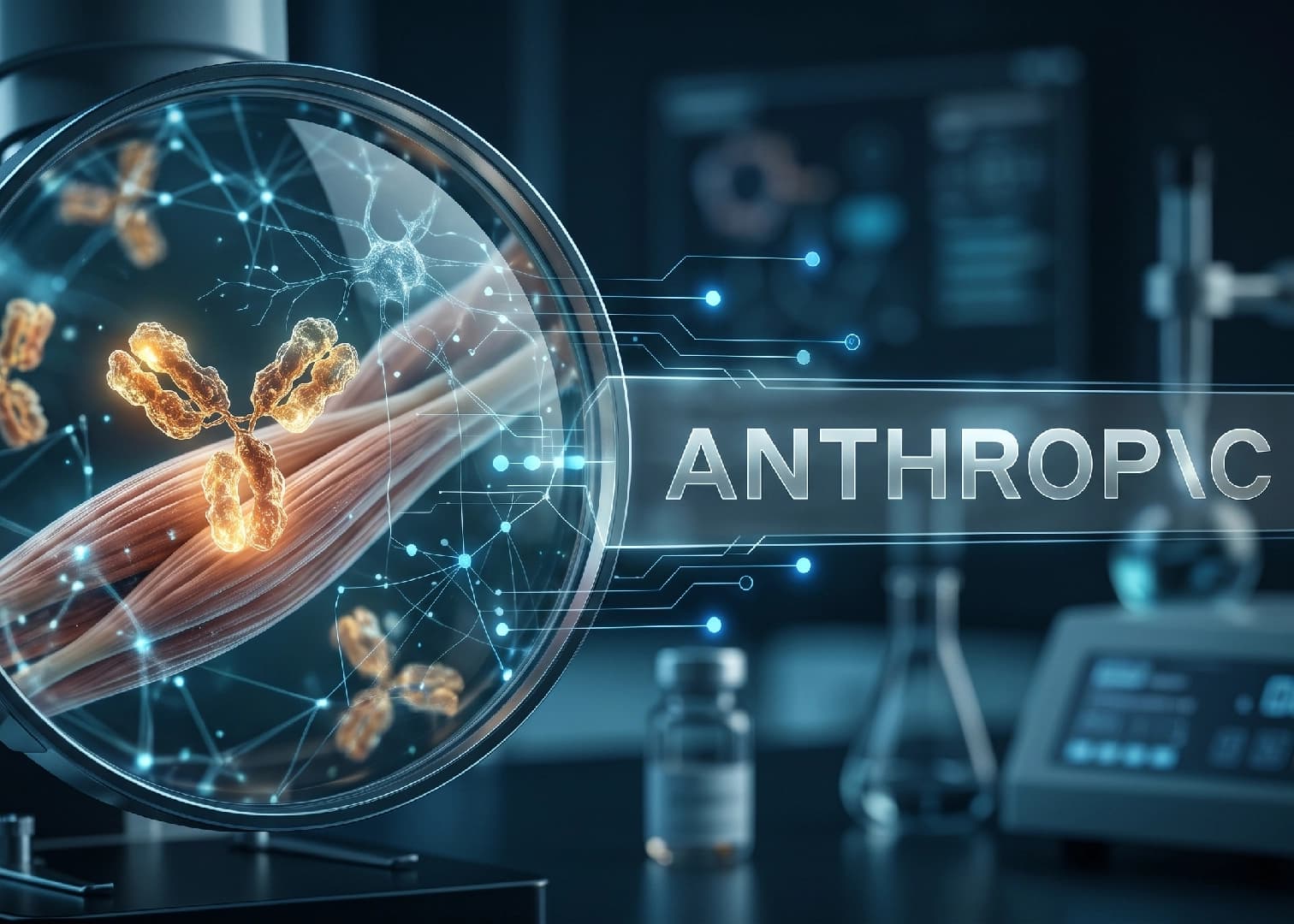
Anthropic has begun developing experimental medicines itself, moving from supplying the software to working at the lab bench.
In an update published on October 27, 2026, the company said it has started drug discovery programs of its own, led by rare childhood forms of muscular dystrophy, while running research partnerships with six life sciences organizations.
The in-house effort rests on Mithril Medicine, a one-person company working on treatments for two rare muscular dystrophies, which Anthropic has acquired.
Its founder, Cody Tranbarger, used Claude to handle contracts, logistics, and experiments across 11 outside labs and, in under 18 months, took a possible treatment from an idea to promising results in mice.
He now works at Anthropic and plans to start several new programs, with the company saying a drug could be ready for human trials as soon as late 2028 if the candidates keep holding up.
The science is still at a very early stage. Anthropic is working on a treatment for a rare muscle-wasting condition that affects children from birth, and the treatment is a specially designed antibody, a type of protein that can latch onto particular targets in the body.
So far it has only been tried on mice, and in that small test, mice given one version of the treatment were about twice as strong, in both muscle force and grip, as mice given a dummy solution with no medicine in it.
That sounds encouraging, but the results come with some big warnings. Other scientists have not yet peer reviewed the study, and it was a first exploratory look rather than a full, tightly controlled experiment.
The study was an early investigation, not a tightly controlled experiment. The researchers did not always follow strict laboratory standards, randomly assign mice to groups, or keep testers unaware of which mice received the treatment.
They also did not calculate the required number of mice in advance. These shortcomings can make results appear more promising than they really are.
In short, the treatment shows promise in mice, but nobody knows yet whether it is safe or whether it works in people.
Cancer features in the announcement, though less directly than suggested. Anthropic says its wider portfolio could eventually yield medicines for “several forms of cancer,” but the examples come from partners rather than its own labs.
Generate Biomedicines used Claude Code to design a CAR-T component about 70% shorter than the standard version, which in lab tests let immune cells make roughly 10 times as many cancer-spotting receptors, a step towards treating solid tumors.
BigHat Biosciences tested about 1,010 variants of a cancer-targeting antibody fragment in around 10 weeks, with the best versions binding more than 10 times more tightly.
Bristol Myers Squibb is using Claude to assess clinical trial plans, with Michael Pourdehnad saying Claude produced an initial analysis from a single prompt “which would otherwise take days to complete,” though none of these is an Anthropic-owned cancer drug candidate.
Some of the biggest time savings come from paperwork. At Enveda, reviewing 1,061 pages of manufacturing documents took less than three hours, down from more than 25 hours.
Claude also drafted a regulatory document in four hours, a task that would have taken about three months. These examples suggest AI could save time not just in drug discovery, but also in the paperwork and processes needed to bring a drug to market.
Anthropic says the programs show where its models fall short and that the plan is to scale the work up substantially. The fair reading is that it has moved into early-stage biomedical research, with rare pediatric muscular dystrophy as its clearest in-house focus and no drug yet in human trials.



Comments
No comments yet. Be the first to share your thoughts.