
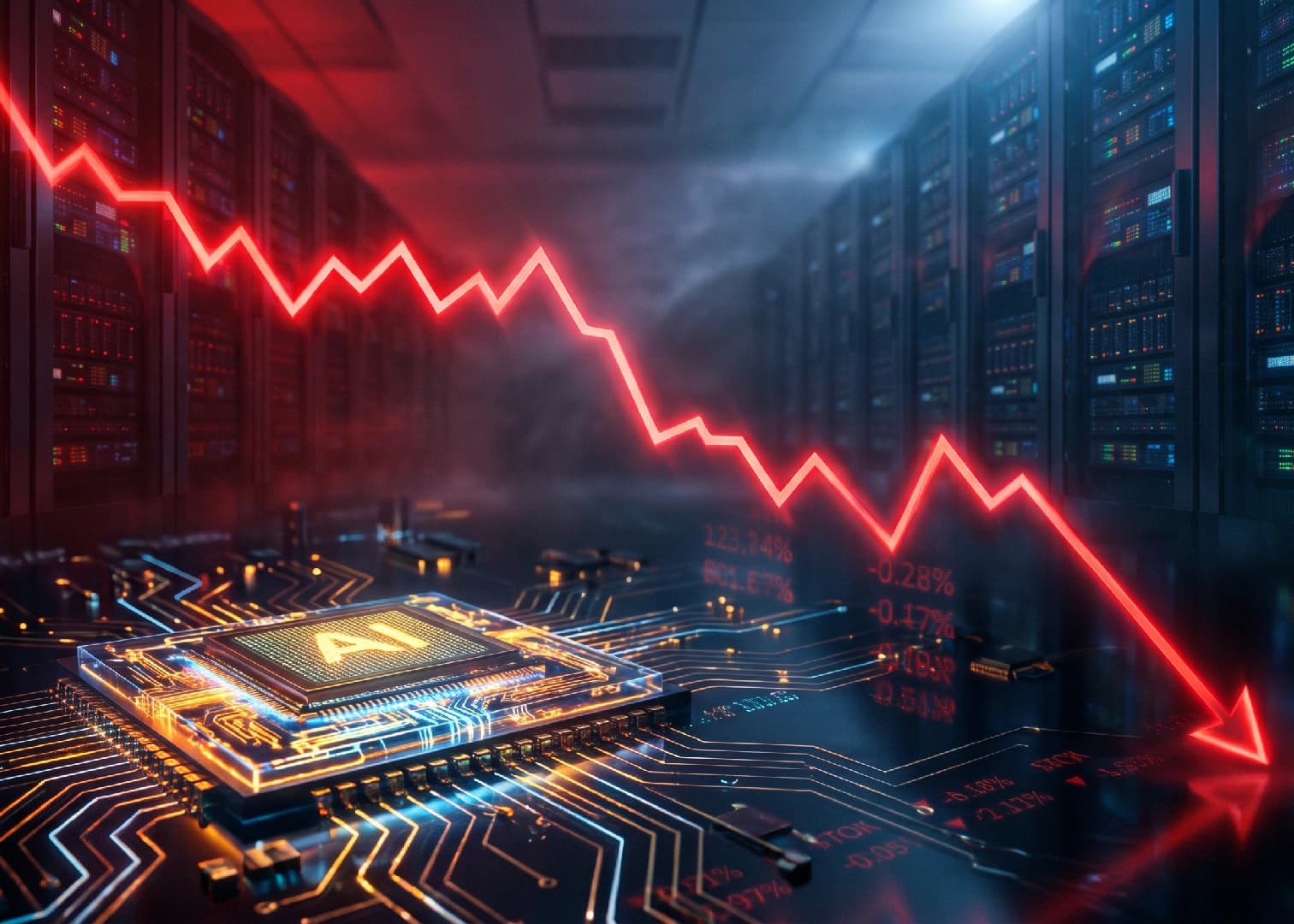
China’s AI industry is going through a sharp financial correction, and the question now is whether years of heavy spending on AI companies and data centers were a bubble that has finally burst.
The numbers make a strong case. The STAR 50 index, which is full of technology and chip companies, fell 40% in less than four months and lost about $480 billion in value, Reuters reports.
However, falling share prices do not necessarily mean China’s AI technology is failing. The bigger issue is whether companies can turn their expensive AI investments into sustainable businesses.
This is crucial to note because China remains one of the United States’ main competitors in developing and deploying AI.
China’s AI boom attracted investors hoping to profit from companies building AI models, designing chips and providing the computing power needed to run these systems.
As enthusiasm grew, company valuations climbed sharply, sometimes far beyond what their earnings could justify. Some semiconductor companies recorded enormous gains when they went public, only to lose much of their value shortly afterwards.
At the same time, China invested heavily in data centers to support its AI ambitions.
An MIT Technology Review report found many of them sitting underused, with some badly located or built for older kinds of AI work. Electricity, maintenance and equipment bills keep arriving whether or not customers show up, so idle capacity quickly becomes a financial drain.
The emergence of DeepSeek added to the strain by showing that capable AI models need less computing power than the industry assumed, which left companies that had spent heavily on infrastructure looking exposed.
Together, these developments exposed a gap between the money flowing into China’s AI sector and the profits it could realistically generate.
Beijing is unlikely to bail out China’s AI trade, preferring to sort winners from losers, protecting the chips, computing power and industrial uses vital to self-reliance while shareholders, private funds and local governments absorb the losses.
October’s Party-State guidelines call for more AI capacity while cracking down on wasteful investment and holding officials accountable for losses. Beijing’s response to the property crisis offers a possible model.
Rather than rescuing every developer, the government protected unfinished homes and directed bank lending towards selected projects. A similar approach could see state-owned firms buy, merge or repurpose struggling data centers while local governments stop building duplicate facilities.
The 2008 stimulus left debt and overcapacity, so expect policy-bank loans and state-company prepayments instead of a blanket lending order.
COVID-19 showed Beijing can hold a line longer than outsiders expect, then reverse abruptly, so falling valuations may be tolerated until defaults or layoffs threaten stability, when mergers and refinancing step in.
Frontier labs and listed hardware firms face a hard test, while projects tied to domestic chips and public services get cheaper capital.

The crash makes things harder for China without handing America an easy win. The two sides play in similar areas, with Alibaba, Baidu and Tencent competing on models, cloud services and AI apps against Microsoft, Google, OpenAI and Nvidia.
China’s biggest firms have other income to lean on. Alibaba reported AI cloud revenue of $7.1 billion in its latest quarter, up 45%, and Baidu’s AI cloud infrastructure sales rose 50%, so demand for AI computing is real even where individual projects look shaky.
Startups are in a tougher spot because they depend on fresh funding to keep going.
The four biggest American cloud companies are on track to spend about $700 billion on capital expenditure in 2026, and that spending is projected to eat up 92% of their operating cash flow, up from 41% in 2023.
They are leaning on customers already signed up, with Microsoft reporting an AI business running at more than $37 billion a year and Google Cloud‘s backlog passing $460 billion, but they still have to earn back those outlays from AI products and services.
There is a possible upside for China as well. Tighter money pushes companies to build cheaper, leaner AI systems, and if they succeed, they could serve more businesses at lower cost.
A long downturn could change how AI is funded and built, and Beijing’s two-speed approach adds a twist.
Chinese chip and AI firms will have to prove they can earn money, while projects tied to domestic chips and public services get cheaper state-backed loans even if their returns are weak. That points to China consolidating its AI capacity rather than switching it off.
For low AI consumer counties like Kenya, the main effect is likely to be price. Chinese firms are pushed to earn from what they have built, and to do more with less computing power, they may offer cheaper models and cloud services to emerging markets.
Lower prices are not guaranteed, though, and access still depends on connectivity, local infrastructure and provider terms.
The wider lesson is that leading in AI takes paying customers as well as big spending, and US firms face that test too. China’s AI bubble has burst in the financial sense, but its ambitions are intact.


Comments
No comments yet. Be the first to share your thoughts.