

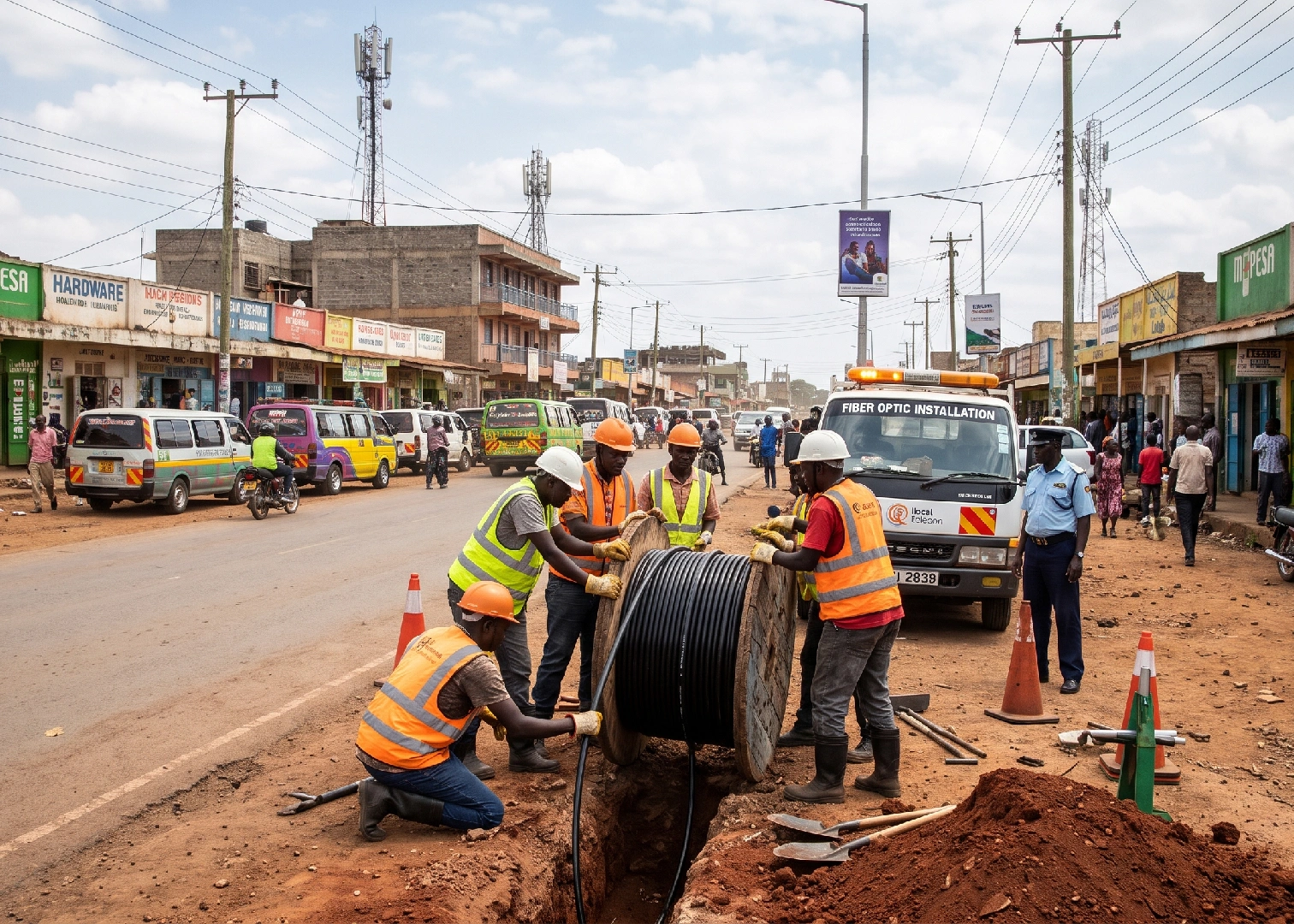
Kenya is planning to expand its fiber-optic network by a further 44,000km as the government seeks to improve internet access, connect public institutions and help more young people participate in the digital economy.
The proposed expansion comprises a 17,000-kilometer fiber project targeting public institutions and an additional 27,000km of backbone, middle-mile and cross-border infrastructure expected to receive support through KES 13 billion in government investment in private-sector development.
The plans are part of the government’s wider Digital Superhighway programme, which targets 100,000km of national fiber infrastructure.
The two projects serve different but complementary purposes.
The 17,000km government-led project is aimed mainly at public institutions such as schools, health facilities and government offices, which could support online learning, digital health services and access to government platforms in areas where reliable internet is still scarce.
The remaining 27,000km covers backbone, middle-mile and cross-border infrastructure, expected to be supported by KES 13 billion. The government says it has invested in private-sector development, which gives approximately KES 481,000 per kilometer.
Backbone links carry heavy traffic over long distances, middle-mile routes connect those networks to local distribution points, and cross-border links tie Kenya to its neighbors.
If both projects deliver additional fiber, the expansion would add 44,000km to the existing network.
The 2022 Digital Master Plan reported more than 8,900km of fiber across backbone, metro and last-mile networks, so adding 44,000km would produce about 52,900km, nearly six times the earlier figure.
The National Broadband Strategy 2025 – 2030 puts Kenya’s current fiber at 40,000km and sets a target of 100,000.
Adding the 44,000 new kilometers would be a 110% increase, taking the network to about 84,000km and leaving roughly 16,000km short of the goal, though only if every planned kilometer is genuinely new.
This is an estimate, not a forecast. The baselines cover different periods and possibly different types of infrastructure, and the plans may overlap with fiber that has already been counted.
Mobile internet already reaches most Kenyans.
Kenya had 64.3 million mobile data subscriptions by June 2026, up about 9.7% from a year earlier, while data usage grew much faster, pointing to heavier use of online services and faster networks.
Coverage is steady, with 4G at roughly 97-98% of the population and 5G at about 30%. fiber connections rose to about 1.57 million, a small base that shows why backbone expansion does not automatically put a connection in a household.
The government is linking infrastructure investment to opportunities in content creation, digital marketing, online entrepreneurship and other technology-driven industries.
During a digital sensitization forum at Kenya Medical Training College in Iten, ICT Principal Secretary John Tanui encouraged young people to approach content creation professionally, comply with platform rules and develop sustainable careers.
The government estimates the global digital-creation industry at approximately $500 billion, with Africa accounting for about $3 billion and Kenya’s market estimated at $1 billion.
Better connectivity could help young people upload content, reach audiences abroad and work with international clients, but skills, affordable devices, stable power and continued access to platforms will shape how much of that market any individual can capture.
Infrastructure alone cannot guarantee jobs or income. Young people still need relevant skills, affordable devices, reliable electricity and access to platforms that pay for their work. Competition, changing platform policies and cybersecurity risks also affect the sustainability of online careers.
Kenya’s existing digital divide shows why expanding the network is only part of the solution.
The latest household evidence shows a wide divide. In the 2023/24 Kenya Housing Survey, 61.6% of households had an internet user, but the share was 81.9% in urban areas against 48.8% in rural ones, and fixed internet reached 17.3% of urban households versus 0.6% of rural ones.
Electricity access is 92.7% in urban households and 49.2% in rural ones. The National Broadband Strategy records only 7.6% connection to fiber broadband against a 40,000km baseline and a 100,000km target for 2030.
The 84% figure is only a scenario, and it assumes every planned kilometer is completed and entirely new. The latest reporting puts installed fiber at about 37,000km by September 2026, which is 37% of the 100,000km target.
The test is how many people can afford and reliably use the network, not how many kilometers are announced.



Comments
No comments yet. Be the first to share your thoughts.