
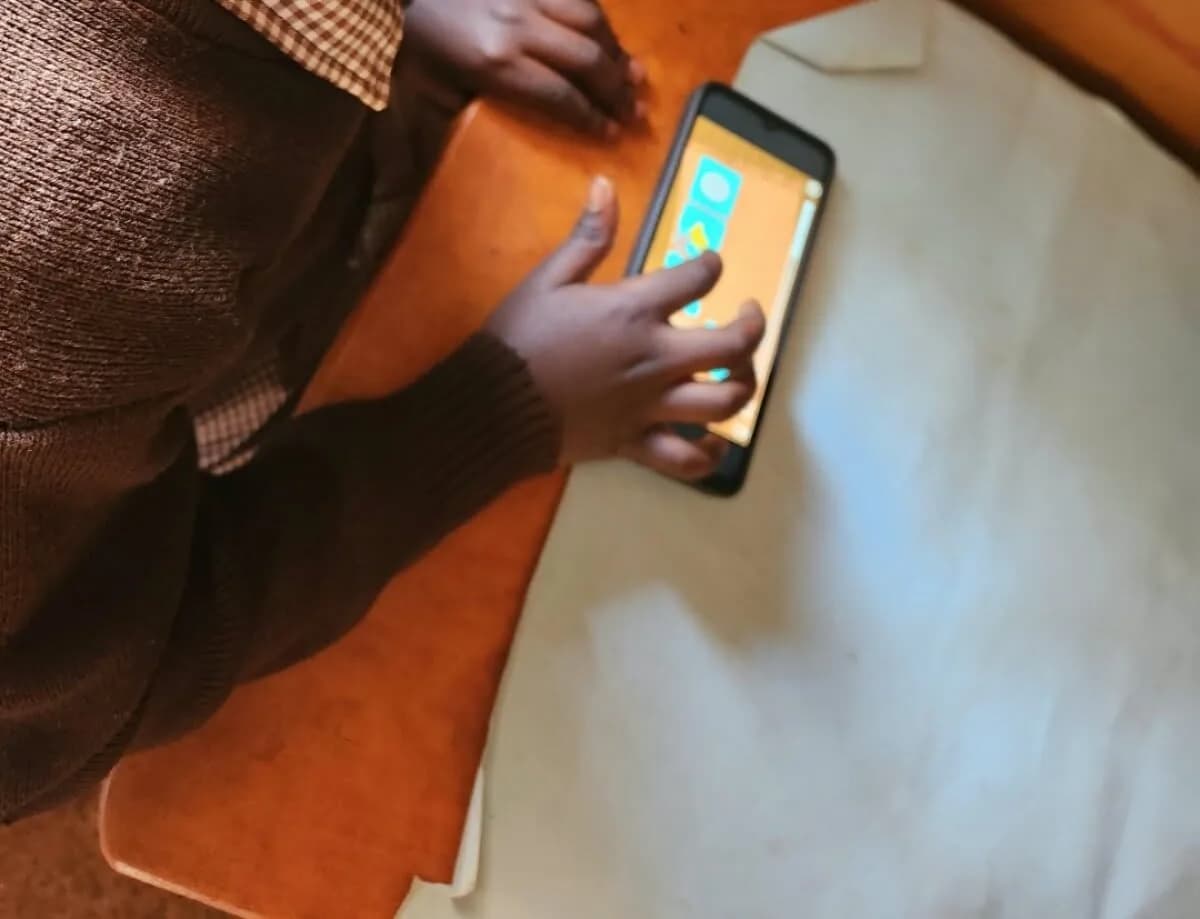
MURANG’A, Kenya, Oct 5 – James and his classmate Faith (not their real names) sit side by side in their classroom, tapping the screens of smartphones as they work through a series of questions while their teacher watches over them.
For the two, interacting with digital devices is part of a normal school routine at Ng’araria Primary School ECDE in Murang’a County, where technology has been integrated into the learning system.
As James and Faith work through their exercises, their teacher, Beth Kimani, remains close by, monitoring their progress and offering assistance where necessary.
“The learners find the lessons interesting and practical. More children are willing to attend class because they enjoy learning,” Teacher Beth said.
The pair are among 126 Early Childhood Development Education (ECDE) learners at the school who use digital devices to interact with lessons designed to develop foundational literacy, numeracy and problem-solving skills.
The digital sessions form part of a wider programme implemented in Murang’a County and 32 other counties to integrate technology into ECDE classrooms and improve foundational learning.
The initiative is being spearheaded through a partnership between EIDU, the national and county governments, with digital learning tools and interactive content being introduced to support foundational learning under the Competency-Based Education framework.
Through the EIDU educational platform, ECDE learners in Kenya access a Digital Personalised Learning (DPL) tool pre-installed on Android devices.
The learner-facing content is entirely aligned with the Competency-Based Curriculum (CBC) and approved by the Kenya Institute of Curriculum Development (KICD).
Learners access structured learning units containing three to five interactive exercises covering areas such as classification, numbers, listening and speaking, reading and writing, among others.
Moses Onjolo, EIDU’s Deputy Head of Operations, said the programme is designed to strengthen the relationship between teachers, learners and educational content rather than replace traditional teaching methods.
He said the digital tools complement teacher-led lessons, classroom interactions and play-based learning.
According to Onjolo, EIDU’s platform currently supports approximately 790,000 learners across the country, with 47,445 devices distributed to schools through partnerships with the government and development partners.
Classrooms often have one or two devices, which enable learners to access and engage with content even when offline. Students take turns using the devices for short, play-based learning sessions before passing them to a peer.
Learners interact with the devices for a maximum of seven minutes each day. The devices can also help teachers identify areas where learners require additional support, Onjolo said.
In the classroom, Beth continues to guide students on how to write, hold and use pencils, practise handwriting, identify, pronounce and spell words, as well as write on the blackboard.
Onjolo maintains that the programme does not undermine teachers’ role in the classroom but instead complements their work and improves the quality of learning.
“We have come in to solve learning poverty and, as we noted, more than 70 percent of students are just going to school, and nothing much takes place there, and by the end of school, you will find that they can’t even fluently communicate. That is why we have come up with a technology that is beneficial to the learner, teacher, and all those involved in a classroom,” Onjolo said.
“Currently, we are only running the programme in pre-primary and primary schools because foundational learning is important. Once a learner learns to read, they are able to progress to higher levels of education more seamlessly. The teacher is central to this programme and has control over how the devices are used and which content learners access,” he added.
Murang’a County ECDE Director Catherine Mwaura says the county has embraced the model across its 250 ECDE centres, supported by more than 1,100 teachers.
“For us, this programme has been a great help to our teachers because the devices can provide accurate pronunciations, allowing our learners to develop these skills at an early age. The best thing about the programme is that all the content being delivered has been approved by KICD,” Mwaura said.
Ng’araria Headteacher James Gitau Chege, whose school implemented the programme three years ago, noted that its alignment with the CBE has given learners early exposure to digital skills.
With 127 children enrolled in PP1 and PP2, he describes the approach as a significant game changer in teaching and learning.
Chege has also called for increased government investment to ensure the sustainability and expansion of early childhood development programmes across the country.



Comments
No comments yet. Be the first to share your thoughts.