
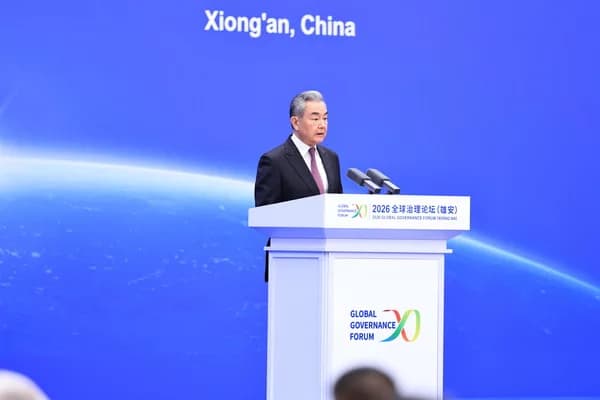
China's Foreign Minister Wang Yi speaks at the Global Governance Forum, Xiong'an, China, October 23.

China has brought outer space governance into its global reform agenda for the first time, proposing international rules to regulate space activities, prevent conflict and ensure developing countries benefit from space technology.
Outer space governance refers to the rules and cooperation arrangements governing how countries and commercial operators explore and use space, manage satellites and space debris, share technology and prevent the weaponisation of space.
China’s proposals seek to strengthen these rules as space activities expand, raising concerns over security, unequal access to technology and the growing risk of an arms race beyond Earth.
Chinese Foreign Minister Wang Yi announced on October 23, 2026, that Beijing would issue a position paper on strengthening outer space governance as part of its Global Governance Initiative (GGI).
The announcement was made at the 2026 Global Governance Forum in Xiong’an, Hebei Province, where President Xi Jinping called for international cooperation to address growing global challenges.
In a message to the forum, Xi said the world was undergoing accelerated transformation unseen in a century, while deficits in peace, development, security and governance were growing rather than diminishing.
He said China was ready to work with other countries to build a fairer international system based on consultation, joint contribution and shared benefits.
Xi called for efforts to implement the GGI to “inject more certainty and positive energy into a world of turbulence and transformation” and move towards a community with a shared future for humanity.
The initiative seeks to promote reforms in global governance, including stronger international cooperation and a greater voice for developing countries in decisions affecting the world.
Wang said governance rules must keep pace with technological advances, warning that emerging areas such as outer space, the deep sea and polar regions risk becoming arenas of competition without adequate international regulation.
“We should embrace the principle of peace, sovereignty, inclusiveness and joint governance, and transform the new frontiers from arenas of zero-sum competition into areas of international cooperation,” he said.
China’s position paper outlines 10 priorities for strengthening space governance, ranging from equal access to space technology to commercial regulation, security cooperation and preventing armed conflict.
The proposals call on countries to ensure the benefits of space exploration reach all nations, including those with limited technological and financial capacity.
China wants greater cooperation in research, technology transfer and personnel training, alongside wider use of space technology in disaster prevention, emergency response and climate action.
The position paper argues that unequal space capabilities and limited access to technology in developing countries could hinder progress towards the United Nations Sustainable Development Goals.
It also calls for countries to respect the right of every state to explore and use outer space without discrimination, while avoiding activities that threaten other nations’ sovereignty, security and development.
On international law, China wants countries to uphold existing agreements, including the Outer Space Treaty, and develop additional rules through broad international consensus.
The treaty provides the foundation for international space law, including the principle that space exploration should be conducted for peaceful purposes and for the benefit of all countries.
China’s proposals oppose the weaponisation of outer space and efforts to turn it into a theatre of conflict. They also support an international legal instrument to control space weapons.
The document calls for confidence-building measures to reduce mistrust, including information-sharing on national space policies, advance notification of launches, collision warnings and the re-entry of space objects.
Another priority is regulating commercial space activities as private companies expand their role in satellite services, exploration and other space-related businesses.
China proposes stronger national regulatory systems to ensure commercial operators comply with domestic and international law and respect the legitimate interests of other countries.
The proposals also encourage international cooperation in space traffic management and the reduction of debris, which can threaten satellites and other objects in orbit.
China wants the United Nations to remain the main channel for global space governance, while other multilateral bodies contribute to developing rules and coordinating activities.
It further calls for greater representation of developing countries in international decision-making, arguing that governance arrangements should be open, equitable and based on broad participation.
Beyond outer space, Wang outlined other measures China plans to pursue under the GGI, including supporting United Nations reform, strengthening the Group of Friends of Global Governance and advancing international cooperation on marine biodiversity.
China will also promote a greater focus on the right to development in global human rights discussions, publish a progress report on its artificial intelligence capacity-building plan and establish a Global Governance Research Centre.
The centre will conduct research on global governance, publish an index and compile annual reports to support efforts to reform international institutions and improve cooperation.
The forum, hosted by the Chinese People’s Institute of Foreign Affairs, was held under the theme “Rebuilding Confidence and Cooperation: Reforming and Improving Global Governance in a Transforming World.”
China said the measures were intended to build a more just and equitable international system at a time when technological advances and security challenges are creating new demands for global cooperation.



Comments
No comments yet. Be the first to share your thoughts.